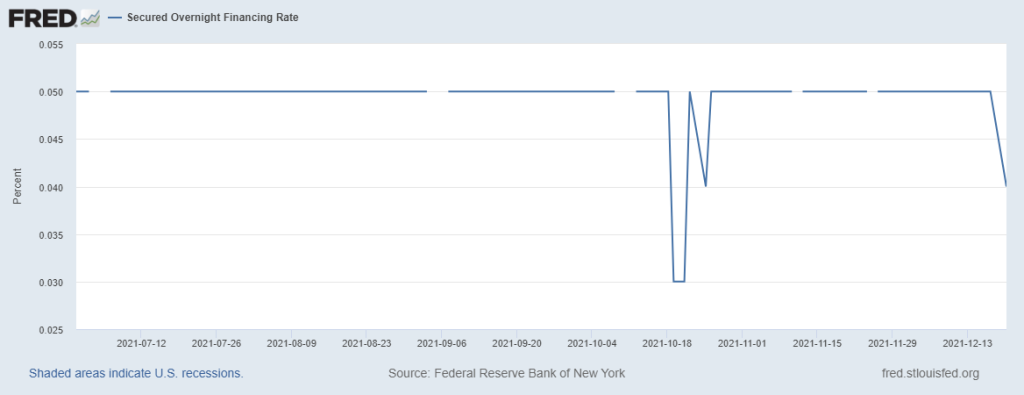
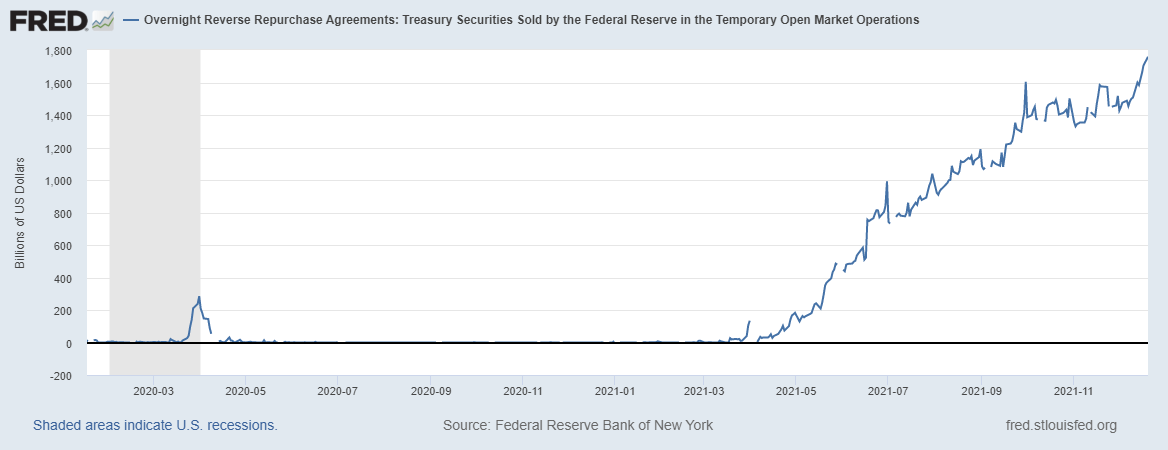
In the wake of the financial system’s cash glut and collateral shortage from the Fed’s quantitative easing program, the Secured Overnight Financing Rate drops to 0.04% from 0.05% on Monday, the first decline since October.
Even with asset purchase tapering underway, “it’s largely the same set of circumstances as in October,” TD Securities Strategist Gennadiy Goldberg told Bloomberg. “Lots of cash in the system and not a lot of collateral and that’s weighing down repo.”
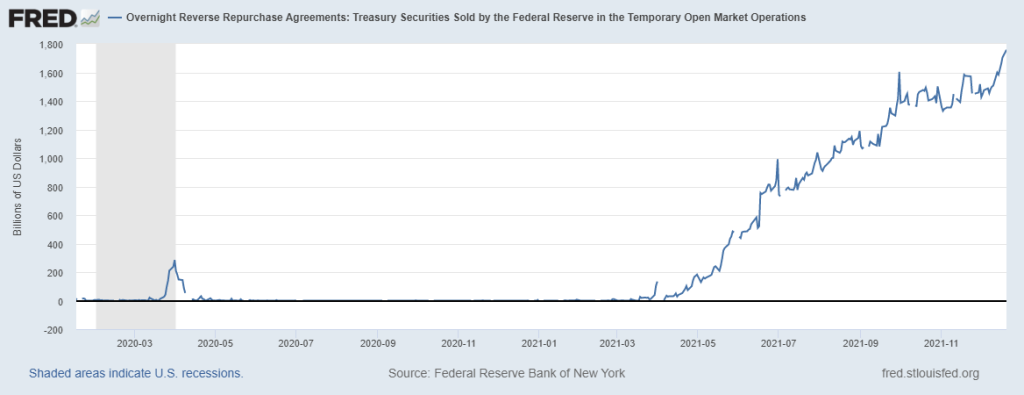
Meanwhile, U.S. commercial banks park yet another record $1.75T at the Fed’s overnight repo facility, implying the banks are drowning in excess reserves, while searching for yield – which is scarce as most of the Treasury yield curve trades in net negative territory on an inflation-adjusted basis.
There’s an “incredibly large amount of cash sloshing the market,” said Complete Intelligence Founder Tony Nash via Twitter.
In August, the Fed’s overnight repo facility took up more than $1T.
Complete Intelligence – a fully automated and globally integrated AI platform for smarter cost and revenue planning.
Complete Intelligence provides actionable, accurate, and timely data to make better investment and procurement decisions.
The platform provides an integrated global model to ensure that actions in one market, country, or sector of the economy are reflected elsewhere in markets, industries, and the global economy. International trade, economic indicators, currencies, commodity prices, and equity indices are all factored in to create a proxy of the global economy. Over 1200 industries in more than 100 countries are covered!
Based on interviews with Tony Nash, founder, CEO, and Chief Data Scientist, this brief report introduces Complete Intelligence, one of a growing number of highly innovative companies supported by the Oracle for Startups program. The company, founded in 2019, is already significantly improving the forecasting and budget planning of a variety of large corporations through its advanced AI-driven intelligence platform. The theme for this month is around startups in the energy and utility sector and how they are innovating, changing the competitive landscape, and contributing to sustainability. CX-Create is an independent IT industry analyst and advisory firm, and this report is sponsored by the Oracle for Startups program team.
The business context for Complete Intelligence
Commodity price volatility and a post-pandemic surge in demand drive the need for more timely and accurate forecasting Businesses coming out of lockdown have increased demand for commodities, from energy supply to raw materials for their products. In Europe, benchmark prices for natural gas to power their factories and heat their buildings have risen from €16 megawatt-hour in January 2021 to €88 in October. This, in turn, has sent electricity prices soaring. (Source: Euronews). While some have locked in prices through forward-buying, others have been exposed and seen profit margins plummet, unable to pass on price hikes to their customers.
But it is not just energy prices that are volatile. Semiconductor chip shortages have impacted many industries that depend on them, from automotive to electronic household goods manufacturers, putting a brake on their post-pandemic recoveries despite strengthening demand.
The growing demand for clean and sustainable energy sources and precious metals, like copper and lithium that power batteries have also seen tremendous volatility. As major industrial companies digitally transform their organizations and business models seeking elusive growth, the importance of data and AI are increasingly recognized as fundamental to success.
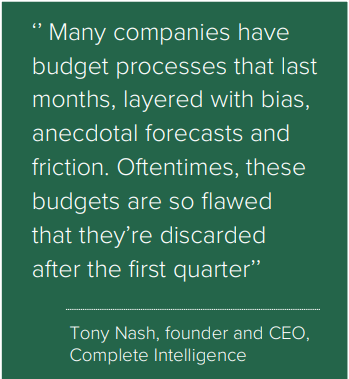
Forecasting and budgeting needs data science, not spreadsheets The ability to sense change, respond quickly and adapt rapidly relies on a synthesis of massively increased volumes and varieties of data, both from operational and external sources. Data volumes are too complex for manual approaches and spreadsheets and require AI to extract insight and meaning from this complex array of external demand and supply signals. The old industrial-age planning approaches can’t cope. They are too slow, involve armies of accountants and analysts, and political wrestling between departmental heads, and are often based on opinion and inaccurate forecasts leading to erroneous budgeting decisions.
Complete Intelligence provides the accurate evidence base for budgeting and forecasting decisions
When markets are relatively calm and stable, the cycle of annual planning and budgeting makes sense. But amidst continual volatility and dramatic accelerated change, the planning cycle is too slow. It fails to mitigate the risks unfolding at such speed and is impacted by a confluence of so many variables, like extreme weather, scarcity of raw materials, pandemics, and weakened supply chains. An array of intelligent internal and external feedback loops is needed to mitigate risks and optimize resources in pursuit of the company’s goals. This is what Complete Intelligence provides with its integrated and modular intelligence platform.
Key observations
• Complete Intelligence provides the accurate evidence base for budgeting and forecasting decisions • The Complete Intelligence Platform consists of three modules – CI Futures, RevenueFlow and CostFlow • Forecast accuracy has rapidly improved, and error rates are now around 2%, which compares favorably with traditional methods and error rates of 35% or more
Complete Intelligence, the story so far
Tony Nash, founder, CEO, and Chief Data Scientist, is steeped in market intelligence. A former VP of market intelligence firm IHS (now IHS Markit), and The Economist Intelligence Unit, where he was Global Director Consulting and Custom Research. He observed that large international companies he had supported typically followed an annual budgeting cycle based on often inaccurate or opinion-based data. It was not unusual to find large teams of people, sometimes several hundred involved in the process and heavily reliant on gathering data from multiple departments in complicated spreadsheets. The process could last several months, and the variance between forecasts and actuals was often above 35%, which could erode profits or tie up resources unnecessarily.
Trial, error, and persistence As a data scientist familiar with cloud technologies, he developed algorithms to improve forecast accuracy and a complete process from data ingestion to forecasting and testing the results. He started developing the machine learning ML algorithms in 2017 while still consulting in Asia from his base in Singapore. His first iteration failed to produce a level of accuracy that would provide a sufficiently compelling proposition. He wanted to get down to an error rate of no more than 5%-7%. He adopted the ‘ensemble’ approach covering thousands of different scenarios layering external data on commodities such as the copper price with a customer’s actual costs, identified in their general ledger.
Ready for launch late 2019 In 2019, Nash returned from Singapore and set up his company in The Woodlands, near Houston, Texas. He continued his work on the algorithms and developed a commercial product ready to launch in early 2020. And then Covid-19 struck.
Through Covid-19, companies first tried to understand the changing environment, then remained risk-averse until public health, business environment, and supply chains became more stable. This has been a challenge for a cutting-edge machine learning firm like Complete Intelligence. It is only as the environment has begun to stabilize that enterprises have sought new solutions to legacy problems. With that has come a renewed interest in Complete Intelligence and deployment at a large scale.
Solution overview The Complete Intelligence Platform consists of three modules The Complete Intelligence Platform hosted on Oracle Cloud Infrastructure (OCI) consists of three forecasting modules:
•CI Futures – to forecast market trends. Covering over 1,400 industries in more than 100 countries and a database of over 16 billion data points from proprietary and publicly available data. Millions of learning algorithms are used, which factor in the most recent global events.
• RevenueFlow – provides accurate results for demand and forecast sales and revenue projections.
• CostFlow – to enhance product line profitability and improve supply chain and procurement outcomes.
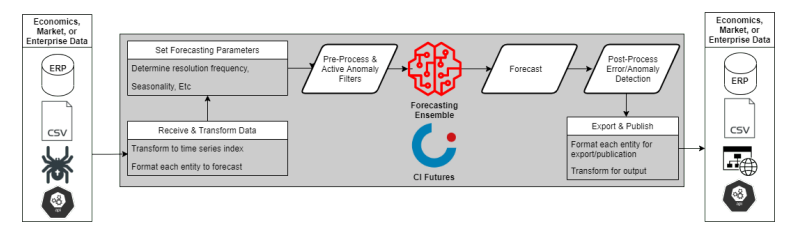
Figure 1. provides a diagram of the Complete Intelligence Platform
Figure 1: Complete Intelligence Platform by Complete Intelligence.
Market data is ingested from multiple trusted data sources like national statistical agencies, multilateral banks, multilateral government bodies, commodities exchanges, bilateral trade bodies and combined with the client’s data from their general ledger. A multi-layer testing and validation process used to ensure the accuracy of the data to be used in any forecast. Third-party data is gathered via internet spiders and APIs.
The platform provides an integrated global model to ensure that actions in one market, country, or sector of the economy are reflected elsewhere in markets, industries, and the global economy. International trade, economic indicators, currencies, commodity prices, and equity indices are all factored in to create a proxy of the global economy.
A comprehensive list of futures, currencies, and market indices is covered and accessed through a highly graphical and easy-to-use interface. Almost 1,000 assets, with historical data from 2010 and forecasts over a one-year horizon, are provided. More assets are being added all the time.
The platform is designed around three attributes: • A globally integrated model • A data-driven process without human intervention in the output • A simple means of interfacing with the platform.
The platform can be connected to existing ERP systems and automatically upload pricing data from the general ledger at a very granular level for each item.
The Complete Intelligence Platform supports a variety of use cases: • Supply Chain & Purchasing Optimization – help lower costs, anticipate risks, and provide input to sourcing strategies. • Sales and market entry strategies – by identifying higher growth markets and optimizing resources • Strategic Financial Planning – identifying growth markets and fine-tuning resource allocations in each market to minimize exposure to currency fluctuations. • Mergers and acquisitions – provide a snapshot of cost structures and projections of future costs and profitability of target acquisitions.
Forecast accuracy has rapidly improved, and error rates are now around 2% Nash’s persistence has resulted in significant levels of forecasting accuracy. A twelve-month forecast now sees error rates around 2%, which gives users considerable confidence compared with traditional methods, where the error rates are often above 35%.
As well as dramatically improving forecast accuracy on markets, revenues, and costs, the onboarding process to going live is a matter of a few weeks. After that, forecasting takes hours, not months.
Current position
Successes to date
While still a relatively new company, Complete Intelligence has already proved its value to several large companies.
• A major petrochemical company wanted to improve its predictive intelligence capability for feedstocks and refined products. They asked Complete Intelligence to examine nine categories across crude oil, gasoline, diesel, natural gas, and gas-to-liquid (GTL) products. Monthly forecast averages are provided by category with extremely low differences from actual results on the order of 3% or less.
• A global furniture company wanted a more explicit link between their sales and revenue planning and their sales teams in China. Complete Intelligence built a sales forecasting model that more clearly identified and utilized market demand drivers and connected these directly to their business. An analytics-based approach to identify the drivers of sales by city and industry. Complete Intelligence built a city and industry-level forecasting tool that determined the company’s growth trajectory and provided recommendations to support the direction and transition of their sales teams. • A global chemicals company needed a better understanding of the trends for costs in their supply chain and a more precise way to manage margin expansion and contraction at the bill of material level. Complete Intelligence was commissioned to forecast factor inputs and currencies for the key categories. The forecasts were calibrated based on the component make-up of the bill of materials. This enabled the client to identify the direction of the materials pricing and the impact on their BOM. Through the process, the client learned how to anticipate cost movements and protect margins.
Current go-to-market model
Complete Intelligence sells directly to large organizations, mainly targeting CFOs and COOs with a broad view of their companies and strategic decisions.
The company also has strategic partnerships with Microsoft and is listed on the Azure Marketplace and with Oracle as part of the Oracle for Startups program and hosted on OCI.
Other partnerships with Bloomberg and Refinitiv allow for exchanging financial and market data and connection to their platforms.
More transparent accuracy reporting so customers can view accuracy/error for every line item
More robust and flexible data visualization for clients to utilize Complete Intelligence forecasts within their visual narratives
More sophisticated data science to account for detailed sentiment and other qualitative factors
Do-it-yourself forecasts for customers to do ad hoc forecasts for any data at any time. This will enable teams within a company to do their own sophisticated, reliable forecasts without waiting on their in-house market analysis or forecasting team with complicated macros and massive spreadsheet workbooks
Embedding Complete Intelligence forecast APIs into ERP and accounting software.
Oracle Cloud Infrastructure and the Oracle for Startups program prove their value to Complete Intelligence When asked what he felt about the relationship with Oracle and the Oracle for Startups program, Nash said, “Oracle Cloud Infrastructure is very flexible and secure. The Oracle for Startups team has been great. Oracle has been the most responsive and helpful of all our partnerships, connecting us to the right people to help with marketing, sales, or technical questions. I really feel that they want us to succeed. I’m a huge advocate of the Oracle for Startups program.’’
CX-Create’s viewpoint The Complete Intelligence Platform addresses a fundamental business need
Providing a global proxy model on markets, commodities, currency fluctuations, and many other aspects and making this easily accessible for business people will significantly improve strategic investment and procurement decisions. The emphasis on accurate and timely data supported by ML models will make it easier for business people to make informed decisions, stripped of personal bias. Digital transformation should lead to a more agile and responsive organization. The more progressive organizations will want highly attuned external signals that are constantly updated, enabling them to de-risk investment decisions and optimize resources for growth. Complete Intelligence provides for that.
Tony Nash joins Daniel Lacalle in a discussion on the rise of the machines in a form of AI and machine learning and how Complete Intelligence helps clients automate budgeting with better accuracy using newer technologies like now casts. How GDP predictions are actually very erroneous yet nobody gets fired? And how about China’s GDP as well, and why it’s different from other economies? All these and so much more in markets in this fun discussion.
The video above is published by Daniel Lacalle – In English.
Show Notes
DL: Hello everyone and welcome to this podcast. It is a great pleasure to have somebody that you should actually follow in social media on Twitter, Tony Nash. He is somebody that you definitely need to need to look for because it has very very interesting ideas. Tony, how are you?
TN: Great, thanks Daniel. Thanks so much for having me today.
DL: It’s a tremendous pleasure as I said I was very much looking forward to to have a chat with you. Please introduce a little bit yourself. A little bit to our audience and let us know what is it that you do.
TN: Sure, thanks Daniel. My name is Tony Nash. I live in Houston, Texas. I’ve spent actually most of my life outside of the U.S. I spent most of my 20s in Europe, North Europe, the UK, Southern Europe and from my 30s to almost the end of my 40s I was in Asia. And so you know being in the U.S., Europe and Asia has really given me personally an interesting view on things like trade economics markets and so on and so forth.
During that time I was the global head of research for the economist out of London, I was based in Singapore at the time. Led the global research business. I moved from there to lead Asia consulting for a firm called IHS Markit which is owned by S&P now.
And after that I started my current firm Complete Intelligence which is a machine learning platform. We do global markets currencies, commodities, equity indices, economic concepts. We also do corporate revenue and expense forecasting so we’ll automate budgeting for large multinational firms.
DL: Wow! amazing. Truly amazing. You probably have a very interesting viewpoint on something that a lot of the people that follow us have probably diverging views. Know the situation about the impact of algorithms in the market the impact of high frequency trading and machines in markets.
We had a chat a few months ago with a professor at the London School of Economics that he used to invite me to his year-end lectures to to give a master class. And he mentioned that he was extremely concerned about the almost the rise of the machines. What is your view on this?
TN: I think so an Algo is not an Algo, right? I mean, I think a lot of the firms that are using Algo’s to trade are using extremely short-term algorithmic trading say horizons. Okay? So they’re looking at very short-term momentum and so on and so forth. And that stuff has been around for 10 plus years, it continues to improve. That’s not at all what we do we do monthly interval forecasts, Okay?
Now, when you talk to say an economist they’re looking at traditional say univariate and multivariate statistical approaches, which are kind of long-term trendy stuff. It’s not necessarily exclusively regression, it gets more sophisticated than that.
When we talk to people about machine learning, they assume we’re using exclusively those kind of algorithms. It’s not the case. There’s a mix we run what’s called an ensemble approach. We have some very short-term approaches. We have some longer-term traditional say econometric approaches. And then we use a configuration of which approach works best for that asset or that revenue line in a company or that cost line or whatever for that time.
So we don’t have let’s say, a fixed Algo for gold, Okay? Our algorithm for the gold price is continually changing based upon what’s happening in the market. Markets are not static, right? Trade flows economics, you know, money flows whatever they’re not static. So we’re taking all of that context data in. We’re using all of that to understand what’s happening in currencies, commodities and so on, as well as how that’s impacting company sales. Down to say the department or sub department level.
So what we can do with machine learning now. And this is you know when you mentioned should we fear the rise of the machines. We have a very large client right now who has hundreds of people involved in their budgeting process and it takes them three to four months to do their budgeting process. We’ve automated that process it now takes them 72 hours to run their annual budgeting process, okay? So it was millions of dollars of time and resources and that sort of thing. We’ve taken them now to do a continuous budgeting process to where we churn it out every month. So the CFO, the Head of FP&A and the rest of the say business leadership, see a refresh forecast every month.
Here’s the difference with what we do, compared to what a lot of traditional forecasters and machine learning people do, we track our error, okay? So we will as of next month have our error rates for everything we forecast on our platform. You want to know the error for our gold price forecast, it’ll be on there. You’ll know the error for our Corn, Crude, you know, JPY whatever, it’s on there. So many of our clients use our data for their kind of medium term trades so they have to know how to hedge that trade, right? And so if we have our one, three month error rates on there, something like that it really helps them understand the risk for the time horizon around which they’re trading. And so we do the same for enterprises. We let them know down to a very detailed level to error rates in our forecast because they’re taking the risk on what’s happening, right? So we want them to know the error associated with what they’re doing with what we’re doing.
So coming out of my past at the economist and and IHS and so on and so forth. I don’t know of anybody else who is being transparent enough to disclose their error rates to the public on a regular basis. So my hope is that the bigger guys take a cue from what we’re doing. That customers demand it from what we’re doing. And demand that the larger firms disclose their error rates because I think what the people who use information services will find is that the error rates for the large firms are pretty terrible. We know that they’re three to seven times our error rates in many cases but we can’t talk about that.
DL: But it’s an important thing. What you’ve just mentioned is an important thing because one of the things that is repeated over and over in social media and amongst the people that follow us is well, all these predictions from the IMF, from the different international bodies not to the IMF. Actually the IMF is probably one of the one that makes smaller mistakes but all of these predictions end up being so aggressively revised and that it’s very difficult for people to trust those, particularly the predictions.
TN: Right. That’s right.
DL: And one of the things that, for example when we do now casts in our firm or when with your clients. That’s one of the things that very few people talk about, is the margin of error is what has been the mistake that we have made in the in that previous prediction. And what have we done to correct it because one might probably you may want to expand on this. Why do you think that the models that are driving these now cast predictions from investment banks in some cases from international bodies and others? Are very rarely revised to improve the prediction and the predictability of the of the figures and the data that is being used in the model.
TN: It’s because the forecasters are not accountable to the traders, okay? One of the things I love about traders is they are accountable every single day for their PNO.
DL: Yeah, right.
TN: Every single day, every minute of every day they’re accountable for their PNO. Forecasters are not accountable to a PNO so they put together some really interesting sophisticated model that may not actually work in the real world, right? And you look at the forward curves or something like that, I mean all that stuff is great but that’s not a forecast, okay? So I love traders. I love talking to traders because they are accountable every single day. They make public mistakes. And again this is part of what I love about social media is traders will put their hypothesis out there and if they’re wrong people will somewhat respectfully make fun of them, okay?
DL: Not necessarily respectfully but they will.
TN: In some cases different but this is great and you know what economists and industry forecasts, commodity forecasters these guys have to be accountable as well. I would love it if traders would put forecasters up to the same level of criticism that they do other traders but they don’t.
DL: Don’t you find it interesting? I mean one of the things that I find more intellectually dishonest sometimes is to hear some of the forecasters say, well we’ve only made a downgrade of one point of one percentage point of GDP only.
TN: Only, right. It’s okay.
DL: So that is that we’ve grown accustomed to this idea that you start the year with a prediction of say, I don’t know three percent growth, which goes down to below two. And that doesn’t get anybody fired, it’s sort of like pretty much average but I think it’s very important because one of the things. And I want to gather your thoughts about this. One of the things that we get from this is that there is absolutely no analysis of the impact of stimulus packages for example, when you have somebody is announcing a trillion dollar stimulus package that’s going to generate one percent increase in trendline GDP growth it doesn’t. And everybody forgets about it but the trillion dollars are gone. What is your thoughts on this?
TN: Well, I think those are related in as much as… let’s say somebody downgraded GDP by one percent. What they’re not accounting for, What I think they’re not accounting for is let’s say the economic impact kind of multiplier. And I say that in quotes for that government spending, right? So in the old days you would have a government spending of say you know 500 billion dollars and let’s say that was on infrastructure. Traditionally you have a 1.6 multiplier for infrastructure spend so over the next say five years that seeps into the economy in a 1.6 times outs. So you get a double bang right you get the government spending say one-to-one impact on the economy. Then you get a point six times that in other industries but what’s actually happened.
And Michael Nicoletos does some really good analysis on this for China, for example. He says that for every unit of say debt that’s taken out in China, which is government debt. It takes eight something like eight units of debt to create one unit of GDP. So in China for example you don’t have an economic multiplier you have an economic divisor, right?
DL: Exactly.
TN: So the more the Chinese government spends actually the less GDP growth which is weird, right? But it tells me that China is an economy that is begging for a market. A real market, okay? Rather than kind of central planning and you and Europe. I’m sure you’re very familiar with the Soviet Union. I studied a lot of that in my undergrad days very familiar with the impact of central planning. China there’s this illusion that there is no central planning in China but we’re seeing with the kind of blow-ups in the financial sector that there is actually central planning in China.
And if you look at the steel sector you look at commodity consumption, these sorts of things it’s a big factor of china still, right? So but it’s incredibly inefficient spending. It’s an incredibly inefficient way and again it’s a market that is begging for an open economy because they could really grow if they were open but they’re not. They have a captive currency they have central planning and so on and so forth.
Now I know some of the people watching, you’re going to say you’ve never been to China, you don’t understand. Actually I have spent a lot of time in China, okay? I actually advise China’s Economic Planners for about a year and a half, almost two years on the belt and road initiative. So I’ve been inside the bureaucracy not at the high levels where they throw nice dinners. I’ve been in the offices of middle managers for a long time within the Chinese Central Government so I understand how it works and I understand the impact on the economy.
DL: Don’t you think it’s interesting though that despite the evidence of what you just mentioned. And how brutal it has been because it’s multiplied by 10. How many units of debt are required to generate one unit of GDP in a little bit more than a decade? Don’t you find it frustrating to read and hear that what for example the United States needs is some sort of central planning like the Chinese one. And that in fact the the developed economies would be much better off if they had the type of intervention from from the government that China has?
TN: Sure, well it’s it’s kind of the fair complete that central bankers bring to the table. I have a solution. We need to use this solution to bring fill in the blank on desired outcome, okay? And so when central bankers come to the table they have there’s an inevitability to the solution that they’re going to bring. And the more we rely on central bankers the more we rely on centralized planning. And so I’ve had so many questions over the last several years, should the us put forward a program like China’s belt and road program, okay?
We know the US, Europe, the G20 nobody needs that, okay? Why? Because Europe has an open market and great companies that build great infrastructure. The US has an open market and although European infrastructure companies are better. The US has some pretty good companies that build infrastructure in an open market. So why do we need a belt and road program? Why do we need central planning around that? And we can go into a lot of detail about what’s wrong with the belton road and why it’s not real, okay? But that type of central planning typically comes with money as the as kind of the bait to get people to move things. And so we’re already doing that with the FED and we’re already doing that with treasure with money from the treasury, right?
And if you look at Europe you’re doing it with the ECB. You’re doing it with money from finance ministries. The next question is, does the government start actually taking over industries again? And you know maybe not and effectively in some ways they kind of are in some cases. And the real question is what are the results and I would argue the results are not a multiplier result they are a divisor result.
DL: Absolutely. Absolutely it is we saw it for example. I think it’s, I mean painfully evident in the junk plan in Europe or the growth and jobs plan of 2009 that destroyed four and a half million jobs. It’s not easy to to achieve this.
TN: You have to try to do that.
DL: You have to really really try it, really try.
I think that you mentioned a very important factor which is that central banking brings central planning because central banks present a program of monetary easing of monetary policy. And they say well we don’t do fiscal policy but they’re basically telling you what fiscal policy has to be implemented to the point that their excuse for the lack of results of monetary policy tends to be that the that the transmission mechanism of monetary policy is not working as it should. Therefore because the demand for credit is not as much as the supply of money that have invented. They say, well how do we fill in the blank? Oh it has to be government spending. It has to be for planning. It has to be so-called infrastructure spending from government.
You just mentioned a very important point there is absolutely no problem to invest in infrastructure. There’s never been more demand for a good quality infrastructure projects from private equity, from businesses. But I come back to the point of of central banks and a little bit about your view. How does prolonging easing measures and maintaining extremely low rates affect these trends in growth and in these trends in in productivity?
TN: Well, okay, so what you brought up about central banks and the government as the transmission mechanism is really important. So low interest rates Zerp and Nerp really bring about an environment where central banks have forced private sector banks to fail as the transmission mechanism. Central banks make money on holding money overnight, that’s it. They’re not making money necessarily or they’re not doing it to successfully to impact economies. They’re not successfully lending out loans because they say it’s less risky buying bonds. It’s less risky having our money sit with the Fed. It’s less risky to do this stuff than it is to loan out money. Of course it’s less risky, right? That’s goes without saying.
So you know I think where we need to go with that is getting central banks out of that cycle is going to hurt. We cannot it… cannot hurt, well I would say baby boomers in the West and and in Northeast Asia which has a huge baby boomer cohort. Until those guys are retired and until their incomes are set central banks cannot take their foot off the gas because at least in the west those folks are voters. And if you take away from the income of that large cohort of voters then you’ll have, I guess I think from their perspective you’ll have chaos for years.
So you know we need to wait until something happens with baby boomers. You tell central banks and finance ministries or treasuries will kind of get religion and what will happen is behind baby boomers is a small cohort generally, okay? So it’s that small cohort who will suffer. It’s not Baby Boomers who will suffer. It’s that small cohort who will suffer. It’s the wealth of that next generation that Gen x that will suffer when central banks and finance ministries get religion.
So we’re probably looking at ten more years five more years of this and then you’ll see kind of… you remember what a rousing success Jeff Sax’s shock therapy was, right?
DL: Yeah.
TN: So of course it wasn’t and it’s you know but it’s gonna hurt and it’s gonna hurt in developed countries in a way that it hasn’t hurt for a long time. So that kind of brings to the discussion things like soundness of the dollar, status of the Euro that sort of thing. I think there are a lot of people out there who have this thesis. I think they’re a little early on it.
DL: Yeah, I agree.
TN: So economists you know these insurance people see it from a macro perspective but often they come to the conclusion too early. So I think it’s a generational type of change that’ll happen and then we start to see if the US wants the dollar to remain preeminent. They’re going to have to get religion at the central bank level. They’re going to have to get religion at the fiscal level and really start ratcheting down some of the kind of free spending disciplines they’ve had in the past.
DL: Yeah, it’s almost inevitable that you’re in a society that is aging. The net prison value of bad decisions for the future is too positive for the voters that are right now with the middle age, in a certain uh bracket of of age. Me, I tried the other day my students I see you more as the guys that are going to pay my pension than my students. So yeah…
TN: But it’s you and me who will be in that age bracket who will pay for it. It’s the people who are 60 plus right now who will not pay for it. So they’ll go through their lives as they have with governments catering to their every need, where it’s our age that will end up paying for it. So people our age we need to have hard assets.
DL: Absolutely.
TN: You know when the time comes we have to have hard assets because it’s going to be…
DL: That is one of one of the mistakes that a lot of the people that follow us around. They they feel that so many of the valuations are so elevated that maybe it’s a good time to cash in and simply get rid of hard assets, I say absolutely the opposite because you’ve mentioned a very important thing which is this religious aspect that we’ve that we’ve gotten into. And I for just for clarity would you care to explain for people what that means because…
TN: I say get religion? I mean to become disciplined.
DL: I know like you because that is an important thing.
TN: Yes, sorry I mean if anybody but to become disciplined about the financial environment and about the monetary environment.
DL: Absolutely because one of the things that people tend to believe when you talk about religion and the the state planners religion and and central bank’s religion is actually the opposite. So I wanted to write for you to very make it very clear. That what you’re talking about is discipline you’re not talking about the idea of going full-blown MMT and that kind of thing.
TN: No. I think if there is if there is kind of an MMT period, I think it’s a I don’t think it’s an extended period. I think it’s an experiment that a couple of countries undertake. I think it’s problematic for them. And I think they try to find a way to come back but…
DL: How do you come back from that because one of the problems that I find when people bring the idea of well, why not try. I always, I’m very aware and very concerned about that thought process because you know I’ve been very involved in analyzing and in helping businesses in Argentina, in Hawaii, in Brazil and it’s very difficult to come back. I had a discussion yesterday with the ex-minister of economy of Uruguay and Ignacio was telling me we started with a 133 percent inflation. And we were successful in bringing it down to 40 and that was nine years.
TN: Right. So, yeah I get how do you come back from it look at Argentina. look at Zimbabwe. I think of course they’re not the Fed. They’re not you know the EU but they are very interesting experiments when people said we’re going to get unhinged with our spending. And we’re going to completely disregard fundamentals. Which I would say I would argue we are on some level disregarding fundamentals today but it’s completely you know divorced from reality. And if you take a large economy like the US and go MMT it would take a very long time to come back.
DL: Absolutely.
TN: So let’s let’s look at a place like China, okay? So has China gone MMT? Actually, not really but their bank lending is has grown five times faster than the US, okay? So these guys are not lending on anything near fundamentals. Sorry when I say five times faster what I mean is this it grew five times larger than the bank lending in the US, okay? So China is a smaller economy and banks have balance sheets that are five times larger than banks in the US. And that is that should be distressing followers.
DL: Everybody say that the example of China doesn’t work because more debt because it’s growing faster what you’ve just said is absolutely critical for for some of our followers.
TN: Right, the other part about China is they don’t have a convertible currency. So they can do whatever they want to control their currency value while they grow their bank balance sheets. And it’s just wonderland, it’s not reality so if that were to happen there are guys out there like Mike Green and others who look at a severe devaluation of CNY. And I think that’s more likely than not.
DL: Yeah, obviously as well. I think that the the Chinese government is trying to postpone as much as it can the devaluation of the currency based on a view that the imbalances of the economy can be sort of managed through central planning but what ends up happening is that you’re basically just postponing the inevitable. And getting a situation in which the actual devaluation when it happens is much larger. It reminds me very much. I come back to the point of Argentina with the fake peg of the peso to the dollar that prolonging it created a devastation from which they have not returned yet.
TN: Right. And if you look at China right now they need commodities desperately, okay? Metals, they need energy desperately and so on and so forth. So they’ve known this for months. So they’ve had CNY at about six three, six four to the dollar which is very strong. And it was trading a year ago around seven or something like that. So they’ve appreciated it dramatically and the longer they keep it at this level. The more difficult it’s going to be on the other side. And they know it these are not stupid people but they understand that that buying commodities is more important for their economy today because if people in China are cold this winter and they don’t have enough nat gas and coal then it’s going to be a very difficult time in the spring for the government.
DL: And when you and coming back to that point there’s a double-edged sword. On the one side you have a currency that is out to free sheet are artificially appreciated. On the other side you also have price controls because coal prices are limited by the government. And therefore you’re creating on the one hand a very big monetary hole and on the other hand a very big financial hole in the companies that are selling at a loss.
TN: That’s true but I would say one slight adjustment to that things like electricity prices are controls. When power generators buy coal, they buy that in a spot market, okay? So coal prices have been rising where electricity prices are highly regulated by the government this is why we’ve seen blackouts and brownouts and power outages in China. And why it’s impacted their manufacturing base because they’re buying coal in a spot market and then they’re having to sell it at a much lower price in the retail market.
And so again this is the problem with central planning this is the problem with kind of partial liberalization of markets. You liberalize the coal price but you keep the electricity price regulated and if you don’t have the central government supporting those power plants they just blow up all over the place. And we’ve seen the power generators in the UK go bankrupt. We saw some here in Texas go bankrupt a couple years ago because of disparities like that and those power generators in the UK going bankrupt that’s the market working, right? So we need to see that in China as well.
DL: Yeah, it’s a very very fascinating conversation because on the other hand for example in Europe right now with the energy shortage we’re seeing that a few countries Spain, France, etc. are actually trying to convince the European Union, the European Commission to try to get into a sort of intervened market price in the in the generation business. Which would be just like you’ve mentioned an absolute atrocity very very dangerous.
TN: This creates a huge liability for the government.
DL: It creates a massive liability for the government. This is a key point that people fail to understand the debate in the European union is that, oh it’s a great idea because France has this massive utility company that is public. And therefore there’s no risk it had to be bailed out twice by the taxpayers. People tend to forget that you’re paying for that.
TN: But again this is what’s that block of voters who doesn’t really care about the impact 10 or 20 years down the road. That’s the problem. There’s a huge block of voters who don’t really care what the cost is because the government’s going to borrow money long-term debt. And it’s going to be paid back in 10 or 20 years and the biggest beneficiaries of this and the people on fixed incomes they actually don’t care what the cost is.
DL: Yeah, yeah exactly, exactly. There’s this fantastic perverse incentive to pass the bill to the next generation. And that obviously is where we are right now. Coming back to the point of the infrastructure plans and the belt and road plan. What in your view are the the lessons that we must have learned or that we should be learning from the Belgian road initiative?
TN: So here’s a problem with the Belton road and I had a very candid discussion with a senior official within China’s NDRC in probably 2015 which was early on, okay? And this person told me the following they said the Belgian road was designed to be a debt financed plan. What’s happening now, and again this was six or seven years ago, very early on in the in the belts and road dates. They said the beneficiary countries are pushing back and forcing us to take equity in this infrastructure, okay?
Now why does that matter well the initial build out of infrastructure is about five percent of the lifetime cost of that asset, okay? So if you’re if China is only involved in the initial build out they’re taking their five percent, it’s a loan and they get out. If they’re equity holders in that let’s say they’re 49 equity holders in an Indonesian high-speed rail then they become accountable for part of that build-out. And then they have to maintain the other 95 of the cost for the next 30 to 50 years. So they thought they were going to be one and done in and out. We do this infrastructure we get out they owe us money and it’s really clean what’s happened is they’ve had to get involved in the equity of those assets.
And so I’ve since had some uh government officials from say Africa ask me what do we do with the Belton road with china? Very simple answer force them to convert the debt to equity, okay? They become long-term involved on a long-term basis. They become involved in those assets and then they’re have a different level of interest in them in the quality maintenance and everything else but they’re also on the long-term basis accountable for the costs.
So they don’t just build a pretty airport that and I’m not saying this necessarily happens but they don’t just build a pretty airport that falls apart in five years, okay? They then have to think about the long-term impacts and long-term maintenance costs of that airport, right? And so but you know the original design of the Belton road was debt financing. Mobilizing workers and so on and so forth what it’s become is a mix of debt and equity financing. And that’s not what the Chinese government has wanted.
So I’ve been telling people for three or four years the Belton road is dead, okay? And people push back me and say no it’s not, you know think tank people or whatever. But they don’t understand the fundamental fact of how the Belton road was designed it was designed as a one-and-done debt financed infrastructure build out it’s become a long-term investment all around the world. So it’s a different program. It’s failed, okay?
They’re not going to make the money they thought yes they’ll keep some workers busy but they’re not going to make the money they thought. All of those assets, almost all those assets are financed in US dollars, okay? So they’re not getting their currency out. It’s not becoming an international unit like they had hoped. They’re it’s not they’re not clean transactions and so on and so forth. So this is what’s happened with the Belgian road. So the lesson learned is they should have planned better. And they should have had a better answer to you become an equity owner. And uh
I think you know if any western governments want to have kind of a belt and road type of initiative. They’re going to have to contend with the demand from some of these countries that they become equity owners. And I think that’s a bad idea for western governments to be equity owners in infrastructure assets so you know this is this is the problem.
Japanese have taken a little bit different because of where the Yen is and because of where interest rates are in Japan. Japanese have basically had kind of zero interest or close to zero interest on the infrastructure they’ve built out. And so they haven’t gone after it as aggressively as China has. They’ve had a much cleaner um structure to those agreements. And so they’ve been, I think pretty successful in staying out of the equity game and staying more focused on the debt financing for their infrastructure initiatives.
DL: Oh, absolutely big lesson, big lesson there because the we see now that the vast majority of those projects are impossible to the debt is impossible to be repaid. There’s about 600 billion dollars of unpayable debt out there. And we also have the example from from the internationalization of the French, Spanish, Italian companies into Latin America that they fell into the same trap. They started with a with a debt-financed infrastructure build type of clean slate program that ended up owning equity. And in some cases with nationalizations hopefully that will not…
TN: And watch for debt to equity conversions in these things. It’s good. There’s going to be huge pressure because the Chinese say the exit bank the CDB. A lot of these organizations are going to be forced to convert that debt to equity and then unload it on operating companies in China. They’re not going to want to do it but we’re going to start to see more and more pressure there over the next couple of years.
DL: Great! Well I’m absolutely convinced that will happen. Tony, we’ve run out of time so it’s been an incredible conversation lots of things that are very very interesting for our followers. We will give all the details to follow you and to get more information about your company in the details of the of the video. And thank you so much for your time. I hope that that we will be able to talk again in a not too distant future.
WASHINGTON — The former U.S. Secretary of the Navy and former Senator Jim Webb recently issued an article in which he put forward an interesting proposal in which he called on the Biden administration to launch the “American version of the Belt and Road Initiative” to counter China’s influence in the world. Weber believes that the United States can do better than China. This proposal has sparked a lot of debate. Some scholars believe that the United States encourages free competition and that the “Belt and Road” initiative is not the way the United States does things.
Weber published an article in the Wall Street Journal on February 17 advising the Biden administration to consider launching the “US version of the Belt and Road.” “China invests in large-scale infrastructure projects all over the world to increase its influence, and the United States can do the same,” he said.
Weber pointed out that as an important part of China’s global strategy for hegemony, the Chinese government has established economic and diplomatic ties with developing countries in Asia, Africa and Latin America through the “One Belt, One Road” project, and conducted military infiltration on the grounds of protecting the interests of these projects. However, public discussions in the United States have not paid enough attention to this.
Weber believes that the Chinese government’s escalating military, diplomatic provocations and human rights persecution in recent years have made many developing countries hesitate to participate in the Belt and Road Initiative. He called on the Biden administration to seize this opportunity and begin to attach importance to the “often neglected countries” in U.S. foreign policy, and to give these regions the opportunity to choose the U.S. in order to counter China’s influence and prevent the world system from being coerced by authoritarianism. This is conducive to the “diplomatic and economic health” of the United States.
“This is not a doomed career, but an unrecognized opportunity,” Weber said.
Weber proposed that the Biden administration implement a comprehensive and coordinated policy in Asia, Africa and Latin America, integrating thoughtful diplomacy, security commitments, and project investment and participation by the American business community to fill the vacuum.
Weber also believes that the United States can do better than China. “The U.S.’s major investment in this—without colonial motives and based on a more credible and more time-tested business model—will forcefully start developing economies, and at the same time boost the U.S. economy, and inspire further progress in a global free society. Pre-development,” Weber said.
The United States encourages free competition, “One Belt One Road” is not our way of doing things
As soon as the article came out, supporters called Weber a “visionary pragmatist”, and the United States urgently needed to implement it, and it was not too late. Jose Manuel, a student of international relations at King Juan Carlos University in Spain, said on Twitter: “If the United States wants to prevent China from winning the title of world superpower, it will be able to retaliate and support the Asian and African countries. Investment projects in Latin America.”
However, American liberal economists urged that the United States should not follow China in its competition with China.
Tony Nash, founder of the data analysis company Complete Intelligence, told VOA: “The Belt and Road Initiative or the Made in China 2025, this is not an American way of doing things.”
Nash believes that the best way for the United States to deal with competition among major powers is to encourage free competition. The United States’ world influence should come from an international system that advocates transparency and free competition.
On February 23, John Tamny, editor of RealClearMarkets, a US economic news website, pointed out that “the influence of the United States is freedom.” He believes that projects such as the “Belt and Road” highly dependent on government regulation will only waste huge amounts of resources. , And damage the United States’ world image of advocating free competition.
In an interview with VOA, Michael Kugelman, director of Asian projects at the Wilson Center in Washington think tank, said that the United States’ number one strategic competitor, China, is exerting its influence on a global scale through the Belt and Road Initiative. It is true that the United States has increased its investment in overseas infrastructure projects. There is strategic value, but now is not the time. Currently, the focus of the Biden administration is to revitalize the US economy.
However, Joyce Mao, a professor of history at Middlebury College in Vermont and an expert on U.S.-Asia relations, supports the United States’ overseas infrastructure investment. She told the Voice of America that the US foreign policy that integrates mature diplomacy and strategic intervention is inseparable from the domestic development of the United States. But she also pointed out that it is a challenge to obtain sufficient American public support and bipartisan consensus on this point.
Whether the proposal can be supported by the American public
Henry Blodget, the founder of the news website Business Insider, said on Twitter: “Good idea, but the United States has not yet reached an agreement on investment in domestic infrastructure.” Independent media “Chinese “Non-projects” also said on Twitter: “U.S. taxpayers’ own roads, bridges, and airports are in a state of disrepair. It is hard to imagine that they will support huge investments in infrastructure construction in developing countries to compete with China.”
Nash of Complete Intelligence believes that the American public cannot accept spending trillions of dollars on overseas projects right now. Under the impact of the epidemic, there are too many places to spend money in the United States. If the US government spends money and energy on this knot to form a global infrastructure investment plan, it will certainly make many taxpayers angry.
Kugelman of the Wilson Center said that the top priority of the Biden administration is obviously to restart the motor of the US domestic economy. Investment in overseas infrastructure is a strategic issue worth considering in the future, but at least it will have to wait a few more months. “If you do this at the same time, Two things become a situation where you have to keep the cake and eat the cake,” Kugelman said.
“People who are struggling in the’rust zone’ due to industrial decline will not have a good response if they hear that their government will launch such a huge plan to develop infrastructure projects thousands of miles away,” Kugelman said.
Professor Mao of Mingde College said that Weber’s proposal while the U.S. economy is still trapped by the epidemic is worthy of scrutiny. She pointed out that there are many debates about where the health and well-being of the American economy come from. This has always been a classic political issue that has divided opinions between conservatives and liberals in the United States. At this special moment of the epidemic, this disagreement focuses on what kind of economic plan is the one that will enable the United States to recover from the epidemic.
Weber said in the article that US investment in infrastructure projects in developing countries not only helps to counter China, but also benefits the US economy. But Professor Mao pointed out that Weber’s proposal seems to “assume that most Americans can understand and agree that the future of the US economy depends on the existence of internationalism and interventionism”, but the reality is not the case. She said that although there is a lot of political support in the United States, especially within the Republican conservatives, in the fight against China, investing in large-scale overseas infrastructure projects may not be consistent with their political priorities.
“What benefits will the U.S. version of the Belt and Road Initiative bring to ordinary U.S. citizens? How will employment opportunities be realized? To what extent can it help develop overseas markets and other resources for U.S. goods?” Professor Mao believes that this proposal is necessary Get enough support. These are the basic questions that need to be answered to the American public and policymakers.
Kugelman: There are ready-made investment frameworks available
Kugelman pointed out that although a large-scale plan such as the “US version of the Belt and Road” should first give way to the restoration of the domestic economy, Biden’s policy can make good use of the relevant institutions and tools that have been established during the Trump administration to implement Related investment commitments.
In 2018, Trump signed the “Good Use of Investment Guidance and Development Act” (referred to as the BUILD Act), which merged the Overseas Private Investment Corporation (OPIC) and the Development Credit Administration (DCA) under the United States Agency for International Development (USAID) to form a new establishment The United States International Development Finance Corporation (IDFC) was established to enhance the United States’ international development financing capabilities, and expanded financing and financing tools to coordinate and promote the participation of the U.S. private sector in the economic construction of developing countries.
Under the “Free and Open Indo-Pacific Policy”, the Trump administration signed a memorandum of cooperation on a trilateral infrastructure investment partnership with Japan and Australia in 2018 to jointly encourage and support domestic private companies to build high-tech projects in the Indo-Pacific region that meet international standards. Quality infrastructure construction project.
In 2019, the United States, Japan and Australia jointly launched the Blue Dot Network (Blue Dot Network) to counter China’s “One Belt One Road” initiative in Asia. The plan unites the government, enterprises and civil society to evaluate and certify infrastructure projects under “common standards” to promote high-quality projects for sustainable development.
David Dollar and Jonathan Stromseth, fellows of the Brookings Institution’s China Program, also called on the Biden administration to implement a series of infrastructure investment commitments in Southeast Asia during the Trump administration. They pointed out that nearly 42,000 U.S. companies export products to 10 member states of the Association of Southeast Asian Nations (ASEAN), supporting approximately 600,000 jobs in the U.S. However, the U.S.’s economic position in the region is facing the erosion of China, and Southeast Asia has become Beijing. A hotbed of strategic competition with Washington.
Nash: Government-supported projects shouldn’t be a way of American competition
Nash, who had provided consulting and assistance to China’s National Development and Reform Commission on the “Belt and Road” project, told VOA that China’s “Belt and Road” operation principle is to transfer funds from banks that carry out overseas business in China to China, which invests in infrastructure projects around the world. Among state-owned and semi-state-owned entities, it is a way of financing overseas and domestic debt. Although the United States also has international financing institutions such as the International Development Finance Corporation (IDFC), its scale of operation is unlikely to support large overseas investment projects such as China’s “One Belt, One Road” initiative. In addition, China can provide loans with negative interest rates for certain projects, but US financial institutions that have always focused on risk management standards are unlikely to do so.
Nash also said that the best way for the United States to compete among major powers is to compete freely. Whether it is China’s “One Belt, One Road” or “Made in China 2025” industrial policy, it should not be the way the United States follows. These projects are highly dependent on the role of the government, and the government has invested heavily to support the technology industry or support domestic companies to invest in overseas projects. Doing so may nourish a group of companies and industries whose actual competitiveness is not up to the standard.
“The best way is to let American construction companies and infrastructure companies go out to compete for projects. If they can’t compete, then they should fail because they are not competitive enough,” Nash said.
At a seminar last month, Clyde Prestowitz, a well-known American expert on globalization and Asian issues and director of the Institute for Economic Strategy, said that the Biden administration should have a far-reaching industrial policy. “China has their Made in China 2025, and we should have our Made in America 2025,” he said.
Nash believes that the way for the United States and China to maintain influence and leadership on a global scale is to uphold the values of transparency and free competition. He believes that the United States previously required NATO allies to be open and transparent in defense spending as a manifestation of leadership.
He believes that the United States should also continue to pursue transparency against government subsidies and non-tariff barriers, so as to ensure that the World Trade Organization can effectively perform inspections in this area, so that the world can see how the industries of various countries are protected. of. At the same time, the United States should also call on the international community to pursue transparency in foreign aid. Where does the money go?
“The United States has come forward to demand transparency in multilateral organizations, transparency in foreign aid, and a free competition environment for international bidding for infrastructure projects. This is the best way for the United States to demonstrate and maintain leadership,” Nash said.
How to do the “US version of the Belt and Road Initiative”?
Kugelman believes that the United States is still gaining the upper hand in the competition between the United States and China, whether it is military strength or a leading advantage in high-tech fields. Like Weber, he also believes that although the United States has faced some setbacks in soft power in recent years, it is still ahead of China.
Kugelman therefore emphasized that the United States should have its own pace and expectations in terms of overseas infrastructure investment, and there is no need to equalize with China in the order of magnitude. After all, China has already led too many steps in this area. “With some progress in the field of infrastructure investment, instead of investing heavily in this to catch up with China in vain, why not focus more on maintaining the United States’ competitive advantage and comparative advantage in its traditionally leading field?” Kugelman said.
Kugelman partially agrees with Weber’s view that the United States can do better in infrastructure investment. He said that the quality of many of China’s Belt and Road projects has been criticized, such as financial opacity, the breeding of corruption, damage to the local environment, and the substandard rights of workers. The United States can provide a higher standard and high-quality options for these issues. China has built surveillance systems through infrastructure projects in some areas to export authoritarianism. The United States obviously can also provide less intrusive options in this regard.
Like Weber, Kugelman also believes that China’s “wolf war diplomacy” in recent years has opened up opportunities for the United States. Kugelman cited, for example, that China’s aggressive strategy of flexing muscles in the South China Sea has sounded the alarm for many countries in the region, and began to question whether the consistent attitude of “asking the United States for security and asking China for money” should continue. He believes that the United States should focus on investing in countries like the Philippines that hesitate to China and are a key regional ally of the United States.
How much confidence do you have in traditional price forecasts for the components of your supply chain? Your answer is probably “not much”, if you have been in business for over a decade — or even just during 2020! But AI can do better — much better — at price forecasting than the standard statistical technique of linear regression most of us learned in college.
Complete Intelligence has built a comprehensive platform for making very accurate supply chain ingredient forecasts. The forecasting Saas have done the hard work of aggregating (and cleaning!) billions of data points from many high-quality sources, including import/export trade data, all feeding the AI algorithm engines to produce amazingly accurate predictions. You should follow the postings of Tony Nash , for his economic commentary based on many forecasts for exchange rates, basic commodities, and supply chain components important for world economies and local business operations.
Many companies have antiquated, inaccurate processes for forecasting costs in their supply chain. Their standard statistical forecasting is usually done with linear regression – a straight-line projection of historical costs, into the future. But the price behavior of most commodities is not linear, it is non-linear. Artificial intelligence algorithms are especially suited to making accurate forecasts using non-linear data, which is why they are increasingly applied to dynamic financial forecasting.
Many industries are especially sensitive to supply costs:
Manufacturing (electronics, energy equipment, automotive, health supplies, pharmaceuticals, metals, plastics, papers)
Extraction operations (oil and gas, forestry, mining)
Services (transportation, shipping, hospitality, food and beverage)
Supply chain cost planning is a core process, and AI tools are destined to become key ingredients, deeply embedded in operations. They enable automation of proactive planning and monitoring to digitally transform the organization. The licensing cost for these financial forecasting tools or financial projection software is a small fraction of the operations cost – and potential savings. It is also worth noting that having reliable forecasts of future price trends can create a rational basis for supplier negotiations. Simplify financial planning with AI and machine learning.
I’m excited about the AI-driven digital transformation of micro-economic forecasting, and would eagerly discuss the benefits with you.
Here’s a mathematical problem: The sum of all the individual country GDPs never equals the global GDP. That means forecasting models are flawed from the start, and it’s impacting global supply chain economics in a big way. Entrepreneur Tony Nash found that unacceptable, so he built an AI platform to help businesses “understand the sum of everything” through a highly automated, globally data-intensive solution with zero human bias.
Complete Intelligence, Nash’s Houston-based startup, uses global market data and artificial intelligence to help organizations to visualize financial data, make predictions, adjust plans in the context of a global economy, all on the fly. The globally-integrated, cloud-based AI platform helps purchasing, supply chain planning, and revenue teams make smarter cost and revenue decisions. It’s a way on how to make better business decisions.
“The machines are learning, and many times that has meant deviating from traditionally held consensus beliefs and causality models,” said Nash. “Causal beliefs don’t hold up most of the time—it’s human bias that is holding them up—our AI data is reducing errors and getting closer to the truth, closer to the promise of superforecasting.”
Massive datasets across 1,400 industry sectors
More than 15 billion data points run through the Complete Intelligence platform daily, making hundreds of millions of calculations. Average business forecasting saas software models use 10-12 sector variables. Complete Intelligence, on the other hand, examines variables across 1,400 industry sectors. The robustness gives businesses insights and control they didn’t have before.
“We’ve seen a big shift in how category managers and planning managers are looking at their supply chains,” said Nash. “Companies are taking a closer look at the concentration of supply chains by every variable. Our platform helps companies easily visualize the outlook for their supply chain costs, and helps them pivot quickly.”
Superforecasting brings a modern mindset to an old industry
Australia-based OZ Minerals, a publicly-traded company, is a modern mining company focused on copper with mines in Australia and Brazil. OZ says their modern mantra is more than technology, it’s also a mindset: test, learn, innovate. They wanted to better navigate and understand the multi-faceted copper market, where the connectivity between miner, smelter, product maker, and consumer is incredibly complex and dynamic. They turned to Complete Intelligence.
“I need a firm understanding of both fiscal and monetary policies and foreign exchange rates to understand how commodity prices might react in the future because a depreciating and/or appreciating currency can impact the trade flows, and often very quickly, which might influence decisions we make,” said Luke McFadyen, Manager of Strategy and Economics at OZ Minerals.
“Our copper concentrate produced in Australia and Brazil may end up being refined locally or overseas. And then it is turned into a metal, which then may be turned into a wire or rod, and then used in an electric vehicle sold in New York, an air conditioner sold in Johannesburg, or used in the motor of a wind turbine in Denmark,” he explains. “The copper market is an incredibly complex system.”
With Complete Intelligence, McFadyen has a new opportunity to test for a bigger-picture understanding and responsiveness. Previously, he updated his models every few months. Now he could do it every 47 minutes if he needed to.
McFadyen points to the impact of COVID-19 as a “Black Swan” event that no business forecasting saas software could have predicted, but is nonetheless impacting currencies, foreign exchanges, and cost curves throughout global copper market and supply chains.
“If your model isn’t dynamic and responsive in events like we are experiencing today, then it is not insightful. If it’s not insightful, it’s not influencing and informing decisions,” he said. “Complete Intelligence provides a different insight compared to how the traditional price and foreign exchange models work.”
McFadyen says early results have reflected reductions in error rates and improved responsiveness.
Cloud power and partnership
Complete Intelligence needed a strong technology partner but also one with global expertise in enterprise sales and marketing that could help boost their business. They found it with Oracle for Startups.
“We have lots of concurrent and parallel processes with very large data volumes,” said Nash. “We are checking historical data against thousands of variables, anomaly detections, massive calculations processing, and storage. And it’s all optimized with Oracle Cloud.”
Nash, who migrated off Google Cloud, says Oracle Cloud gives him the confidence that his solution can handle these workloads and data sets without downtime or performance lapses. The partnership also gives him a credible technology that is native to many clients.
“As we have potential clients that come to us that are using Oracle, having our software on Oracle Cloud infrastructure will make it easier for us to deploy and scale. A seamless client experience is a critical success factor for us.”
Nash says the Oracle startup program‘s free cloud credits and 70% discount has allowed them to save costs while increasing value to customers. He also takes advantage of the program’s resources including introductions to customers and marketing and PR support.
“We’ve been impressed by the resources and dedication of Oracle for Startups team,” he said. “I’d recommend it, especially for AI and data startups ready for global scale.”
Beyond mining: superforecasting futures with AI
Beyond mining, Complete Intelligence is working with customers in oil and gas, chemicals, electronics, food and beverages, and industrial manufacturing. From packaging to polymers and sugar to sensors, these customers use Complete Intelligence for cost and revenue planning, purchasing and supply chain proactive planning, risk management, and auditing teams, as well as general market and economic forecasts.
The error rates for Complete Intelligence forecasts in energy and industrial metals performed 9.4% better than consensus forecasts over the same period, and Complete Intelligence continues to add methods to better account for market shocks and volatility.
OZ Minerals’ McFadyen said, “This is the next step in how economists can work in the future with change leading towards better forecasts, which will inform better decisions.”
Nash and Complete Intelligence are betting on it – and building for the future.
Most Innovative Revenue Forecasting AI Tech Company 2020 & Best Price Forecasting & Data Analytics Platform: CI Markets
CV Magazine awarded our company, Complete Intelligence, as the “Most Innovative Revenue Forecasting AI Tech Company 2020” and our best-selling app CI Markets as the “Best Price Forecasting & Data Analytics Platform.“ We are very thankful for this recognition!
Complete Intelligence’s globally integrated cloud-based AI platform provides companies with timely and accurate information to make smarter cost and revenue planning decisions.
CI Markets, BudgetFlow and AuditFlow give companies the visibility into future revenues to schedule manufacturing, to plan purchases and negotiate pricing of those purchases, in addition to understanding the risks associated with the concentration and timing of costs and revenues.
CI Markets provides forecasting without bias covering 900 assets across currencies, commodities and equity indices. Each forecast contains statistical confidence and interrelated assets.
CI Markets is live in Bloomberg, Refinitiv, Microsoft, and Oracle.
Before an audience of global analysts, six startups presented and two walked away with kudos for ‘Most Innovative.’
The participants were members of Oracle for Startups, and the webinar was just one perk of the program, similar to our Dragon’s Den event in London in February. Each founder had just three minutes to impress a host of top analysts in virtual attendance, enabling founders to show how they are pushing innovation forward, and analysts to get a sneak peek into the future.
Most Innovative: Rocketmat and Supermoney
Rocketmat uses machine learning to enable human resources departments to fairly find and retain the best talent for companies. Its CEO and Cofounder, Pedro Lombardo, described the innovation as ‘a brain that you can put in existing AI.’
He believes that recruiter tools such as assessments and semantic search are outdated, and that adding AI to several points from ‘hire to retire’ helps with talent retention. “Our solutions range from our recruiting robot Sophia, to ranking candidates against future KPIs in selection and working with the internal company talent management,” he said.
In the last 100 days, many healthcare customers are using Rocketmat’s services in response to COVID-19. “Helping those companies recruit very much needed doctors and nurses gave us great press in Brazil,” Lombardo said.
He believes Rocketmat saves its customers time and money in selecting candidates. “But the most important and the foremost benefit is equal opportunities. Everybody gets their shot by our algorithms,” he added.
Supermoney is a blockchain business making it easy for its customers to build its own blockchain solutions. The technology is based on the Oracle Blockchain platform, which is a wrapper around hyperledger fabric that is the leading enterprise blockchain protocol.
“The magic that we bring is in the form of 40 smart contracts – the thing that does stuff in the blockchain – and we provide access to our smart contracts via a suite of APIs,” Joel Smalley, CEO of the London-based fintech explained. There are also user interface templates for iOS and Android, making it easy to build blockchain products to take care of payments and contracts, for example.
“Our biggest win at the moment is a partnership with HSBC, which has agreed to provide the payment structure for all of our solutions and … we have some big names in automotive finance too,” he said.
Supermoney is currently building on its success by engineering a front, middle, and back-office system for the insurance industry and has some ‘significant’ companies on-board.
Most Creative: Airfluencers
Airfluencers was awarded ‘Most Creative,’ and not just because CEO Rodrigo Soriano began his pitch with a Black Mirror clip.
“Anyone who’s a content creator needs to know how much they are worth when they post something. Any content has a price and metrics behind it. Our goal is to provide companies and marketing departments with all the information they need to create the most trustworthy content,” he said.
Soriano believes that influencers are the future. His company uses proprietary algorithms to estimate an influencer’s reach and value. The startup has 150 global clients so far and Soriano said the company’s benchmarks are “way, way higher than traditional media” in Brazil, sometimes exceeding 20 times traditional digital
The startup has two products. The first, a dashboard for marketing departments, allows them to run campaigns end-to-end – from discovery to predictive analysis and measurement. The second product is an analytics app for influencers so they can provide better content to their clients.
“Basically, we’re linking B2B with B2C and creating a huge, huge database of content and people where marketing depts can maximize,” Soriano said. “Social media and anybody who creates content is a target for us and we have probably the largest database in Latin America of influencers. We’re pretty happy with it.”
Best Overall Pitch: Complete Intelligence
Complete Intelligence CEO Tony Nash won ‘Best Overall Pitch.’ Packing plenty of examples into his three-minute presentation, he adeptly explained how Complete Intelligence is a cloud containerized platform for forecasting costs and revenues for better decisions.
The Texas-based startup overcomes the problem of inaccurate forecasts for costs and revenues by enabling customers to be specific. “In many cases, we’re significantly better than consensus forecasts,” he said.
The company’s products, CostFlow and RevenueFlow, provide context for companies during forecasting with a hierarchical view down to component level, where a CEO can manage the pipeline for procurement. “We take in data from ERP systems and procurement systems and process it on our platform for highly accurate context,” he added.
Finally, drawing on a real client with $2bn of revenue, Nash showed how Complete Intelligence can save millions on cost lines while adding millions in cash flow.
“So, this might seem like a very specific forecasting problem, but it leads to a better valuation for manufacturing firms,” he concluded.
The Best of the Rest
Analysts were also impressed with BotSupply and Gridmarkets’ pitches.
Francesco Stasi, CEO of BotSupply, explained how using Oracle’s chatbot platform, the Copenhagen-based firm helps customers build chatbots in up to 27 languages. He highlighted how relationships with Oracle’s sales reps can lead to a better product and big customers.
GridMarkets cofounder Mark Ross explained how his startup simplifies and accelerates computationally demanding workloads such as animation rendering, visual effects, and molecular simulations for drug discovery. He explained how the product saves costs and is integrated into the end user’s software and sets up in seconds. “There are no special skills and training required. Our pricing is competitive as we leverage the highly secure Oracle capacity,” he said. The startup has acquired more than 3,000 customers in over 90 countries including Fox Studios, the BBC, and Facebook.
eWEEK CLOUD PERSPECTIVE: It used to be nearly impossible to compare cloud costs because different providers typically have their own nomenclature for cloud features, define services differently and offer different tiers of services that don’t line up with one another. Forget apple-to-apple comparisons, cloud price bake-offs were more like contrasting apples to peach cobblers. But help is here.
Cloud has inspired almost as much evangelical fervor as open source computing, particularly in the heady 2000s. The advent of cloud computing seemed to render traditional enterprise software vendors as out-of-date as telegraph operators. The monolithic process of releasing software every 18 months wasn’t fast enough for business, running your own servers became as fashionable as generating your own electricity, and the expense involved restricted technology access to the wealthiest businesses.
Cloud computing represented a true democratization of enterprise IT, allowing small companies to compete with bigger rivals without breaking the bank to buy servers, storage and software. Tens of millions of dollars for the right to walk onto the playing field were no longer required.
The other promise of cloud computing was of a more transparent and equitable business model.
In one of my first interviews as an IT reporter, in 2003, I asked the chief technology officer of a large health IT organization to define enterprise software. “It’s when they can’t tell you the price of the software upfront,” he said.
Sure, this lack of transparency reflected the complexity of the forecasting applications on offer, but also showed that the dominant sales model gave more power to vendors than customers.
The emergence of profitable cloud-native businesses both threatened existing business models and inspired business transformation. The agility and innovation made possible by cloud computing inspired many businesses to move their IT stacks from their own server rooms or data centers to the cloud.
The law of universal gravitation as applied to the cloud
By 2020, however, the low-hanging fruit has been picked. Businesses have reaped the benefits of relatively lower costs and more frequent innovation. And with the lion’s share of IT spending at most companies moving into the cloud, cost – and cost transparency – matters. Yet, the transparency promised by the cloud revolution has largely failed to materialize.
As was the case with the previous generation of technology, obfuscation isn’t a bug, it’s a feature, and it begins with Newton’s Law of Universal Gravitation. Pricing structures at legacy cloud providers punish moving data from one cloud to another. By intentionally making the cost of putting data into their clouds as low as possible, while making it prohibitively expensive to move data out to interact with systems in different clouds—a concept known as data gravity—they are walling in their customers. This is an explicit strategy to make their clouds “sticky” and keep forecasting applications from moving to other clouds.
But the reality is that businesses want and need to operate in different cloud environments for many reasons. Not to mention, who wouldn’t want to cut 10, 30, or even 80 percent of cloud costs if possible?
Newton’s law of motion applied to the cloud
It used to be nearly impossible to compare cloud costs because different providers typically have their own nomenclature for cloud features, define services differently and offer different tiers of services that don’t line up with one another. Forget apple-to-apple comparisons, cloud price bake-offs were more like contrasting apples to peach cobblers.
There is help available. For one example, Oracle Cloud Workload Cost Estimator is a new tool now available for obtaining empirical cost information. It lets customers assess comparative costs of Oracle Cloud Infrastructure and Amazon Web Services in as close to a real apples-to-apples comparison as possible.
The calculator prices not only computing and storage costs, but that of IOPS (data input/output per second), and data transmission out of the cloud as well. That last factor, also known as data egress, is usually a wild card because traditional cloud companies start charging a markup after a given amount of data flows out. So once you hit a monthly target—1GB for AWS, according to the cost estimator—data egress charges kick in. At Oracle the meter doesn’t start until after 10,000 times more data egress—or 10 TB—per month.
IT leaders can enter the parameters of proposed workloads and then run their own OCI vs. AWS comparisons. In the end, they may discover that one cloud provider offers services that are closer to Newton’s third law (that for every action in nature, there is an equal and opposite reaction) than to his first
A few examples
Cost and performance go hand in hand, especially as software-as-a-service providers rely on third parties to serve their software to customers. Data technology firm Complete Intelligence, for instance, provides real-time risk management and forecasting services for its customers. It needs to know how much it will spend providing that service on an ongoing basis, and also be sure that its customers get the responsive service their businesses need.
“For us, it’s the entry cost, but it’s also the running cost for a cloud solution. And so that’s critically important for us. And not all cloud providers are created equally,” said Tony Nash, CEO of the Houston-based company, which picked Oracle Cloud Infrastructure.
Another example of how modern businesses use the cloud is data integration provider Naveego. The company helps customers parse data from a myriad of sources. It cleans the data, deletes duplicates, provides a trail of sources, and then provides a clean golden record of data that is ready for analytics in real time.
“To do that, we run instances of our product in multiple availability zones. AWS charges for communications back and forth between those availability zones. Oracle doesn’t, and the cost difference ended up being huge for us. So, we decided to move our research and development, and some production, cloud tenancies to Oracle Cloud,” wrote Naveego CEO Katie Horvath in a blog post.
The company saved 60 percent on its costs since moving to the Oracle cloud, while being able to do more research and development. “Oracle’s claims that Oracle Cloud Infrastructure is 65 percent more cost effective on computers have also proven to be true for Naveego,” she says.
We’re starting a new decade on an awkward footing, and businesses need technology to help make smarter decisions. They may still want to fail fast, but they will also want to know what went wrong fast, what the fast road looks like to the promised land – and at long last, what it costs to get there. They’ve long known the cost of sending a telegram, and they can finally figure out the cost of using the cloud.
Michael Hickins is a former eWEEK and Wall Street Journal editor and reporter.
The Complete Intelligence team is so thrilled to have been awarded as one of the best tech startups in The Woodlands for 2020! Thank you so much to The Tech Tribune for this honor.
Article as it appeared on the Tech Tribune website is below.
The Tech Tribune staff has compiled the very best tech startups in The Woodlands, Texas. In doing our research, we considered several factors including but not limited to:
Revenue potential
Leadership team
Brand/product traction
Competitive landscape
Additionally, the best tech startups must be independent (un-acquired), privately owned, at most 10 years old, and have received at least one round of funding in order to qualify.
1. Othram
Founded: 2018
“Othram applies cutting-edge genomics to forensics in a novel way that harnesses the full potential of genome sequencing to deliver superior genomic insight from degraded and low-input DNA samples. Founded in 2018, Othram operates at the intersection of molecular biology, population genetics and bioinformatics. Our team includes leading scientists and engineers working at the frontier of genomics, using proprietary laboratory techniques and computational algorithms to extract the most value possible from human DNA. We work with the military, law enforcement, private investigators, historians, and academic researchers to maximize the value of their genetic samples. Othram is headquartered in The Woodlands, Texas.”
2. Complete Intelligence
Founded: 2019
“Using advanced Artificial Intelligence, Complete Intelligence provides highly accurate cost and revenue forecasts highly accurate cost and revenue forecasts fueled by billions of enterprise and public data points using proprietary platform. Our platform gives companies insight into their future, so they can plan for success. Stop guessing. Start planning. Succeed.”