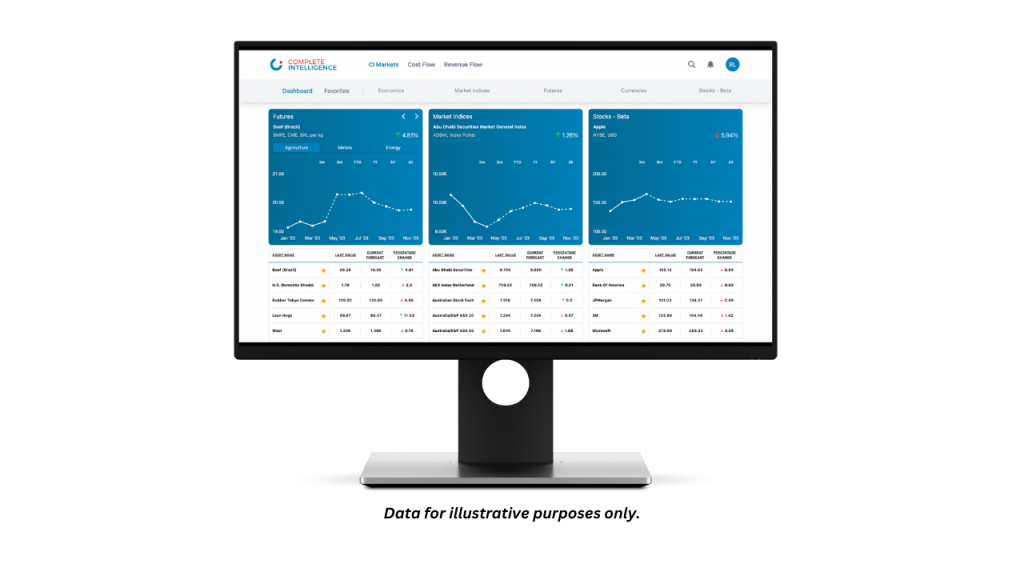
🔥BLACK FRIDAY SALE!🔥 80% OFF CI Markets! Get it for only $99/yr: https://bit.ly/3uscpEI 👈 🔥 Promo ends Nov. 28th ⏳
Transcript:
BFM
BFM 89.9, you’re listening to The Morning Run with Keith Kam, and I’m Wong Shou Ning. It’s just gone past 7:06. It’s a very wet Thursday morning. It’s the 23rd of November. And in about 30 minutes, we’ll be discussing the outlook for the Indian economy, which is growing at a steady clip in contrast to other major economies this year. But in the meantime, let’s recap how global markets closed yesterday.
BFM
On Wall Street, when Americans sit down for the Thanksgiving dinner, this is another thing they get to be thankful for. The Dow closed up more than 200 points, up 0.5 %. S&P 500 was up 0.4 %. The Nasdaq was also up 0.5 %. Earlier in the day, yesterday, in Asia, Japan’s decay was up 0.3 %. The HangSeng was flat. Shanghai’s composite was down 0.8 %. Singapore’s STI was up 0.6 %. Back home, the FPMKLCI closed 0.5 % lower.
BFM
For some insights on where international markets are hitting, we speak to Tony Nash, CEO of Complete Intelligence. Good morning, Tony, thanks for speaking to us. I know it’s almost Thanksgiving in the USA, so I have a question about you. How thankful are you for the US equity markets? Because the Nasdaq is up 36 %, the S&P 500 up almost 19 %. Can this very, this yearlong rally continue?
Tony Nash
Yeah, to be honest, I think we’re lucky that we are where we are. Are we grateful? Yeah, we are. But I think we’re pretty lucky to be where we are. I think without tech, without tech surging and the AI surge, I think it’d be in a very different place.
BFM
Tony, FOMC minutes revealed that the Fed isn’t keen on cutting rates anytime soon. How might equity and fixed income investors position themselves for a higher for longer scenario? Do you think we might be getting a Santa Claus rally?
Tony Nash
Yeah, maybe it’s possible. I think with higher for longer, treasures are paying 5 %. You can sleep at night with a 5 % return and fall in inflation. Honestly, that’s really a no-brainer, and it’s the easiest trade to make. I’d be careful of tech right here. I’m not saying it’s due to fall. I’m just saying valuations are incredibly stretched. If Hire for longer is really a thing, then tech valuations are likely to take a hit in the new year. I’m not sure much is going to change before the end of the year, but they’re likely to take a hit in the new year. I’d be watching energy stocks. I’d be watching pretty boring sectors like utilities and consumer staples, and really take a look at when it’s time to get in.
BFM
Okay, staying on the team of Tech cutting, I think nobody can ignore NVIDIA results, which actually beat expectations, excuse me, but the stock has come down overnight in the last two days, actually. What is the reason for this?
Tony Nash
I think with NVIDIA, it’s been priced for perfection. I think people are looking at it and asking if this is as good as it gets, because when you look at NVIDIA’s PE ratio, which I know that’s not necessarily perfect, but it’s at 116, 116. Effectively, NVIDIA would have to have 116 years of its current earnings level to justify the current price. That’s optimistic, right? When you look at what the NVIDIA CFO said on the call, she basically said that they do not have good visibility into the magnitude of the impact of the China stuff that the US government has imposed on them. They’re saying they don’t know.
Tony Nash
There’s uncertainty. China is 25 % of their data center revenue, and data center is their biggest revenue bucket. So 25 % of their biggest revenue bucket is uncertain. I wouldn’t be surprised to see some people take some profits here and just wait and see until there’s some clarity.
BFM
Okay, so it sounds like the premium awarded to NVIDIA is really due to the scarcity when it comes to AI teams. Would Microsoft now be that new AI proxy?
Tony Nash
Well, Microsoft has been trading off that because of OpenAI. They have the relationship with OpenAI and ChatGPT, and they’ve added ChatGPT type of activities to all of their products. They’ve already done very well off of that AI theme. I don’t know that they would necessarily be the new darling of AI.
Tony Nash
Microsoft announced, I think last week that they’re going to be making AI chips. Of course, everybody’s going to announce they’re making AI chips, MD, Microsoft, everybody, because that’s where the money is.
BFM
Tony, Fed officials mentioned that they needed to see more weakness in labor markets in order to hit their inflation target. Just jumping off on your comment earlier that 2024 might actually be a bit of a moderation. Do you expect that same moderation to be reflected in US job numbers?
Tony Nash
I do. The bigger issue there, I think, rather than just job numbers, it’s really wages, right? Average hourly earnings as of last month are growing at 4.1 % annualized, while CPI, consumer price inflation is growing at 3.2. Wages are growing faster than inflation, which for the worker is great. But the Fed believes that average hourly earnings number is pulling up prices. We’ve been through the part of the cycle where it’s supply side inflation, and we lived that out in ’21 and ’22. We’re now getting to the part where wages are higher than inflation. The Fed is saying, Hey, that’s where this leftover inflation is coming from. They’re trying to find a way to push down that average hourly earnings number. I think in their minds, they’d like to see some people lose jobs so that there’s pressure, downward pressure on those earnings numbers.
BFM
Okay, Tony, help us understand what’s going on in the oil markets because demand has reached record highs with stocks depleting. Yet crude prices, I would say volatile, in fact, on the downward trend. So why is there a disconnect between this?
Tony Nash
Yeah, well, I mean, that’s a really interesting market to look at, especially in light of the fact that energy is playing such a large part of inflation slowing down, right? And so crude prices falling at this point is really a paper trade rather than a physical trade. It’s possible if we see a recession in say Q1 or Q2 next year, which is not the consensus call, but if we see a recession, the paper to market weakness might become a reality. We might see easing of the demand in global markets. But consensus at the moment seems to say that we’re going to avoid recession. It’s possible the market gain strength.
Tony Nash
My firm, Complete Intelligence, we forecast 1,600 things a month. Crude Oil is one of them. What we’re saying is in Q1, WTI will be in the low to mid ’80s, and Brent will be in the mid to high ’80s. We do see some upward pricing pressure from here. We’re not necessarily seeing the three-digit numbers that some people are talking about for next year.
BFM
Tony, OPEC Plus is meeting this Sunday, and the expectation is they are going to discuss further reductions in supply. What are your thoughts on this going into 2024?
Tony Nash
Yeah, that Sunday meeting, I’m not sure if it’s happening. I thought that had been pushed back until November 30th. The reason being is there were some back-room meetings made between the UAE and Saudi at the last meeting that allowed the UAE to increase their output. My understanding is that other OPEC members are pretty upset that UAE was allowed to pump more, but they weren’t. There’s some disagreement behind the scenes, and my understanding is they put that meeting off until the 30th. That’s really what’s behind today’s price weakness. I think Brent and WTI were down at like 3 % at one point.
Tony Nash
Until we have an idea of the agenda for the November 30th meeting or more clarity on what the outcome will be, I think there’s a fear in markets that the producers will produce more if they’re allowed to. And people want more revenue. People are feeling that economics is a little bit weird, and so they want to produce more to make more money. The Saudi are going to have to work it out with the other OPEC members over the next few days and then come together with some concrete conclusions for the November 30th meeting.
BFM
Tony, do you have any views on gold? Because this is another asset class I can’t really quite figure out. It’s at $19.90 per ounce and at the moment it’s up 10 %. On one hand, the market looks like it’s wrist-on, but that is wrist-off. What do we do with this precious metal?
Tony Nash
What you’re saying is exactly right. Again, we forecast a lot of stuff on our platform. And so when Gold was telling us until two weeks ago, actually until last Monday, that it was going to fall. And gold, in fact, was falling. Some of the items we monitor in the market had turned around and Gold told us this past Monday morning that it was going to start rising again, maybe it was two Mondays ago, that it was going to start rising again. And it did. Actually, that was two Mondays ago. And it did start rising. And gold is one of those that you really have to take a look at frequently.
Tony Nash
We have some customers who made 4X on some of their gold shorts last month. And then when it turned around, they sold those and started to get long again. So gold, and what we’re seeing now is strength in gold. Not a huge amount of strength, but we’re seeing strength in gold. I would be very careful. It’s like looking at equity markets right now. There’s underlying strength in equity markets, but I would wait until a few more things fall into place before you really want to go super long right here.
BFM
All right. Thank you very much for your time. Happy Thanksgiving, by the way, Tony. That was Tony Nash, CEO of Complete Intelligence, telling us to look at some sectors because markets might be volatile in the coming months, looking at utilities, consumer staples, and wow, what do we make of all and gold? The price movements don’t really follow, I suppose, typical market theory.
BFM
Not at all. I’ve been following gold for a while, and I see that it’s got a very, very strong support at 1920, $1,920 an ounce. But it’s been trying for the past two or three months to break that $2,000 resistance, and it did for a split second.
BFM
Sure. Well, whenever there’s any geopolitical tensions, ratcheting up, I noticed. But in the meantime, let’s take a look at one of the world’s largest distributor of agriculture, machinery, deer, and coal, because this is a good barometer in terms of what are farmers feeling like, what have the rising inflation and the rising agriculture prices have meant have they squeezed the margins of agriculture companies? Now they saw a five % increase in the fourth quarter net income to $2.4 billion and a 43 % increase to $10 billion for the fiscal year.
BFM
They saw a one % fall in total worldwide net sales. Revenue was at $15.4 billion for Q4. However, for the full year, it rose 16 % to $61 billion. Moving ahead, the company is actually forecasting slowing demand from farmers driven by declining crop prices because future net income for the fiscal year, they’re expecting to be between $7.8 and $8.3 billion. The full year outlook is also below consensus estimates of $9.3 billion. Not so. Rosy, actually.
BFM
No, not really. I think margins have really been squeezed, actually, because in terms of global food prices, there’s a limit to how much you can raise it, but there definitely has been higher input cost for all these farmers. Now, the stock is actually down 13 % on a year to date basis, trading at a forward PE of 12 times. The street, 16 buys, 11 holds, two sells. Consensus target price for this US listed stock, $427.93. Last done was actually down almost $12 to $370.76. Now that’s all the corporate US corporate news we have for you the moment. Up next, we’ll be covering the top stories in the newspapers and portals this morning. Stay tuned for that BFM 89.9.
The US Federal Reserve has left interest rates unchanged at a 22 year high in a bid to stabilise price rises which has reached record levels. We’ll be getting the latest reaction from a business in the US.
Shares in the world’s biggest offshore wind developer Orsted has fallen all because they abandoned a project to build two huge wind farms off the east coast of the United States. We hear why it seems so hard to get these developments of the ground.
And would you fancy a 70-hour working week? Well one man in India has sparked a debate in the country with this call saying young Indian professionals need to work harder and longer.
LIMITED-TIME DEAL! Subscribe to CI Markets for 40% off! That’s only $500 $300 per year! Go to https://completeintel.com/save200/ and use the promo code SAVE200 at checkout.
Transcript
BBC
Tony Nash is also with us, CEO of Complete Intelligence. Of course, he’s there in Texas. Tony, if you were to be interviewed by anybody, who would you want it to be?
Tony Nash
Oh, gosh. Elon Musk is not a bad choice. Joe Rogan is not a bad choice. I mean, or are you?
Rachel Cartland
Yeah, exactly. One of those BBC seasoned professionals, these are the people.
Tony Nash
Right, exactly.
BBC
Yeah, well, I’m certainly not seasoned and certainly not professional either, to be perfectly honest with both of you. But, I mean, interestingly, Joe Rogan did interview Elon Musk quite recently, didn’t he?
Tony Nash
He did just last week.
BBC
Yeah, good chat there. Tony, everybody expected this. There’s rates between five and a quarter to five and a half %. The key is, is this the end of the rises or could we see more? And how long are they going to be paused at these high levels? Do you want to have a bash in answering all those questions?
Tony Nash
Sure, yeah. I honestly think they don’t know. I think there is still instability in the banking sector, so they have to be very careful how much higher they push things. I think there’s difficulty on personal balance sheets, household-level balance sheets. I think with higher mortgage payments, things are delicate there. But we do have persistent inflation. I really do think these guys are taking it month by month to see they’ll raise if they have to. But I think things are fairly delicate right now and they’re trying to see how long they can keep this going.
BBC
When you say they’re fairly delicate, in what way?
Tony Nash
Well, we have a lot of, say, commercial real estate buildings right now that have lost a lot of value. A lot of that commercial real estate is on the balance sheets of regional banks, which came into problems in March of this year. But some of them are on the balance sheets of bigger banks. The Fed doesn’t want those regional banks to, any more of those regional banks, to fail because they don’t want to force a larger bank to buy any more regional banks. They had JPMorgan buy Silicon Valley Bank. That’s just one example. But when you look at, say, household cash flows and what’s happening because of higher mortgage interest. Now, a lot of people are at 3% mortgage interest rates. But for those people who aren’t, it’s really stressful on households to pay those. When we look at even things like grocery prices, the tightness of personal budgets and household budgets is very high. We’ve seen 22% or 24% price rises on average since 2020, and wages have not kept up. It’s tight all around. He has to really put pressure on downward and pressure on inflation. But interest rates are really to the point where they’re hurting people a little bit.
Tony Nash
I wouldn’t say they’re excessive interest rates, but if he can keep it at the current rate, he’s going to try to do that.
BBC
A quick one for you, Tony. When will we see rates being cut? It could be six months, nine months.
Tony Nash
Oh, yeah. I don’t think it’ll be until at least the first half of ’24 is over, unless there’s a catastrophic event, of course. But short of that, I think it’ll be mid ’24 by the time we see starting to talk about talking about interest rates coming down. Yeah, and that, of course. The inflation has been very high. And so, yeah, it’ll be sometime.
BBC
Yeah. And we’ll be heading right into the election period. There you are in Texas. Everyone talks about Silicon Valley, but a huge tech industry in Texas, isn’t there? At the moment in places like Austin, et cetera. Do you think there’s a lot of interest there in what’s happening here in the UK? Or do people think, Actually, it’s really not that important, this conference? Sure.
Tony Nash
Sure. And, Rahul, you know I run an AI company, right? Yeah. This is very relevant to us. I think when multilateral statements like this are made, I think it’s a nice sentiment, but there is no enforcement mechanism to this. Do we think the US, China, the UK, EU are going to abide by this? Probably not. Okay. Most of those places, I doubt, try to know, but most of those places have laws against things like malicious code, which is viruses and malware. There are existing laws against this stuff. Ai is just software. Many of the worries that people have about AI, around things like doing bad things, around racial profiling, these sorts of things, there is existing law in place about doing these things. If we look at Joe Biden’s executive order from yesterday, every single point that was in his executive order, there is existing law and regulation already on the books for all of those things. This is an interesting event, but none of these countries are really going to adhere to it. When somebody like Elon Musk stands up and says AI is terrifying, we have to ask why he’s saying that. He’s saying that because he has existing AI technologies, and he and the other large AI companies are trying to build a regulatory moat around their businesses.
Tony Nash
They’re trying to stuff down companies like mine so that they can be entrenched from a regulatory perspective in the AI space.
BBC
Well, yeah, it’s fascinating to hear from you.
Tony Nash
Why do you laugh? I’m just curious.
BBC
No, that was Rachel.
Rachel Cartland
That was me. Sorry. I was just wondering if there’s a, I don’t want to be rude, but is there the teeniest, tiniest bit of self-interest creeping in here?
Tony Nash
For me or for Elon Musk?
Rachel Cartland
Yeah, for you.
Tony Nash
No. Look, of course, I want to compete, but who are the loudest voices around AI regulation? It’s Sam at ChatGPT, it’s Elon Musk, it’s Facebook, and so on. These are the largest AI businesses out there today. Amazon, they just invested in a large language model called Anthropic. These are the largest AI companies out there today, and they’re out screaming for regulation. Why do big companies scream for regulation? Because they want to be entrenched into the business. And so there is no other reason for them to want to scream for regulation.
BBC
It is a subject we’re going to discuss, but fascinating to hear that conversation between Tony and Rachel. Before we went to the news, we were having this discussion about offshore wind as the world’s biggest offshore wind company, Austin, actually canceled two wind projects in the US. And, Tony, there you are in Texas. We think about it. We think of Texas and oil, don’t we? A lot. But there’s a lot of renewable energy there. But interesting that another big energy company recently said, BP, that the US offshore wind industry was fundamentally broken.
Tony Nash
Yeah, I mean, it is. Obviously, this Orsted issue, they got a billion dollars from the New Jersey government just recently, sorry, from the state government of New Jersey. So if these guys can’t survive without subsidies in a market environment, then there’s only so long over which you can amortize the initial costs of these. Windmills, I see windmill blades, used windmill blades going up and down the highway near my house on a regular basis. Those windmill blades only last so long. Then there’s actually a burial ground for windmill blades here in Texas. It’s a massive site where they can’t recycle windmill blades, so they have to take them out into the middle of West Texas and bury them. There’s the cost of them. There’s the cost of repairing them and maintaining them. There’s just not a feasible scenario for it. Texas was one of the first places in the US to deploy massive wind farms in the 1990s, and at one point had the largest wind farm in the US. And now obviously there’s been so much subsidy across the US for wind farms that other places are competing for that.
BBC
To this issue of productivity, it is an important one, isn’t it? Because for many economies, if they want to drive growth, it’s going to have to come through increased productivity.
Tony Nash
Yeah, you’re exactly right. And whether it was literal or figurative, you just need to work harder. Predictivity is output per worker. You get that either by investing in some technology, whether it’s mechanical or software or whatever, or by workers working harder. I think all he’s saying is it’s unlikely that a lot of this investment is going to come for some companies. So people are going to have to do it by working more. Is 78, 5 hours excessive? I mean, I’ve done it through my career. I’m not German or Japanese, but I don’t do it anymore. But for 15, 20 years, that’s what I did probably longer. I think people have to realize that if you want to have a higher income at a national level and or a personal level, in most cases, you’re going to have to work harder. You’re going to have to be more productive. I think that’s really all he’s saying.
BBC
Rachel, is there something a little bit generational about this? My dad said to me, You don’t work as hard as I do, and I find that I say that to my kids nowadays. We all think that maybe the next generation doesn’t work quite as hard as we do.
Rachel Cartland
Yeah, and I think we’ve got to be careful to avoid this looking back with rosy tinted glass and thinking we were so wonderful. But on this quiet quitting thing, I happened to be in a coffee shop the other day and a really well-dressed, well-spoken, obviously well-educated young woman was speaking, chatting at the next table so bitterly to a friend, I suppose, saying that she was not going to do a moment more than she considered that she was being paid for, that she would work out how many dollars worth of effort she needed to put in. At that point, she would turn off. I must say it was all I could do not to get up and go, Hey, this really isn’t having a way to have a happy life, believe me. Find a job you really can put your heart into and then do it.
BBC
I can hear you nodding in agreement there, Tony.
Tony Nash
Well, yeah. If people don’t want the job, then they can work for something else. It’s really interesting the generational question because the generation that, say, really gains the wealth. If you look at in China through the say, ’90s and 2000s, ’80s, ’90s, and 2000s, a lot of hard work, a lot of hours have gone in. Do Chinese workers today work as hard as people did 20 years ago? Probably not because they’ve hit a certain income level and they don’t have to. In the US and in the West, largely people talk about work-life balance. That’s a luxury to be able to talk about work-life balance because a level of wealth has been achieved in the West. That level of wealth hasn’t been achieved in India yet. So is that a luxury that people in India can talk about? Yeah, maybe in certain social classes and certain income strata, but generally across the board, it’s just not a luxury that people have.
BBC
Yeah, it’s a good point that I know many people in India, many women who were doing three or four different jobs just to try and make ends meet and just to keep the families going. Tony, whatever happens in this case, there are going to be a lot of questions at the end of it about the regulation that took place of this company. And there are concerns there, aren’t there?
Tony Nash
Oh, there are concerns were voiced for years. This isn’t something that just happened because of FTX. People have been shouting about regulation that was needed around crypto for years. This is just a symptom, as the commentator said, of a wider problem. It’s interesting that I think that what’s going to happen with SPF is he’ll be found guilty of something, but I really don’t think he’s going to serve that much of a sentence, and he’s probably going to be the CEO of another company in 2-3 years. This is really something that I think likely is going to be overlooked at some point.
BBC
Let us see what happens. Of course, he has quite strenuously denied those charges that have been, We’re going to end the program. Rachel set the theme for the program today, which she started by talking about her concerns about what happened with her We talked about the world’s largest wind offshore company seeing its shares collapse. Well, we’ve also seen WeWork see, it shares plunge in after hours trading, following reports that the troubled flexible office sharing firm is preparing to file for bankruptcy. No confirmation yet of that. I mean, Tony, have you ever used a WeWork yourself?
Tony Nash
I’ve never done it for my company, but I’ve met other companies in a WeWork. I actually knew the guy who broke the WeWork story about how their revenues were pretty hollow. And he was actually a WeWork tenant when he broke that story. And they kicked him out because he’s the one who broke the story about WeWork.
With CI Markets Free, our goal is to democratize financial insights. We believe that everyone should have access to powerful forecasting tools, enabling them to make informed decisions that align with their financial goals.
In terms of the oil and gas industry, the geopolitical crisis in the Middle East is not expected to have a significant impact on the industry. Despite the volatility in oil prices, there have been consolidation deals within the industry, as companies look to prepare for the future and navigate the shift towards green energy.
In the US markets, there is a sense of nervousness regarding the future of AI and tech valuations. The recent earnings reports have shown that 77% of S&P 500 companies have beaten street expectations, but this could be attributed to a game of meeting or beating numbers rather than a true reflection of corporate America’s performance. Business activity in the US has picked up in October, driven by a rebound in factory demand and an easing in service sector inflation. This trend is expected to continue into 2024. The Yen has weakened against the dollar, but the BOJ is not expected to intervene unless it reaches a level of discomfort.
Meta, formerly known as Facebook, reported better-than-expected third-quarter profits and revenues, driven by a recovery in digital advertising. The company’s operating margin doubled to 40%, its best in two years, largely due to cost-cutting measures. However, its augmented reality division, the metaverse, has incurred significant operating losses. Despite this, Meta’s CEO, Mark Zuckerberg, remains committed to the metaverse. The company expects revenue to be between $36.5 billion and $40 billion for the fourth quarter. Meta is also facing a legal challenge over its addictive qualities and impact on the mental health of younger users.
Transcript:
BFM
BFM 89.9, it’s 7:06 AM on Thursday, the 26th of October. You’re listening to The Morning Run. I’m Shazana Mokhtar with Wong Shou Ning. We’re going to kickstart this rather lovely-looking Thursday morning with a recap on how global markets closed overnight.
BFM
Okay, it’s a nice day, but it wasn’t such a nice night for US markets. They all ended in the red. The Dow is down 0.3 %. And I want to highlight on a year to date basis, it is now in negative territory. It is down on a year to date basis also by 0.3 %. And Nasdaq had its worst day so far this year, down almost 2.5 %. So it’s only up 22 % on a year to date basis. Meanwhile, we look at the S&P 500, it was also down 1.4 %, only up nine % on a year to date basis. So all these earlier gains that we saw throughout the year seem to be slowly disappearing. Meanwhile, if we look at the Asian markets, the Nikkei225, however, was up 0.7 %. Hang Seng was up 0.6 %. Shanghai Composite up 0.4 %. The Singapore Straits Times were however down by 0.2 %, while our very own FBMKLCI was actually up by 0.5 %.
BFM
So for some thoughts on what’s moving international markets, we have on the line with us, Tony Nash, CEO of Complete Intelligence. Tony, good morning. Thanks, as always, for joining us. I would like to start with oil and gas. So Shell Oil has given the US some measure of energy independence, but the number of operating oil rigs, a barometer for activity has dropped 16 % to 502, compared with the same time last year. How do you see the geopolitical crisis in the Middle East affecting the fortunes of this industry?
Tony Nash
Yeah, it’s a great question. At this point, I don’t see too much impact at this point. There is a lot of pressure to continue to reduce crude prices. And we’ll see actions in markets, we’ll see intervention by, say, central banks to try to reduce crude prices. But I think we’ll also see, even with the geopolitical risk in the Middle East, we’ll see the supply from Iran continue to hit global markets. We saw with the geopolitical issues in Russia and Ukraine that Russian oil continued to hit markets. I think the go-to place for crude traders is, Oh, gosh, geopolitical risk in the Middle East, that must mean crude prices are going to rise. Not necessarily the case. If they don’t rise, you probably won’t see those rigs come back online.
BFM
Meanwhile, Tony, we have seen a lot of consolidation or quite some pretty big consolidation deals within the oil and gas industry. I think despite the volatility in oil prices. How do you see this trend moving forward?
Tony Nash
Well, yeah, I think these companies are seeing that if the 2030, 2035 goals are kept by a lot of the companies that have… Sorry, national legislatures and regulatory bodies that are trying to push green energy and force, say, electric cars by 2035, which I believe California is doing other things, then really the for these guys are capped, so it’s time to start consolidating. But if that doesn’t happen, which we’re starting to see some pushback on that, then it’s also a great time to consolidate because we’re in a sweet spot where crude prices are, it’s not too high, it’s not too low. And so we’ll likely see more of these deals, not a lot more, but a couple more of these deals on the horizon.
BFM
And let’s talk about U. S. Markets. Well, Nasdaq had a pretty rough day down 2.5 %, pretty much the worst for the year. We did see Meta and IBM come out with their numbers, both actually beating street expectations. What’s driving this nervousness?
Tony Nash
I think a lot of people are feeling that, at least for now, AI has played out. You even had Bill Gates today come out and say that large language models are not what people think they are in terms of the level of innovation, that thing. I think large language models and AI are really cool, and I think there’s a lot more room to run. But I do think valuations are very stretched right now. With interest rates rising, it’s very hard to stretch tech valuations much further. A lot of these companies for the past, say, four quarters, you can count the number of times they say AI in their quarterly earnings calls, and it’s just increased. As they’ve said AI more and more, it’s just helped their share price. But I think that’s a little bit played out. I think until people start to see real gains from AI outside of the chip makers, like CONVIDIA, real gains within corporate sectors, real gains within the user sectors, then I think we may see valuations as stretched as they can be, at least for now.
BFM
Okay, so far, about a quarter of the S&P 500 companies have reported earnings, and apparently, 77 % of them have actually beat street expectations. I’m not sure whether it’s just the street being conservative or really corporate America is doing better than I expected. So is there some contradiction? Because everyone’s been talking about that recession that’s coming, but just never seems to happen yet.
Tony Nash
Yeah. The recession calls are a big game, too. It’s a little bit of conservatism on behalf of analysts and a meeting of the minds between, say, the CFO to the publicly traded companies and analysts, and everyone wants to beat their earnings, right? So it’s a game. Everything, it’s a game. We saw MetaBeat and we saw Microsoft Beat and all this stuff. That’s great, but it’s a game number. Nobody’s going to put a number out there that they knowingly that they’re going to either meet or not meet. They all want to beat everything by a certain amount. It’s a bit of a game. I think we’ve seen in sectors like real estate where things haven’t gone so well. We’ve seen in energy where things haven’t gone so well. Again, those energy valuations are down a bit and that’s created some room for some of those deals that we just talked about. Sectors like materials and health care, they’re down a bit as well compared to a year ago. So even though some of these current firms beat, they are a bit sensitive to market conditions of debt and other things. And so it’s not all good all around.
BFM
Can we talk about US business activity, which picked up in October after back to back months of stagnation, helped by a rebound in factory demand and an easing in service sector inflation? So do you see this trend continuing into 2024?
Tony Nash
Yes. What we’ve seen with business activity is we have seen some prices come off a little bit. With service sector activity, really service sector inflation comes down to the wages of service sector workers for the most part. As the rate of inflation for those service sector wages have started to slow, you’ve seen on a relative basis, more activity. A lot of this is really inflation-slowing and the impact of interest rate rises hitting markets. In some ways, like we said, real estate and some other sectors, it’s not a good thing. But in services, as we start to see some pressure on those prices, it can be a better thing for consumption because we do have wages rising in a lot of the economy, but costs have just continued to rise, especially in services. So as people are seeing some of their service costs slow down a little bit and in some cases even decline, people are more willing to spend.
BFM
Okay, I’ve got a quick question on the Yen. It’s slumpab past $150 per dollar, weakest level this year. BOJ, are they going to intervene?
Tony Nash
I think at 150, it’s okay. I think at 155, it becomes a little bit uncomfortable. I think it’s a delicate balance, and they’ll try to keep it at 150 as long as they can. But it really all depends on what happens with the dollar. With geopolitical risk, the dollar becomes more appealing generally, not in all cases, but it becomes more appealing generally as a safe haven. The Yen is a secondary safe haven currency, but it really depends on their monetary policy. If they continue with YCC and some of these other policies, they really need to tighten slightly. Not a lot, but slightly. I’m sure you guys remember 2012. Maybe you were in school. I don’t know, but maybe I’m sure you remember 2012 when Abenomics first came into discussion. The Yen was trading at ’76, I think, right? And then within a month or two, it was in the ’80s or ’90s, and it ripped really quickly.
BFM
Yeah, Tony, I’m the only one in the room that remembers that. You and I.
BFM
I read history books.
Tony Nash
That’s right. The Yen can really fluctuate. It hits these extremes. Once they change policy, it can really boomerang back fairly quickly. If they made some policy tweaks, we could see a Yen at 1:30 or 1:35 or something like that. It sounds like it’s a long way from here, but it’s actually not.
BFM
Tony, thanks as always for the chat. That was Tony Nash, CEO of Complete Intelligence, giving us his take on some of the trends that he sees moving markets in the days and weeks ahead. A lot to watch there, especially as we’re in the thick of earning season. Speaking of that, let’s talk about some of the earnings that have crossed our table this morning. A Meta, third quarter profit and revenue beat analyst expectations thanks to a recovery in digital advertising ahead of the holiday season. We saw this exact same trend with Alphabit yesterday. They also saw digital advertising recover. So Meta is also seeing the same thing. Revenue rose by 23 %. It’s the fastest rate of growth since 2021. They achieved $34.2 billion better than the expected $33.6 billion.
BFM
Okay, so at the same time, their operating margin in the third quarter doubled to 40 %. It’s best in two years. Now, a lot of it is actually driven by their cost cutting measures, right? They’re keeping an eye on this because they’re a bit uncertain in terms of the outlook. So the best thing to do is just really just not spend very much money. Remember their augmented virtual reality thing that they.
BFM
Are so The metaverse. It was all the rage a while back. It’s largely forgotten right now.
BFM
Well, it’s cost them $3.74 billion in operating losses. So you might have forgotten, but they’re paying the price of your forgetfulness. Clearly, it’s not going to turn around so quickly. Since the start of 2022, this division has lost close to $25 billion. But Mark Zuckerberg is plowing ahead. He’s not giving it up. So the outlook, they expect revenue to come in between 36 and a half to 40 billion for the fourth quarter. Analyst will however expect sales for that quarter of 38.5, like the analysts being a bit chicken and really coming in the middle. Now, does the street like this name? The answer is still yes. 60 buys, seven holds, two sells. Consensus target price, 373 US dollars and 87 cents. During regular market hours, the stock was actually down $13. $2.99 to $299.53. The stock’s still up 148 % on a year to date basis.
BFM
Well, Meta has found itself in a bit of a legal pickle over in the US. We’ve got several states that are actually filing a lawsuit against Meta for its addictive qualities impacting the mental health of the younger generation. We are going to get more into that social media impact a little later in the show. 7:19 in the morning, we’re going to head into some messages, but we’ll come back to cover the top stories in the newspapers and portals this morning. Stay tuned to BFM 89.9.
The World Health Organisation says it needs urgent safe passage to send supplies as people are ‘dying unnecessarily from a lack of water and medical care’.
President Biden and other world leaders have called on Egypt to open the border known as the Rafah crossing as tonnes of aid piles up.
Sam Fenwick discusses this and more business news from around the world with Tony Nash, chief economist at Complete Intelligence, in Texas, and Rachel Cartland, author, writer and expert on Hong Kong.
With CI Markets Free, our goal is to democratize financial insights. We believe that everyone should have access to powerful forecasting tools, enabling them to make informed decisions that align with their financial goals.
Transcript
BBC
Ask our guests today who join us from Hong Kong and Houston, Texas. Good evening to Tony Nash, CEO of Complete Intelligence. It’s an AI forecasting firm, so you should be quite well-placed to talk to us about chips and AI.
Tony Nash
Absolutely, yes. Thank you for having me.
BBC
It’s always good to have you on the show, Tony. Thank you for joining us. I want to just come to Tony Nash on this. As we say, Joe Biden arriving in the region on Wednesday had planned meetings with Jordanian which have now been canceled, also had a meeting with President Abbas of the Palestinian Authority and President CC of Egypt, all of which have been postponed according to the White House. What do you think Mr. Biden will want to achieve from this visit now?
Tony Nash
I think the biggest thing that Biden wants to achieve is the release of American hostages. And if that’s all that can be coordinated, then that’s a major win. It looks very good for the domestic population in the US, and it brings American citizens free and clear from this conflict. I really think that that’s the main priority for Biden’s visit at this moment.
BBC
Okay, thank you, Tony Nash. Let’s bring in Tony Nash. He’s the CEO of Complete Intelligence, and it’s an AI forecasting firm. He’s based in Houston in Texas. As we said, this policy has been in place 12 months. Do you think it has done anything more than just annoy chip makers in the United States?
Tony Nash
NVIDIA says that they comply with the laws that are in place, and they’ve already said that any announcement they made today really won’t have a meaningful hit on their business.
BBC
Although their shares nose-dived, and lots of other chip companies did the same.
Tony Nash
Yeah, they did. There was an estimate that it would hit about $100 billion for their business. It’s really unclear, but they’re a regulated company, they have to comply with what are called ITAR regulations, which is International Technology Regulations that the US government puts out. The real issue here is, will NVIDIA chips be used for Chinese military applications? That’s really what the US government is worried about. And so there are a thousand ways to circumvent the regulation, ship into a third country, all these sorts of things. So it’s not as if the chips won’t get into China. There have been ways to circumvent these regulations for hundreds of years. So they’ll find a way to get them. The real question is, will they get them at the scale that they want them?
BBC
We talked about this time, 12 months ago, we were having the conversations about why this policy had been brought in. And it seemed to be, prior to this, it had been about keeping China and the technology 20 years behind the advancements of the US. And now the policy had changed and they wanted to stop all advancements completely, just cut them off. It doesn’t sound like it’s working from what you’ve said.
Tony Nash
I don’t think anybody expects China’s advancements to stop completely, but I think having the state-of-the-art technology shipped into China to be placed in Chinese military equipment when China has been threatening Taiwan, they’ve been making other threats, the US has been threatening China, these sorts of things, of course, you want to hamper your adversary as much as you can. I think this is just normal technology regulation, export controls. Whoever has the leading edge technology wants to control the leading edge technology. Will China continue to develop its chips? Yeah, absolutely. Are they behind what NVIDIA is producing? Yes, they are. Will it take them a few years to catch up? Yeah, it’ll take them 5-10 years to catch up. But I think over time, China will definitely catch up with where the US is. It’s just going to take some time.
BBC
Now, apparently, NVIDIA was selling an A-800 and an H-800 type of chip, and they were able to do that because it went around the original ban, and then now those have been banned. Will it be that these chip companies will just make a chip that isn’t covered by the ban, and then the government will change the goalpost again?
Tony Nash
Well, that’s the way it works, right? That’s how regulatory arbitrage works. So NVIDIA will look to the letter of the law and conform a chip to match the letter of the law. And then if the trade regulators in the US want them to change, they’ll change. These types of regulations change pretty regularly, and technology companies have to adjust their output according to what the regulators say. This sounds extreme. It’s actually not extreme because there are ITAR regulations, technology export control regulations in most countries. It’s just because it applies to AI-specific chips that it’s really getting this level of attention.
BBC
Let’s talk to Tony Nash first. What do you make of this plan? Do you think it could rival the Panama Canal?
Tony Nash
Yeah, absolutely. I think it’s a great plan. I live in Texas, which is on the US border with Mexico. I think this railway plan is fantastic. There is already a lot of electronics manufacturing moving from Asia to Mexico to service the US. I think three years ago is the first year in 20 years that the US imported more televisions from Mexico than from China. So televisions are pretty straightforward to assemble now. And so more and more sophisticated electronics is moving to Mexico. What your guest said about obviously transiting things across Mexico, but also manufacturing things in Mexico, I think that’s very much on the table, especially as we see more trade regionalization and manufacturing regionalization.
BBC
Is that because of what we’re calling nearshoring, this thing that occurred during the pandemic?
Tony Nash
That’s right. Exactly. Similar. So the risks of having a majority of your manufacturing concentrated, I think Northeast Asia makes 35, 40 % of the world’s manufacturing goods. And so during the pandemic, we saw all the supply chains lengthened because they were bottlenecks. Whereas if we had had those, whether they’re in, say, Eastern Europe or for Europe or Mexico for the US or something like that, I think it reduces a lot of that transit risk for a lot of people. And I think East Asia is probably facing some reinvestment over the next, say, 10 years because that nearshoring or regionalization is a real… It’s definitely on the horizon.
BBC
What was interesting, Tony, is that Benjamin there was talking about investors from the US being interested in building that original rail line a century ago.
Tony Nash
Yes, and obviously, the US was very instrumental in building the Panama Canal as well. The US is very interested in developing Mexico and developing Central America. It doesn’t surprise me that that was the case 120 years ago. It doesn’t surprise me that that’s the case today.
BBC
Tony, there were concerns or have been concerns about what’s known as debt trap diplomacy, that if you borrow money off China, then they will somehow have you over a barrel. Has that come… That still a worry for the US, do you think?
Tony Nash
For the US? Not necessarily, but certainly for African countries. I remember speaking with African representatives probably six or seven years ago, talking to me about how can they restructure their debt for the Belt and Road. The really strange part about the Belt and Road is it’s fully financed in US dollars. We have a time right now where the US dollar is appreciating. Not only is that debt at a relatively high rate, I wouldn’t say it’s sky high, but a relatively high rate, but you have it in a currency that’s appreciating against most emerging market currencies. It’s very difficult for companies to pay back or countries to pay back. I think one of the things about Belt and Road that really isn’t covered that much is the Belt and Road peaked in 2017 and 2018. The funding that you have going into the Belt and Road today is about a fifth of what you had in 2017 and 2018. Construction projects like the transport construction projects that you highlighted, those things all happened in 2013 through 2018, really. The largest portion of investment coming out of Belt and Road right now today in 2023 is for mining. It’s not construction, it’s investment.
Tony Nash
When you look at what’s tabulated as Belt and Road investment, it’s really Chinese money going into mining worldwide.
BBC
Just gives us time at the end of the show to ask our two guests who’ve joined us today, Rachel Cartland and Tony Nash. What are your side hustles? Rachel, you tell me what you’re earning money from.
Rachel Cartland
What’s your side hustle? I’m retired. My husband is constantly reminding me that I’m busy all the time, but with nothing that brings in a dollar, although I have endless voluntary commitments, which are great things to do. I think it’s what they call a portfolio, isn’t it? -bits and pieces of things –
BBC
Absolutely.
Rachel Cartland
-rather than a side hustle.
BBC
-it sounds very satisfying. Tony Nash, do you have time for a side hustle when you’re doing your AI forecasting?
Tony Nash
I make time, Sam. I have to make time. So I run an AI company during the day. On the weekends, I have my own coffee roastery called Nerve Roaster, and I sell coffee as my side hustle because it’s what I love.
BBC
You love drinking coffee?
Tony Nash
Sorry?
BBC
You love drinking coffee?
Tony Nash
I love roasting coffee, so I sell roasted beans.
BBC
Fantastic. I had no idea, Tony. You are a man of many talents. Thank you very much for joining us on Business Matters. And thank you also to Rachel Cartland, author, writer, and expert on Hong Kong. That was Business Matters. Thank you so much for listening. My name was Sam Fenwick. The producer today was Hannah Malane. I’ll be back the same time tomorrow. Don’t join me if you can.
With CI Markets Free, our goal is to democratize financial insights. We believe that everyone should have access to powerful forecasting tools, enabling them to make informed decisions that align with their financial goals.
Transcript:
BFM
BFM 89.9, good morning at 7:07 AM on Thursday, the 12th of October. You are listening to The Morning Run. I’m Shazana Mokhtar with Wong Shou Ning and Keith Kam. We’re going to kickstart the morning with a look at how global markets closed overnight.
BFM
Wall Street ended higher with investors looking at the minutes of the latest Fed meeting. The Dow Jones was up 0.2%. The close to 0.4% higher, while the Nasdaq rose 0.7%. Earlier in the day, the Nikkei in Japan was up 0.6%. Hong Kong’s Hang Seng was up 1.3%. Shanghai’s Composite was up 0.1%. STI in Singapore was down 0.2%. Back home, the FBMKLCI closed 0.1% higher.
BFM
For some insights on what’s moving international markets, we have on the line with us, Tony Nash, CEO of Complete Intelligence. Good morning, Tony. Thanks for joining us. Let’s take a look at oil prices. Tensions in the Middle East have caused a surge in oil prices, although there has been some pullback. I think currently Brent crude is hovering at around $85 per barrel. How do you think OPEC is going to react to these events over the next few weeks and how is that going to impact the trajectory of oil prices?
Tony Nash
Yeah, it was interesting seeing crude spike early this week. Unless things change materially on the ground and we see a much broader conflict, I’m not really sure it’ll impact prices much. We’ve said for months that we expect prices to peak out in late September, October, and then fall into the end of the year. Will we see OPEC, say, shut off supply or constrict supply in some way because of the conflict? Not necessarily something we’re seeing yet. Although if let’s say US embargo on Iran is, say, intensified or something, that could really change the narrative.
BFM
Tony, some analysts are betting that the share prices of defense companies will so in the coming months. We’re looking at the share prices of Lockheed and Northrop Grumman, which have shot up nearly 9% over the last few days. What are your thoughts on this?
Tony Nash
Yeah, we saw the Fed stocks, as you said, 9%, 10% up early in the week, and they’ve settled a bit. I think if you’re looking at specific companies and have specific reasons for investing in those companies, I think it’s different. But whether or not they continue to rally as a group or not really depends on the breadth of the conflict. So at this point, if you’re investing them in them as a group, probably pretty speculative bet, a gruesome speculative bet, but probably speculative. I’m not sure I’d take that group bet, but of course, individual companies have different tactics and strategies. So I’d look harder at those individual companies before betting as a group.
BFM
Tony, JPMorgan, City Group, and Wells Fargo will kick off earning seasons on Friday. What are your expectations in terms of how the big banks will do? And what picture will they paint about the health of the US economy and consumer?
Tony Nash
There’s a lot there. I think first, in terms of their, say, the interest they can charge, that thing, I think their interest margins are widening out as interest rates rise, which is obviously good for them. Now, those are the big banks for the, say, regional banks are still, I think, although they’re relatively stable, I think they’re still facing some pretty choppy waters. And I think there’s a given or I guess, depending on what happens in commercial real estate, you could see some difficulties in regional banks. But the bigger banks, I think, the consumer slowed down a bit in September, and I think they’re taking a breather before they go into the holidays at the end of the year. So there are a number of things to think about in terms of their net interest margins, in terms of their lending and the consumer spending. So credit card debt, for example, in the US, I believe, is at all time highs. And so the interest that they’ll make off of that will grow as well.
BFM
But generally, do you expect this time round, the results season to come in within expectations or even exceed analysts’ expectations because they’ve been cutting their numbers rather aggressively?
Tony Nash
Yeah, I don’t think so. I think they’ll be okay. I don’t think they’ll be great. I think a lot of companies right now are dealing with tighter workforce still, higher wages still, higher prices still for things on the services side. So these guys are very dependent on services expenses. So I think they’ll be okay. I don’t think they’ll exceed or disappoint dramatically either way.
BFM
And we are expecting the release of the latest CPI and PPI numbers sometime tomorrow, your time, I believe. Do you have any thoughts on what that figure could stand at and how this is going to impact what the Fed does in its remaining two meetings for the year?
Tony Nash
Yeah, PPI came in a little bit high, actually quite a lot higher than expected. So I guess Wednesday’s CPI or the next CPI, sorry, will likely also run hot. I think this puts additional pressure on the Fed to hike. Even though there’s heightened geopolitical risk, there may be continued pressure to squeeze out one more hike. Whether they’ll do it or not is a real question. They’ll continue to talk about lags between Fed policy and the market. So the Fed will try to push back on additional rate hikes. They may have to do it, say, in November. Part of the reason they’ll push back on it is because people are already feeling it in the housing space. And nobody wants another housing crisis in the fast. So they’ll try to push back on rate hikes. They’ll try to tighten money in different ways by doing things like selling off its balance sheet.
BFM
All right, Tony, thanks very much for speaking with us. That was Tony Nash, CEO of Complete Intelligence, giving us his take on some of the trends that he sees moving markets in the days and weeks ahead, talking a little bit about expectations for CPI, also how oil prices are going to trend. I think we’re still not certain how everything’s playing out, right? It’s a very touch and go situation. All right, it’s 7:18 AM. We are going to head into some messages, but we’ll come back with more of the top stories in the newspapers and portals this morning. Stay tuned to BFM 89.9.
As the conflict continues, we hear how a business tries to stay afloat in Israel, and we look into the role cryptocurrencies may have played in the financing of Hamas.
The trial of the founder of FTX, Sam Bankman-Fried, goes on in New York. We get the latest from our correspondent.
An undercover investigation by the BBC has exposed a blackmail scam using instant loan apps to entrap and humiliate people across Asia, Africa, and Latin America. We hear more about how it worked.
Rahul Tandon discusses these and more business stories with two guests on opposite sides of the world: Mehmal Sarfraz, Co-founder of The Current in Lahore, and Tony Nash, chief economist at Complete Intelligence in Houston.
With CI Markets Free, our goal is to democratize financial insights. We believe that everyone should have access to powerful forecasting tools, enabling them to make informed decisions that align with their financial goals.
Transcript
BBC
Tony, let’s bring you in on this. This is not the first time we’ve had questions about how cryptocurrencies are being used or who is using them. I suppose when we live in a world now where it’s much easier to transfer money, we’re going to have these questions, aren’t we?
Tony Nash
Sure. Yeah, absolutely. I think the way it’s being used or when it’s used for these types of activity, it’s effectively money laundering, right? They’re taking money from legitimate sources and taking it to use it for not great activity. It’s effectively almost a reverse money laundering operation. And as your guest said, they can track a lot of that stuff now, which is great. And so they can track down that money and figure out where it’s coming from and where it’s going to, which is a good thing.
BBC
Yeah. And tell me, on that point, people will point the finger at cryptocurrency saying, Oh, this is one of the problems with them. We had money laundering before. We had cryptocurrencies, didn’t we?
Tony Nash
Oh, yeah. We’ve had money laundering through all kinds of different means. As your guest mentioned, art, it’s done through real estate, it’s done through all sorts of different factors. And he said those can be harder to trace. So maybe crypto is a simple way to trace money laundering, and maybe that use is a little bit stale now, we can hope.
BBC
Tony, can I bring you in here, firstly? Because really this is a debate centered on the US. How serious do you think that Republican threat is to cut some of the funding for Ukraine in the long term?
Tony Nash
Absolutely very serious. I think I hear people saying, Don’t worry, the funding for Ukraine is going to be there. I think it really underestimates the capacity of American politicians to hold two international issues in their mind at the same time. I really don’t believe that American politicians can hold Israel and Ukraine in their mind at the same time. They can really only focus on one word at a time. I think the events of Saturday and Sunday and the ongoing events in the Middle East have really superseded Ukraine in terms of American spending, and American political opinion and media attention. I think Ukraine is, as of Saturday, it’s yesterday’s news. There may be some funding there, but I think for the most part, those days are gone.
BBC
We’ve got Tony, of course, who is in Houston. What’s the air quality like there, Tony?
Tony Nash
It’s pretty good, but don’t forget we have a lot of refineries here, so we have some days that aren’t great. The worst air quality I was in was when I was in Singapore in the Hayes, which is these days when palm plantations burn their excess palm leaves and plants. But Houston is nowhere near the Hayes.
BBC
Yeah, you’ve managed to avoid that. It’s interesting what you talk there about burning because we’re seeing that in Manout, aren’t we? There in the Amazon where the air quality is so bad because of those fires in the rainforest. Let us talk about some political developments, Tony, that are taking place in the US. That’s right. Republicans in the US House of Representatives have nominated Steve Scalise to be the chamber’s next speaker. Just remind listeners why we got into this situation.
Tony Nash
We had a speaker of the House who was fairly middle ground. He wasn’t responsive to a number of conservative representatives, and they voted to outst him.
BBC
Very good. We’re now making you a political correspondent. And this is important, isn’t it, Tony? Because at the moment, a lot of decisions, whether it’s about funding for Ukraine, etc, It’s difficult to take them until we have a speaker in place.
Tony Nash
Right, exactly. So the speaker controls the bills that come to the floor. And without a speaker, you can’t really vote on bills like that. And so it’s a big deal taking the speaker out.
BBC
Tell me, how easy is it going to be for the Republicans to agree on getting a new speaker? Because the process of getting Kevin McCarthy in place was extraordinary, wasn’t it?
Tony Nash
Yeah, I’m pretty sure Steve Scalise is already replacing. Look, it’s like a no-contest vote in the UK. And so as a person who likes representative democracy, I like my representatives to represent what I want in them. Although it’s portrayed in media as this terrible process and Republicans being not in control of their own caucus. I think it shows that Republicans are demanding that their leadership is more responsible to their voters. These guys vote out based upon when their leader isn’t useful for them anymore. I think as someone who likes representative democracy, it’s a good thing. Steve Scalise was up against another guy, and Steve Scalise is more of a middle ground representative than the person he was against. I actually think Steve Scalise is the most useful applicant for the job because he’ll make sure that legislation works. He’s very experienced. If you remember, Steve Scalise was shot probably 10 years ago while playing softball. There was a Democrat shooter, nobody holding office, but they were a very partisan Democrat, and they shot him while he was playing softball in Washington, D.C. So he’s fairly well known in the US because he went to the hospital, he almost died, and then he returned to Congress.
Tony Nash
So he’s now, I think, he should be Speaker of the House soon.
BBC
Okay, let us see how that goes for him. Tony, election coming up, of course, next year. We’ll be talking a lot to you about that over the course of the next year or so.
Tony Nash
Sure.
BBC
Those prices at the pumps in the US, President Biden really worried about oil prices going up. How significant could they be?
Tony Nash
Oh, very. I just noticed here in Texas, I think a week or so ago, petrol was under three dollars a gallon for the first time in quite a while. That definitely matters for voters. It’s still relatively high on the Coast, especially, but it matters. And so if, say, geopolitical events or other things contribute to fuel price rises, it’ll definitely impact voters. This is part of the reason the dollar continues to remain strong is the US is trying to keep crude prices down, import prices down for crude with a strong dollar.
BBC
Let us see if that policy works. I’m sure President Biden hopes that it may. Let’s move on. That was a fascinating report. They’re really looking at the way that some of these scams are operating and then the way that they’re able to access so much information about the people that they’re trying to scam as well.
Tony Nash
Obviously, people need to have security software on their phone when they can. But I think it’s really hard for a lot of people to understand how strapped many people in South Asia and Southeast Asia are. I was on the board of a microfinance firm in Cambodia for many years, and the interest rates we could charge were regulated. The number of factors around this were regulated because the ability to pay at certain income levels is very, very delicate. And so upsetting that delicate balance can really have devastating results, and obviously, as we saw here. So this is a tragedy, and these types of things obviously need to be addressed as quickly and as harshly as possible.
BBC
Yeah, definitely. Tony, do you have a copy of the Houston Chronicle in your hand?
Tony Nash
Oh, no, I don’t. Definitely not. But I was with the publication, as you probably know, I was with The Economist for several years. And so print journalism, print media generally, obviously very difficult business. I was there as things were changing quite a lot and the nature of the business and the sales were changing a lot. So not easy to keep that business going. And kudos to them for being able to pull this off, at least for now.
BBC
Yeah, at least for now, I think is the key phrase that you use there. And what about, Tony? I mean, as long as you’re reading the articles, whether you’re reading it on your phone or you’re reading it on a physical form, does it really make any difference? As long as you’re absorbing that content.
Tony Nash
As a consumer, I don’t think it matters much as on the business side of it. I think it does matter because I think when people feel something in print and they see maybe a photo of the journalist or the editorialist, I think it’s different. I think seeing it online, it’s a bit less human and a bit more commoditized. So it is different. As it changes, I think the skill of journalism, I’m sorry to say, is possibly a little bit less than it had been at the time. Maybe that’s something that has to do with ease of information access now makes it a bit easier. Maybe AI, composers makes it easier, but I think it’s different.
BBC
It is. There are a lot of people saying that my sons actually start buying a newspaper recently and then after doing it for about two days, realized how expensive it suddenly become and he has ditched that idea completely. Or he said, Can I pay for his subscription? That will not be happening. Tony, always a pleasure to have you on the program.
Tony Nash
Thank you.
BBC
Mehmal, good luck.
Mehmal Sarfraz
Thank you.
BBC
Good luck in that smog in Lahore. Hope it improves over the course of the next few weeks. That is it for Business Matters. Team will be back at the same time, same place tomorrow.
The possibility of former President Trump becoming the Speaker of the House.
Americans’ frustration with politics and the desire for a generational change.
The impact of government debt, the recent volatility in bond markets, higher interest rates on the real estate market, a potential recession and disinflation, and the importance of the interest rate environment on equity markets.
CI Markets Free is now available. Get AI-powered forecasts for major currencies, Nikkei 100 stocks, and top 50 economies. No credit card is required!
Transcript
Peter Lewis
I’m joined now by Tony Nash, Founder of Complete Intelligence over in the USA. Morning, Tony.
Tony Nash
Good morning, Peter.
Peter Lewis
Now it’s been an extraordinary week, hasn’t it? In the House of Representatives, the Republican Party have kicked out their own speaker for the first time ever, I think, in history that’s happened, isn’t it? So we’re really in pretty much on chartered territory now. What happens next?
Tony Nash
There’s a lot that can happen next. There are a number of people who are up for speaker. One is former President Trump. I think he’s taking all the air out of the room right now.
Peter Lewis
Is that serious? Is that serious? The idea that he could be the speaker?
Tony Nash
I think it’s possible. I don’t think it’s probable, but I think it’s possible. I think people are pushing it simply because it’s something unconventional. Look, Americans are really tired of politics right now. Really tired. And it looks like a circus from overseas. Here, it’s a shoulder shrug. It’s like, okay, now what are they doing? And so I think people are just tired of business as usual, and they’re tired of seeing a lot of money go to the federal government. They’re just tired of seeing the money that they send there. They’re tired of seeing people like Dianne Feinstein, who just passed away this week, have a job that pays $140,000 a year, yet she retires having $110 million net worth, okay? So Americans are tired of seeing this. And so I’m not in any way advocating Trump as Speaker of the House. I’m just trying to help people understand why Americans are even entertaining some of this stuff. Americans are tired of paying in, they’re tired of seeing their politicians retire as multi-millionaires after spending time in politics, this thing. And so they’re really looking for something different. They’re looking for a generational change. Is Trump that generational change?
He’s not, but he’s different. I think the people in the House of representatives right now who are really interested in some change are looking for… There was a motion today to set term limits, so people can’t serve longer than 12 years, to say that people while they’re in the House, they can’t trade stocks, these sorts of things. And we’ve had people like my own representative in Texas, his name is Dan Crenshaw. He was a regular guy when he became a representative. When he started in the House of representatives, he started miraculously trading stocks, and now he’s a multimillionaire. While… He’s in that… Again, there is a level of frustration that Americans have in politics, and that’s part of the reason some of these characters like Donald Trump come into the fold as possible nominees for the House. Can they do it legally? Yeah. I mean, you don’t necessarily have to be an elected official to become Speaker of the House.
Peter Lewis
Is there a worry, though, that in trying to get something different, people are also turning to extremists because some of these people are pretty extreme, aren’t they?
Tony Nash
Yeah, that’s why. I don’t think Trump will get it. Okay, people like Jim Jordan, who’s been in the House for a long time, he’s likely to get it, or Steve Scalise, who’s been in the for a long time. Steve Scalise is famous because he was actually shot by a Democrat partisan when he was playing softball in a park in DC 10 years ago or something. So he’s the majority leader in the House right now. And so I think it’s really between him and Jim Jordan as to who’s really going to get it. But I think when people at Overseas hear about this, they hear about Donald Trump and they hear about he might be speaker of the House, there has to be this understanding that Americans are just incredibly frustrated with politics in America, and the partisanship and the media blowing everything up into a huge scandal or a huge, or a clutching incident or something, and it’s just not. It’s politics as usual. It’s drama as usual in DC. Is the government going to shut down? Nobody really thought the government was going to shut down. Last week, right? This was just a story from last week.
Weeks of drama leading up to, Will the government shut down? At the end of the day, surprising no one, the government decided to fund itself. So nobody cares, right? I mean, these things come out and they’re hyped and they’re big stories, but at the end of the day, most Americans look at this stuff and just shrug their shoulders and go, Well, it’s those guys in DC. They’re doing what they do.
Peter Lewis
Has all of this, though, increased the chances now of a government shutdown? Because it seems that it’s going to be really hard for whoever leads the Republicans to be able to work under any circumstances with the Democrats in the House and get anything done, doesn’t it? It seems to increase the possibility that we can actually get a shutdown.
Tony Nash
I don’t think so. I think so. I think that the government, the representatives in government will find a way to make us think that there will be a shutdown and there may be a very short-term shutdown, but this is all theatrics. Again, as a political observer, all my life in the US, and for most of my life I was outside of the US observing US politics. I’m living in Asia for a long time, living in Europe for a few years, and this is theatrics. The government isn’t really going to shut down. There isn’t really going to be reform. These things that most Americans are shocked that we pay so much for, it’s not going to change. Will the government shut down? Maybe, but it’s not going to be for very long. Are there going to be dramatic changes in spending by the US government? Highly unlikely. So all of the suspension and government shutdown and good luck and all this other stuff, it’s drama. It’s made for TV drama. But these guys are friends and they golf together and they go to the club together, and they do all sorts of stuff together, regardless of partisan differences.
And so they’re going to get it done. So whoever is Speaker of the House is going to do it. If Trump has voted in as Speaker of the House, he will turn it into a presidential campaign post, and the House probably won’t get much done for the next year, which again, most Americans are probably okay with that. Because again, most Americans are very tired. It’s just the eye-rolling nature of what happens in DC. It’s craziness. And so do they want to see the drama of Donald Trump as speaker of the House? No. Very few people want to see that. But if it did bring people to really question and expose things that are happening in DC, overspending and corruption and all this other stuff, I think over time, people would probably be okay with it. But when you look back at Donald Trump’s presidency, what did he really do that was remarkable? He did a few things, but you can’t look back at it and say, Oh, wow, that was an amazing presidency. He didn’t do all the things he said he was going to do. It’s like looking back at the Biden presidency. Unremarkable.
Both of them are unremarkable. I don’t necessarily think Trump would get amazing things done in the Speaker of the House. I think it’ll be Jim Jordan or it’ll be Steve Scalise who ends up being Speaker.
Peter Lewis
Okay. Now, presumably one of the things that’s going to be very much in focus is debt, isn’t it? The amount of government debt. In particular with what’s going on in the bond markets recently, we’ve seen the 10-year yield jump 60 basis points in the space of about a week, which is a pretty extreme move for the bond markets. What’s causing these gyrations and these yields to shoot up to what are multi-year highs, 16-year highs in the case of the 10-year?
Tony Nash
Good news is bad news. We’re in a place where when people hear that we’re not going to have a recession and that job growth is strong and other things, that’s actually bad news, meaning interest rates jump on that because there is an expectation that if high hiring continues to be strong, if the job markets continue to be strong, then the Fed is going to have to continue to raise interest rates. And so if we have strong payroll numbers and let’s say we continue to have strong, say, real estate numbers and other things, when the bond markets look at that as the Fed not raising interest rates enough. And so we had a strong jobs report a couple of days ago, and that caused interest rates to spike because people looked at it and said, Oh, gosh, okay, the job market is still very, very strong. That means spending is going to continue and so that means the Fed is going to continue raising rates and they’re not going to just do 25. There’s going to be two or three or whatever more rate hikes, right? Again, that’s possible. But when you look at, say, consumer spending, it did dial down a little bit in September.
And some of these other indicators have dialed down a little bit in September. I think we’re in that part of the cycle where people are talking in both ways. Growth is tempering down. Oh, no, it’s strong growth. Oh, no, it’s not as bad as you think, or whatever. Depending on the day, the market is trying to find the levels that it should trade at, and that’s normal. In this part of the cycle, people trying to find, Are we in a new bull market, or is this a longer bear market? We’re at that part of the cycle where people are trying to figure it out. What we saw in bond markets on Thursday are not the end of that volatility. We’re going to have volatility for several months until we figure out what the direction is, until we have a clear idea from the Fed, until we have a clear idea from, say, the jobs market, what’s happening, until we have a clear idea in terms of wage is what’s happening. I think what we’ve seen, particularly in crude markets, over the past couple of days has really helped because when you look at crude, you’re not only looking at the crude prices, you’re looking at the expected primary and secondary impacts of inflation.
Not just crude, but what goes into, say, gasoline, what goes into plastic, even tertiary impacts of inflation. When crude prices fall, that helps a lot of the economy to have lower prices, hopefully. Go ahead
Peter Lewis
Are these yields at these types of levels? Have they now actually increased the chances of the US economy going into recession? Because at the beginning of the year, people were predicting a recession, but we’re simply wrong. The economy held up much better than people thought. The jobs market has held up much better than people thought. But now we have yields at interest rates at restrictive levels, yields moving higher. Are the chances of a recession, ironically, now increasing?
Tony Nash
Well, the recession is that interesting of economist dilemma. Last year people said it was going to be in the first half of ’23, then we got in the first half of ’23, then they said it’s in the back of ’23. Now people are saying there will be a recession in the first half of ’24. We’re always chasing our tails on that. With these types of things, I like to talk to people in the markets and on the street. I was talking to a mortgage broker here in the US yesterday, and I said, Hey, how much have things slowed down? Have things slowed down a lot? They said, Yes, things have slowed down a lot. The housing market in the US right now, according to this person, is mostly cash purchases. The homes that are being bought are largely not done through mortgages because mortgage rates are so high. That’s what the Fed wants. They want the number of transactions and the nominal rate of those transactions to slow down. They want the prices to slow down. If people are paying cash, then they’re probably buying a higher-end property or something like that. But the legs are coming out from underneath the mortgage market, and that’s exactly what the Fed has wanted to do.
These people who own two or three houses and have Airbnb’s and rental houses and stuff, they’re not able to rent those out as much. They won’t be able to afford the mortgages on multiple houses, so they’ll be foreclosed on, or they’ll sell at a lower price. What ultimately the Fed wants is they want those people who own three, four, five Airbnb’s and rent houses to have to sell at a lower price because it brings the froth out of the real estate market. Do these higher rates mean we will have a recession? Maybe. It really all depends on where people keep their wealth and where that employment is. But what’s more likely to happen? I know this isn’t really a mainstream view, but it’s actually possible that we have disinflation next year. What that means is the margins that companies get are smaller. If the margins are smaller, then the valuations for those companies will be smaller. If the valuations are smaller, then we’ll see a market pullback. Unless those valuation multiples go up for some reason, right? But those valuation multiples wouldn’t go up in a higher interest rate environment. Those valuation multiples would only go up if we saw a strong pullback in interest rates
Tony Nash
And so if we are truly in this higher for longer environment, which I believe we are, if we’re in that environment and we have pullback in margins and disinflation, then we’ll necessarily have to see a pullback in equity markets because valuations will pull back.
Peter Lewis
Okay, well, Tony, look, thank you very much. It’s always good to hear your thoughts. That’s Tony Nash, who is founder of Complete Intelligence over in Texas in the United States.
In podcast, BFM 89.9 invites Tony Nash, CEO of Complete Intelligence, to share insights on international markets. Nash mentions that the recent CPI numbers aligned with expectations, noting the rise in energy prices. He also discusses the potential impact of inflation on Fed fund rates and predicts that next month’s numbers will be more significant.
Nash emphasizes the importance of predictability in markets and suggests that a slight re-acceleration of inflation is being accepted by investors. He mentions the potential benefits of energy prices falling, creating a disinflationary environment. Regarding the Fed’s reaction, Nash believes they would be happy to see inflation come down, as this would align with their goals and shift the focus to policies rather than monetary measures during the upcoming US presidential election year.
The discussion then turns to the tech sector, particularly the rise of AI-related stocks. Nash explains that the late-cycle tech rally is driven by the AI hype, but warns that certain tech stocks, like Oracle, could face significant downside due to inflated expectations.
With CI Markets Free, our goal is to democratize financial insights. We believe that everyone should have access to powerful forecasting tools, enabling them to make informed decisions that align with their financial goals.
The hosts inquire about the apparent negative correlation between rising oil prices and the decline of the energy sector. Nash explains that energy companies face different challenges and may not fully benefit from higher oil prices. He also predicts that oil prices will likely peak in October before receding towards the end of the year.
Lastly, the conversation touches on an IPO priced at the higher end of the range, which Nash deems oversubscribed. He suggests keeping an eye on the company’s performance in the following months to assess its true value.
BFM mentions SoftBank’s need for a successful IPO after losses in their Vision Fund and concludes by highlighting the importance of predictability and hinting at a potential slowdown in the AI hype story based on recent movements in Oracle stocks. They also note the upcoming US presidential election year as a factor to watch in trading patterns.
Transcript:
BFM
This is a podcast from BFM 89.9, The Business Station. BFM 89.9 it’s 7:07 Thursday, the 14th of September. You’re listening to the morning round with Keith Kam, Mark Tan, and I’m Wong Shou Ning. Now, in about 30 minutes, we’ll discuss the highlights of the Apple iPhone 15 launch this week and how investors are reacting. But in the meantime, let’s recap how global markets closed yesterday.
BFM
In the US markets, the Dow Jones was down 0.2%, S&P 500 up 0.1%. Nasdaq up 0.3%. In the Asian markets, the Nikkei was down 0.2%. Hang Seng down 0.1%. Shanghai Composite down 0.5%. STI up 0.1%. FBMKLCI, largely up at 0.01%.
BFM
So for some insights on what’s moving international markets, we speak to Tony Nash, CEO of Complete Intelligence. Good morning, Tony, and thanks, as always, for joining us. I want to start with, of course, the CPI numbers. So the Core Consumer Price Index advanced 0.3 % from July. The first acceleration in six months, so it’s still 4.3 % in line with the estimates, but still above the Fed 2 % goal. So what does this then mean for Fed fund rates?
Tony Nash
Yeah, I think the CPI… People are conditioned to these levels now. It was in line with expectations. Of course, energy rose the fastest and petrol prices here in the US, everyone’s complaining about them because they’ve risen quite a lot over the last few months. That wasn’t a surprise. But the overall headline and even the core was pretty much in line with what everyone thought. You really saw the reaction in equity and bond markets today in the US. There really wasn’t much of anything. People wanted to be surprised one way or another, but they just weren’t. It was in line. It was boring. I hate to be that way, but it’s true. And the Fed rate hikes are firmly taking effect now. And you see with the pressure on margins, you see with companies putting off hiring. I think one of the tech companies fired hundreds of recruiters today. I think Google cut hundreds of recruiters. When interest rates rise, these things happen by design. They’re supposed to happen because cash isn’t as easy to come by. So we’re very much in that cycle. So these CPI numbers are people have been accepting a slight re-acceleration of inflation.
Tony Nash
And so this is where we are. I think the real mystery number is really next month because August was an off month with everyone in Wyoming and messing around. And so this was a live month and there had been expectations a couple of months ago that there may be a rise this month. But I think that’s pushed aside now, especially with the CPI parent.
BFM
But Tony, isn’t boring good for markets? We don’t like surprises. So what does this then mean? What direction will markets take?
Tony Nash
I think, boring is… Well, I’ll say predictable is good for markets, right? But I think what is dangerous for markets is really not knowing what’s happening next. And so I think October at this point is an unknown along. We see real estate slowing down quite a bit here in the US. We see hiring slowing down. We see prices continuing to rise. The question is, are we going to start to see accelerated say, disinflation, meaning the rate of inflation slows. Where energy prices are, it’s really hard to hit that right. The real question is, will we see energy prices fall, whether it’s net gas, or crude or whatever it is? And I think that’s the one area that if we saw those prices fall, it would really create a disinflation sweet spot for people. And it would be pretty pleasing to markets generally, I guess. But you would still have fallout in places like Teck that have been really favorable for the last, say, 6-9 months.
BFM
How do you reckon the FEDs might react to something like this?
Tony Nash
To energy prices falling?
BFM
Sorry, disinflation and your views on inflation.
Tony Nash
I think they would stay where they are. I think if you saw inflation start to come down, if you see markets slowing down, this is exactly what the Fed wants. And so if we were in that position, they would feel very happy with themselves. You would have wage markets slow down a little bit. You would have goods prices. They’ve already slowed down a little bit. So you’d have further, say, deceleration of services, prices, those sorts of things. These are all things that as we enter a presidential election year in the US, they want to see because you don’t want a Fed that is seen as the main economic driver in a presidential election year. You want to see policies being the main driver, not necessarily the Fed and monetary policy.
BFM
Now, Tony, the Nasdaq has risen 32 % over the last nine months. Is this bullishness generated solely by AI-related names or all tech names rising with the tide?
Tony Nash
Well, you have tech names in spots rising with the tide. But I think we’re a really late cycle right now for tech to be rallying the way we are. So investors are really trying to juice out as much as they can. If the AI hype hadn’t started, so if ChatGPT didn’t come out in December of 2022 and that AI hype cycle hadn’t perpetuated through the first half of the year, I don’t think we’d be where we are in tech right now, but it happened. It went all the way to NVIDIA and the hardware underlying AI software. It took a while for that AI hype to really catch on. Now we’re late cycle with rates in the economy. We’re also late cycle with tech hype. If you look at Oracle’s massive fall since Monday, I think they’ve lost like 16 % because investors aren’t buying their cloud and AI story anymore. The problem is stocks like that can fall even more because they pumped up so much on AI and on cloud that there could be some real downside coming for a number of tech stocks.
BFM
Tony, can you help me understand this? Because as we can see, Brent Crude, WTI, they’ve all been on a bit of a mini rally. In fact, Brent Crude this morning close to $92 a barrel. WTI, $88 a barrel. But yet, the energy sector declined 0.8 % last night. The second worst performer. Why is that the case? It’s like negatively correlated.
Tony Nash
Yeah. I mean, if you take a very short term look, yes, I think since July, energy is up somewhere between three and five %. I’d have to double-check. But energy doesn’t move like NVIDIA, right? And so energy is a grind. Those operating companies are a grind. And so because we have shortages in crude, and because we still have things like the OPEC supply cuts on, you’re going to see upward pressure on the underlying feedstocks on crude and other things. That may or may not necessarily translate through to the operating companies. You may have some energy companies that aren’t necessarily can’t put that margin onto their products. But in general, I think we’re pretty close, at least in this short term, before the end of 2023, we’re pretty close to seeing oil top out. We expect October will be the top. We don’t quite think we’ll hit 100. Now that’s on an average basis. We may hit 100 on an individual day basis or something, but we don’t think we’ll see 100 on a sustained basis. Our forecast are showing October as the top, and then we’ll recede into the end of the year. That’s not to say that 2024 is going to be a bad year for oil.
Tony Nash
2024 looks pretty good for crude and for energy companies generally.
BFM
And Tony, one last question on, it was priced at the higher end of the range at $51. Is this an IPO that you’re going to be excited about?
Tony Nash
I’m sorry. Which company is this? It’s okay. I think it was way oversubscribe. And so, yeah, it’ll be a really interesting IPO. But really the question is what happens three months later? I think we’ll have to take a look at arm. I think it was 10 times oversubscribe or something.
BFM
Yes.
Tony Nash
So we’ll have to keep looking at that three to six months down the road because it’s really taking advantage of this AI hype and other things. So we’ll see how much value is there say two quarters in.
BFM
All right. Thank you so much for your time. That was Tony Nash, CEO of Complete Intelligence, telling us, Hey, arm looks exciting, but you really only know three months later down the road, there might be a lot of hype. We might bounce on the first day, and then we’ll find out where it goes. This is something that Softbank really needs. They lost $30 billion in their SoftBank vision fund last year. They do need a winner for change.
BFM
He said that markets are also boring, which in the sense of the word versus volatility, I prefer boring anyway.
BFM
I think predictability was the word he used. But I think Tony did highlight the fact that this whole AI hype started last year, end of last year, due to ChatGPT being the catalyst for the AI hype. And if we look at Oracle stocks this week, maybe some boring science that the AI hype story may be coming to an end.
BFM
He also did put into context that next year is the US presidential election year. So that’s one factor that we can start looking out for in terms of trading patterns.
Country Garden creditors agree to extend onshore bonds
Apple unveils the iPhone 15 at its latest product launch
US Stocks Dragged Lower By Tech Shares
CI Markets Free is now available. Get AI-powered forecasts for major currencies, Nikkei 100 stocks, and top 50 economies. No credit card is required!
In recent times, the global investment community has been increasingly concerned about the stability of the Chinese and US property markets. The latest Bank of America fund manager survey has revealed a significant shift away from emerging market stocks, particularly in China, towards the US. Survey respondents expressed growing apprehension over the Chinese property sector, which they perceive as the primary threat to the global economy. This sentiment is not limited to foreign investors alone; local investors in China are equally skeptical. Meanwhile, the US market has seen a remarkable outperformance compared to its Chinese counterpart. With the potential for credit events looming in both countries, the repercussions could have far-reaching implications.
Chinese Property Market Woes
China’s property sector has been grappling with a series of challenges this year, resulting in its status as the worst performing market worldwide. The negative sentiment towards Chinese equities comes as no surprise, considering the significant drop in price momentum. The Bank of America survey indicates that a third of fund managers view the Chinese commercial real estate market as the most likely source of a systemic credit event. While recent policies aimed at reviving the property sector have shown some initial positive impact, the market’s response has been short-lived. As cities strive to remove restrictions on home purchases and make housing more affordable, it remains uncertain whether these measures will lead to a sustained recovery.
Disconnect Between Foreign and Local Investors
One might assume that local investors in China would have a more positive outlook on the market compared to their foreign counterparts. However, this is not the case. Both foreign and local investors have struggled to generate profits, making it increasingly difficult to justify investments in the Chinese market. Adding to the complexity are the rising presence of quantitative funds, which employ high-frequency trading strategies and advanced technology to exploit market inefficiencies. With these funds consistently outperforming traditional traders, the sentiment among domestic investors has turned increasingly negative.
US Market Attraction Despite Stretched Valuations
While US fund managers have been selling Chinese equities for some time, the allure of the US market remains strong. The survey reveals that investors are pouring back into US stocks, even though valuations appear stretched. The relative strength of the US dollar, interest rate differentials, and ongoing portfolio reallocation contribute to the attractiveness of the US market. However, the US market is currently undergoing a transition phase, with changing sentiment and interest sector dynamics. Thus, investors should remain cautious even in the face of apparent opportunities.
The Lurking Threat to Global Economy
The Chinese and US property markets pose significant threats to the global economy, with credit events on the horizon. These events, when they occur, will undoubtedly have a painful impact on the global financial landscape. Chinese real estate, along with US commercial real estate, are the two main catalysts that could trigger systemic credit events. Both governments are working diligently to slow down these events, but the inevitability remains. The potential bankruptcy of large property developers or regional banks in both countries could be the trigger that sets off a chain reaction of economic consequences.
As investors worldwide grapple with the uncertainties surrounding the Chinese and US property markets, the specter of credit events looms large. The negative sentiment towards Chinese equities and the outperformance of the US market have driven significant shifts in investment strategies. While the Chinese government has implemented numerous policies to revive the property sector, their impact has been limited. Similarly, the US market, despite its apparent strength, faces challenges due to commercial real estate valuations and potential bank failures. The impending credit events in both countries could have profound implications for global financial stability. As the world watches, it remains to be seen how these events will unfold and whether governments can effectively manage the fallout.
Transcript
Peter Lewis
Tony, from your perspective over there, we know that US fund managers have been sellers of Chinese equities for a while, but there is also obviously a geopolitical element to this as well, isn’t there? In that a lot of fund managers are finding it hard to justify to their clients why they’re even in the Chinese market in the first place. I presume this report is not a big surprise.
Tony Nash
No, it’s not a big surprise. I think the Chinese economic officials had a lot of sentiment in their favor earlier this year. Had they done some of the measures that they’ve taken over the past couple of weeks, I think foreign investors would have been very happy to invest more in China, and they would have justified the political issues, they would have pushed them to the side. But because the central government and local governments have been so slow to bring about these measures, there’s inertia, and that inertia has become negative sentiment. I think now it’s going to be very hard to get foreign investors, at least American investors, really interested in China because it’s gone from a financial opportunity to a political liability. Really, that financial opportunity is at least gone for now.
Peter Lewis
I mean, what stands out this year is the huge outperformance of US equities compared to Chinese equities. I think it’s the biggest gap since about 2002, but according to the survey, it looks like it’s going to get even bigger because investors are jumping back into US stocks despite, I suppose, what a lot of people would say, pretty stretched valuations there.
Tony Nash
Yeah, well, when you look at the strength of the dollar on a relative basis, when you look at interest rates in the US and you look at the incremental nature of tightening in the US compared to the easing we have in some other places, I think the US market becomes relatively more interesting. Now, that’s not to say the US market is easy. The US market is in a transition phase right now where there’s a lot of reallocation of portfolios because the sentiment and the interest price sector is really changing at the moment.
Peter Lewis
Hao, the government has done its mortgage rate cuts, it’s cut the down payments as well. It’s made clear it’s going to try and support the UR. What happens next? What does it do next?
Hao Hong
Well, some of the cities, as I mentioned just now, we’re all purchasing restrictions on property. They can give HUCO, which is a residency permit for many cities to rural households to attract them to move to the city, become a city, urban citizen, et cetera, et cetera. There’s still a few other policies that is up to speed, but I think at this stage, as you can see, there have been plenty of policies coming out, but I think the effect is actually like, Laskia. If you look at the first eight months of sales for this year, it’s even lower than last year. There, in many of the cities. That is concerning despite all the policy support.
Peter Lewis
Is there something you in particular would like to see being done or the Beijing authorities doing to really perk up the market? Because as you said earlier, everything they do, it seems to cause a rally which is very short-lived, isn’t it? It just doesn’t seem to have legs, any rally that we’ve seen in the last few months. Is there anything that you would like to see that would make this rally more sustainable and make Chinese equities more attractive?
Hao Hong
Yeah. Well, it is not about saving the Chinese staffs. The Chinese staffs can respond to the economic cycle itself. I think the Chinese property is the biggest asset class in the world. It’s worth 500 trillion bucks, so it’s just huge. It’s imperative to save it. I think that is the reason why there’s so many policies come out aiming to save, to rescue the sector. But the problem is that the profit price is so high. If you look at the house price to income ratio in China is highest in the world. In many of the big cities like Beijing or Shanghai, the prices in terms of income is even higher than, say, Hong Kong and New York and of the top 10 most expensive cities in the world, I think China takes over five. This is just staggering. I think once price gets to this level, households find it exhausting, unaffordable to buy. Then at the same time, you still have the oversupply situation going on. On one hand, you have the new home is still being built. They’re like six billion square meters of residential buildings and the construction. Then at the same time because the price is so high and also the government is trying to shore up confidence to attract people back to the property market.
Hao Hong
The second-hand listing this year has exploded basically. As the policy come out, there are more and more secondary listings coming to the market. Even to just clear this inventory takes close to two years at the current speed. On one hand, you have a very expensive, restrictively expensive property sector, and then on the other hand, you have the oversupplied situation. I think that’s the reason why the market felt to respond to policy initiatives.
Peter Lewis
Tony, from over there, do you see the Chinese housing market as being the biggest threat to the global economy on the biggest maybe systemic credit events here? Is that what we’re heading to?
Tony Nash
Chinese real estate, US commercial real estate are the two main credit events that are yet to happen, and when they do happen, it’s going to be painful. They’re both going to be painful for everybody. And I think once one happens, the other will happen. There is only so much governments and local officials can do, whether it’s in the US or in China, to keep markets from clearing. So the problem that we have in the US with commercial real estate is we have commercial properties that are marked to a level that’s higher to market. They’re valued at a level that’s higher to market. In China, you have properties that are… Markets can’t clear, so they’re marked to a value that’s higher than market. And so there are a number of other dependencies, the solvency of banks, and other things that are linked to the valuations of those assets. And once that happens, it cascade through the economy and really it’s going to hurt.
Peter Lewis
Is it going to be a black swan event in the sense that people just aren’t really prepared for this? Or is there a growing awareness in the US about the risks from the property sector, both in, I mean, maybe in the US? But I should imagine most people are not particularly aware of what’s going on in the Chinese property sector?
Tony Nash
Well, I think both governments are trying to slow the event down. They know it’s going to happen, but they’re trying to slow it down. Through in the US, with the regional banks, we had the BTFP, which was from the federal government, which is a funding program for regional banks because a lot of the issues with regional banks have to do with commercial real estate. In China, they’re doing similar programs to slow the markets down so that we don’t see things bottom too quickly. Things will bottom, but we need to slow down that deceleration of those prices so that somehow we can make it up. Everyone knows there are going to be credit events, very large credit events, but whether it’s the monetary officials or, say, the other governing officials, they’re just trying to slow this down so that it doesn’t disrupt things too abruptly.
Peter Lewis
I’m wondering what could be the trigger that actually makes it a global credit event? I suppose maybe in China it could be the bankruptcy of a very large Chinese property developer. We know Country Garden is struggling to stay afloat. What about in the US? What could be the trigger for this event?
Tony Nash
It could be bankruptcy of a large commercial real estate. It could be ongoing bankruptcies of regional banks because in the US, a lot of the financing of commercial real estate is from these regional banks. So it could be more of those regional banks blowing up. It could be even highly urbanized cities in the US potentially going bankrupt because they don’t get the taxes from those commercial real estate buildings. There could be a number of things that could happen as a result of commercial real estate in the US. It’s unlikely to be something that we can name. It’ll likely come from something unexpected that will eventually cascade into the broader market.
Peter Lewis
How will you hear this? This is why are you? I mean, we could have a credit event simultaneously in the property sector in both China and the US.
Hao Hong
Yeah, Tony is right. It will be very difficult to pinpoint what could be the catalyst to catapult the Chinese credit system into Telspin. Also, as you can see, Country Garden seems to be able to extend its credit terms and also pay back the creditors on time in recent months, despite 2.4 trillion rand worth of the loan that is on the balance sheet. Sorry, that’s Evergrande. Also, Country Garden has about 1.4 trillion rand loan on the balance sheet as well. Just imagine, these are just two developers, even though they are the largest developers in China and probably in the world. But if you look at there are hundreds, at least 100 very significant, large property developers in the world and they all have a similar financing structure. Just imagine that. Each year, the Chinese property sector sells about 10 to 12 trillion euros of property. I think in 2001, we sold 18 trillion euros of property. It’s like 20% of the Chinese economy. That is just huge. It remains to be seen. I think the Chinese government is trying all they could to reinforce the credit risk. Also we did have a credit event two years ago, which is the high net, the high non-air.
Hao Hong
It has about 2 trillion Yen worth of loan on its balance sheet, and the government was able to restructure that. But I think this time around, because the entire sector is in trouble, I think the magnitude of credit risk that we are talking about has increased exponentially.
Peter Lewis
As well as the property sector, there’s another problem, isn’t there, for the Chinese market? That is the yield gap between yields on US government bonds and Chinese government bonds. I think the 10-year yield gap between the US and China is now at a record high, which in turn is putting downward pressure on the UN. I presume this is also negative for Chinese stocks.
Hao Hong
Yes, because the trade union has been under pressure for some time now. I think the latest, lowest one is about 7.36, which is the lowest in I think in recent years, even including the period of COVID. You haven’t seen again we come to this level. But it really…Firstly, it’s an indication of how large the yield gap is, and then secondly, it’s an indication of how pessimistic the market has been towards China. But I think having said all that, though, if you look at how the Chinese currency cycle runs and also with all the stimulus policy coming out, the Chinese currency’s real effective exchange rate is around a cyclical bottom. I’m saying the level between 7.3 and 7.4 is actually, from a cyclical point of view, is actually a cycle for the yuan. If this is the bottom of the cycle, then it means that policy has to become effective to reinforce the property sector risk and also help the Chinese economy get back to its solid footing. It remains to this thing once again, but I think 7.3 and 7.4 could be the lowest point at this cycle for the real effective to stream trade.
Peter Lewis
Tony, this is obviously what’s going on here with the euro and with these spreads is very much down to the Fed as well, isn’t it? It’s not just a Chinese issue. We’ve got the important consumer price inflation data coming out tonight, which might tell us a bit more.
Tony Nash
Yeah, I think when we look at the Chinese euro, and I think our expectations are that Yana is going to hit about 7.5 in December, January, and I know that sounds extreme, but short of any major policy changes, we could be headed toward a bit more devalued than people are comfortable with right now. But the yield gap, as you mentioned, is so extreme right now. And if the Fed raises any time between now and the end of the year, they’ll drain even more money out of the Chinese economy and out of emerging markets. So it becomes even more difficult. So that CPI print that you’re talking about, I wouldn’t be surprised if it comes in, we’ll say an acceptable level, and the Fed takes a breather this month and just waits until the September data that comes in October. I think there’s so much pressure on the Fed right now to just take it easy so that some things can stabilize that I think the CPI data will come in an acceptable boundary and the Fed will be really pushed to keep it stable this month.
Peter Lewis
But presumably whatever happens, even if there’s a pause, we’ve got to get used to the idea that this is going to be a long pause, that there’s not going to be any cut in rates anytime soon.
Tony Nash
Well, yes, assuming that there isn’t a major global credit event.
Peter Lewis
Right.
Tony Nash
Major global credit events, we’ll see the Fed loosen very quickly. So we’ve already started to see real estate markets in the US slow in the last few months. And that’s okay for now, but if we see major credit events in both China and the US, we could definitely see the Fed do even intermediate rate cuts if it’s extreme.
Peter Lewis
There was this report, wasn’t there, in the Wall Street Journal over the weekend that was suggesting that there is already a consensus now to pause rates next week, but also a growing consensus amongst Fed officials that the priority now is not to keep raising rates, that maybe they’ve done enough. Do you think that’s correct?
Tony Nash
I do think that’s correct. I think we have hit a point in the US where you can definitely feel things slowing in economy, in transactions. People feel very financially stressed right now, probably more so than you’ll see in surveys. I think if the Fed were to continue to raise, it would be a very… They’d be in a very difficult position, not just in markets, but also politically. Going into an election year to have people as financially stressed as they are going into an election year could be an untenable position for the Fed.
Peter Lewis
It makes it seem, Hao, doesn’t it, that there is a symbiotic relationship between China and the US at the moment, what the Fed does is clearly impacting Chinese markets and the economy. At the same time, if we get this credit event or worsening situation in the property market, that could be the issue that causes rates to start being cut.
Hao Hong
Yeah, well, I think the market is quite hawkish towards what the Fed is going to do once the CPI figure come out. I think the market is towards a higher CPI than expected. But for the Fed to move… Well, for the Fed to change its decision criteria just based on one CPI data, and also just because CPI is meeting expectation, it doesn’t mean that the Fed has to change its decision criteria. I’m with Tony here. The Fed is ready to move to rescue if there is a global credit risk event happening. I think for China, because the Fed is still maintaining its posture and also given the weakness in the domestic property market, it actually limits the PPOC’s policy choice towards how to rescue the domestic market. But having said all that, what we’re seeing in the global picture, the mandatory policy is that China has no choice but to east. I think the Fed is towards the end of its hiking cycle. I think the BOJ is probably the biggest uncertainty here in the sense that it has to defend its YCC, its policy intent. But then at the same time, it seems to many people in the market that the BOJ is losing control of the Yen and also losing control on the long end of the JJV.
Hao Hong
I think actually out of all the central banks in the world, the BOJ could be the most volatile affected to watch out for.
Peter Lewis
Okay, well, there’s some interesting comments from Governor Ureda over the weekend about maybe slowly exiting this ultra-loose monetary policy. Let me ask you about the Chinese economy, Hao before we finish, we had data that showed credit expanded more than expected. Also we’ve had the inflation data which shows consumer prices at least are creeping out of deflation. We’ve got more data coming on Friday in terms of retail sales, industrial production, and the like. Do you get any sense from the recent data that maybe the Chinese economy now is turning a corner?
Hao Hong
One data point doesn’t make the point, but I think August data is indeed better than expected. I think because the interest rate is so low now, so there has to be incentive for people to at least refinance or borrow to expand the businesses. We need a few more data points to confirm this. Also in terms of retail sales, if you travel domestically in China, like I did in recent months, you actually noticed that the Chinese economy is not as badly performing as the economic data is telling us. Everywhere I go, hotels are fully booked, train tickets are very difficult to find and the planes are flying at good capacity. It’s just staggering. It’s a very complete different picture from what the retail sales numbers is telling us, which is understandable because the retail sales number doesn’t include a lot of services that the Chinese consumer is enjoying. I think as a result, there’s a split between the reality and also what the data is telling us.
Peter Lewis
Okay, Tony, final comments from you. I want to switch topics a little bit. Talk about the G20 that was concluded in India over the weekend. From a US perspective, how do you see the G20 Summit? Did there anything concrete, anything useful come out of it?
Tony Nash
I mean, I don’t really seen a lot coming out of G20 Summit generally. I do think that it was India’s moment to shine. I think Prime Minister, Modi, did a pretty amazing job holding things together and coming to agreement on their statement on Ukraine and other things, and also inviting the African Union to join the G20. I think these were some really interesting moves that he oversaw and things that he intentionally wanted to get through, especially around Africa.
Peter Lewis
I mean, it was a bit of a diplomatic coup, wasn’t it? Really for India and for India’s diplomacy, then it managed to actually get that agreement at all. So I suppose from India’s perspective, it was a big success.
Tony Nash
Yeah, absolutely. And I think some of the statements that were made around Ukraine and Russia, I think for India to be agreeing with those statements was really a coup for the US and Europe to get India to agree to those statements that were critical of Russia, since Russia is such a long-standing ally of India. So I think we are seeing India, we’re seeing the US particularly, really focus on India as maybe not necessarily the closest of allies, but a closer ally than they’ve traditionally been. And all of this is about power playing in Europe, right? And so, yeah, Modi knows what’s happening on all sides as well as a very depth theater. And so it’s really India’s moment to shine. And I think they’re being very smart about how they’re taking advantage of power politics in Asia and their relationships with the West.
Peter Lewis
I mean, Narendra Modi is the world leader, isn’t he? Playing both sides off against each other and sitting in the middle and getting the benefit of it all.
Tony Nash
Yes, he is absolutely. And India has traditionally played all sides against, not all, but many sides against each other for a long time to optimize their outcome. But Modi is very much a master of that.
Peter Lewis
And what about Vietnam? President Biden went off to see, went off to Vietnam after the summit. Is that becoming a more important relationship for the US?
Tony Nash
Yeah, it is for a number of reasons. Obviously, as, say, American companies relocate some of their manufacturing to other places, they’re looking to Vietnam and Mexico and a few other places. But also from a Chinese perspective, if you look eastward and you see Korea, then Japan, then Taiwan, and Philippines, and now Vietnam as a US ally, it really starts to make a mark after a while that these countries really are allied with the US and they’re not necessarily allied with you. I would expect China to really change some of their diplomatic tones with some of their neighbors to try to build relationships. They’ll, of course, start with Vietnam because they do have a good relationship. But I would expect them to soften. I mean, they’ve really softened from the wolf or ear position of, say, a year ago to where they are now, and I would expect China to soften a bit more for its Asian neighbors.
Peter Lewis
Hao, just very quickly from you on this, I mean, it doesn’t change the fact, does it? That Vietnam is still pretty close to China and very dependent. Its economy is also very dependent upon China.
Hao Hong
Yeah, well, I think the Vietnamese are doing very well. It is like a China back in the ’90s, 30 years ago, the whole country is very focused on economic development. As you can see, recently, many of the US manufacturers is relocating their production facilities to India and also to Vietnam as well. Vietnam is a country of close to 100 million people. It’s a very substantial in terms of labor force. What is a big plus to that country is that they’re really focusing on economic development, while China seems to be preoccupied with other things.
Peter Lewis
Okay, well, thank you both very much for your thoughts this morning. Have a great day. That’s Hao Hong, who is Chief Economist at Grow Investment Group, and Tony Nash, who is the Founder of Complete Intelligence over in the USA.
In the latest episode of BFM’s Morning Run, CEO of Complete Intelligence, Tony Nash, discusses the US Consumer Price Index (CPI) numbers, which have been interpreted differently by different market analysts.
While the headline CPI showed that inflation is falling, the core CPI shows that inflation is still rising. The Fed has made it clear that core CPI is what they are monitoring, and market analysts predict that interest rates will continue to rise.
The minutes of the Fed also suggest that there are concerns about a possible banking crisis which may lead to tighter credit conditions, affecting households and businesses.
Commercial real estate is also being watched closely as there are fears that sales and office space may become vacant, creating further problems in the real estate sector.
Although the IMF has downgraded global GDP growth forecasts to the lowest level in 30 years, driven by high-interest rates and the banking crisis, Nash suggests that they may be optimistic and that GDP in the US and Europe may underperform. The strength of the labor market and the lack of negative GDP readings make it difficult to forecast a recession.
Transcript
BFM
This is a podcast from BFM 89.9. The Business Station. BFM 89.9. Good morning. It’s seven 6 A. M. On Thursday the 13 April. You’re listening to the Morning Run. I’m Shazana Mokhtar with Wong Shou Ning and Philip See. In half an hour, we’re going to discuss what’s affecting the price of gold. But as always, we’re going to kick start this rather cloudy morning with a look at how global markets closed.
BFM
Overnight, US markets all closed in the red. The Dow was down 0.1%, S&P 500 down 0.4%, and a Nasdaq was down 0.9%. Over across in Asia, it was mixed. The Nikkei was up 0.6%, as well as the China Composite up 0.4%. But unfortunately, Hang Seng was down 0.9%. Singapore’s STI down 0.4%. And back home, FBM KLCI was down 0.1%.
BFM
For some thoughts on where international markets are heading, we have on the line with us Tony Nash, CEO of Complete Intelligence. Good morning, Tony. Thanks as always for joining us. So we have to start with US CPI numbers that came out last night. What did you make of them and how do you think this will factor in the Fed’s monetary policy decision making at their next meeting?
Tony
Yeah, today’s CPI, really the perception was all in the eye of the beholder. So the headline CPI showed that inflation is falling. So those people who want the Fed to halt or to pivot to a more loose policy, they love seeing that and they want to declare victory over inflation. The core CPI shows that inflation is still rising. In fact, it accelerated a bit on last month. So the people who are looking at core are saying the Fed is going to continue to raise interest rates and continue to tighten. So the Feds made it pretty clear that core is what they’re monitoring. So markets are slightly down in the US this week because people are digesting this report and kind of coming to the fact that, you know, the, the Fed’s likely to raise on May 3 when they meet. Having said that, you know, CPI is only one of the indicators coming out this week. We start having bank earnings on Friday and we have some globally significant banks. So depending on the earnings and the reports of those banks, we’ll know more about what the Fed is likely to do once we hear the news on Friday.
BFM
And I guess then the question and consideration is, what do you make of the Fed minutes with officials sounding a little concerned about the bankering crisis, since it would lead to tighter credit conditions, impacting households and businesses? How will that frame the decision by the Fed them?
Tony
Yeah, those notes in the minutes were from kind of lower level Fed staff or mid level Fed staff, not from the Fed governors themselves. So it’s kind of a side note. It’s not necessarily the main thinking of the governors. So the voting members really have to figure out how to take inflation down.
Tony
So I think one of the things that will start to become louder in the coming weeks is commercial real estate. We’re starting to see some real problems in the commercial real estate sector in the US as buildings are vacant. We saw salesforce.com yesterday announced that they will completely abandon their building in San Francisco. They’re the largest employer and the largest commercial real estate building in San Francisco, and they’re abandoning their building. So commercial real estate, we expect to see problems, more problems in the coming months.
Tony
And so whether it’s solid banks or bank failures, whether it’s commercial real estate finding some, getting a break or not, I think there are several factors coming up as we’ve started to see interest rates rise. I think the Fed will be watching them very closely in the next two weeks.
BFM
Okay, I have a conundrum, Tony, because the Fed minutes, albeit written by junior officials, said forecast a mild recession starting later this year. But yet the job market still remains so robust. Is it possible to have a recession yet have almost full employment?
Tony
Well, that’s the problem. And nobody’s really forecasting a negative GDP reading. So if we continue to have strong or even moderate labor markets and we don’t have dramatically negative GDP readings, then it’s not really a recession. Right? And that’s where you get these kind of muddled definitions of things like recessions within the bureaucracy of the Fed. Whereas the Fed governors and the voting members, they’re accountable to public statements. So they’re pretty critical of when there will be a recession and when there won’t be a recession.
Tony
So you’re absolutely right to point out the strength of the labor market. Although it is weakening slightly, it’s not really weakening that much. So it is with tech companies. There have been layoffs with tech companies and so on, but we haven’t really seen it affect mainstream companies. And only when that happens will we start to really see the economy break.
BFM
Meanwhile, the IMF has downgraded global GDP growth forecasts to its lowest level in 30 years, driven by high interest rates and banking crisis. How much do you agree with their conclusions?
Tony
I think they’re a little bit optimistic. Our view is that GDP, at least in the US and Europe, will generally underperform the IMF’s downgraded expectations. Our view at Complete Intelligence is that we’re looking at GDP growth in Q2 and Q3, that’s under 1%, and that would put the overall annual growth right around 1%, maybe slightly over. I think IMF is still at 1.4, 1.6 or something for the US. Europe has struggles similar to the US. So we don’t really expect much growth in the US or Europe.
Tony
It’s not just interest rates, it’s access to credit that is affecting both consumers and businesses. We’ve seen small business reports both in Europe and the US say that small companies are having a lot of difficulty with access to credit. So none of these are expansionary indicators. None of these are good news, especially in developed markets. So I think the IMF is a little bit optimistic here, and I think when they issue their next report, I think they’re going to downgrade their forecasts even more.
BFM
But perhaps the confidence is in Asia, particularly with China. The question, though, is that do we expect the recovery of China post pandemic to mirror exactly what happened with the US and EU when they reopened a couple of years back?
Tony
Yeah, I think the IMF expects China to grow at 5.3 or something like that, and we really haven’t seen China take off that much yet. Of course things have come back, but I think at least a lot of people in Western markets expected kind of a rocket ship economy in China upon the reopen, and we really haven’t seen that. So will it grow 5%? Maybe, especially if we consider how muted China’s growth was last year, although I think it was overstated. But if China is suffering, so is Southeast Asia, and so we really have to be careful of expectations there. And Asia may be a star. India may do actually fairly well this year, but I still don’t think Asia will really perform at its potential even this year. I think we’re looking at ’24 before things really start to get back to kind of a level of comfort.
BFM
So, Tony, I want to bring the conversation back to the US because you alluded to this result season starts tomorrow for your big banks all report, I do believe, JPMorgan. What are your expectations in terms of earnings for this first quarter?
Tony
I think they’ll be well, they’ll be down on last year for sure. I think they’ll be mediocre. I don’t think they’ll be terrible. This is for the big banks, right? For regional banks and smaller banks, I think they’ll be very difficult because small and medium banks have had trouble keeping depositors. They’ve had trouble with their duration, which we’ve talked about before, meaning they hold very low interest rate government bonds, yet they lend relatively long term. And so they have loans out that are way below the interest rates today, and they have to hold those loans so they can’t pay for their operation. They can’t keep up with inflation based upon a two or three or 4% loan in the US. So small and regional banks are going to have a really tough time this quarter. And I think we’re fortunate that the Fed and the treasury have opened up new vehicles for them to access financing. I think we’re not out of the woods yet with those smaller banks, but I think for the global banks, the systemically important banks, I think they’ll be, again, worse than last year, but I think they’ll be okay.
BFM
Tony, thanks very much for speaking with us. That was Tony Nash, CEO of Complete Intelligence, giving us his take on some of the trends that he sees moving markets in the days and weeks ahead.
BFM
I mean, for me, I think the interesting thing is what is the Fed going to do now with this latest CPI print? And for Tony, he’s also kind of mixed in his view, right, whether there is going to be a definitive decision. And then adding to the mix is the whole SDB crisis, the banking confidence crisis. So that’s the big question mark in my view. Does it muddy the waters for the Fed?
BFM
Well, markets are pointing, if you look at interest rate swaps right at this moment, pointing to still a 25 basis points hike in this May meeting and the terminal rate pretty much close, but close looking at about 5.2%. I think that hasn’t changed at this juncture whether earnings season will actually pause. Some negative sentiment on this outlook, we will see. But I think pretty much if you look at the street, they really adjusted their numbers downwards. The expectations are that Q1 numbers, not going to be great. And as long as market doesn’t have any major surprises, you know what, everything will be hunky dory. The cup will suddenly be half full, not half empty.