Category: Week Ahead

  • No recession – China’s economic inertia – Natgas bounce

    In this latest episode of “The Week Ahead,” Tony Nash hosts David Cervantes, Albert Marko, and Tracy Shuchart to provide valuable insights on a range of topics, including recession indicators, China’s economic challenges, the natural gas market, and Europe’s energy supply problems.

    Challenging Prevailing Narratives

    David Cervantes sets the stage by reflecting on his accurate recession call made several months ago and his process of questioning prevailing narratives. He emphasizes the importance of construction activity and employment data when analyzing the correlation between the housing market and recessions. His research process involves independent replication of economists’ work to understand the underlying factors and ensure a comprehensive perspective.

    Commercial Real Estate and Economic Impact

    The panelists discuss the role of commercial real estate in the broader economy. David explains why it is not a major factor in the economic cycle, highlighting the strength of the construction industry and the scarcity of contractors. By shedding light on the limited impact of commercial real estate, the conversation emphasizes the need for a holistic approach when assessing economic trends and potential risks.

    Tech Job Losses and Economic Outlook

    Tony and David explore the current state of tech job losses and its implications for the overall economic outlook. David counters concerns with data, citing payroll and continuing claims data that do not support the narrative of significant job losses. The conversation also touches on the trend of individuals turning to do-it-yourself solutions for home repairs, adapting to tasks they would otherwise hire professionals for.

    Factors Affecting Hypotheses

    While acknowledging the potential risks to his recession hypothesis, David dismisses concerns about a credit contraction in the banking sector. Structural changes implemented after the global financial crisis provide safeguards against such an event. The conversation also explores the possibility of energy shocks and their potential impact. Falling oil and gas prices are seen as beneficial, but the panelists discuss how energy shocks could still play a role in shaping future economic scenarios.

    China’s Economic Challenges

    The discussion shifts to China’s current state, its economic challenges, and the implications of US economic officials’ actions. Panelists express concerns about China’s lack of movement politically and economically, despite slight retail sales growth. They delve into the influence of interest rates, inflation, and China’s desire to avoid becoming like the Soviet Union or Japan. The participants draw parallels between China’s situation and Japan’s experience in the 1980s, highlighting the complexities and geopolitical considerations at play.

    Geopolitics, Governance, and Natural Gas

    The panelists delve into geopolitics, governance, and the natural gas market. They discuss China’s fear and arrogance regarding its future and Japan’s bureaucrats apprehensive about following the path of the Soviet Union or China. The conversation also touches on China’s challenges, including demographics, environmental issues, and water scarcity. Differences between the US and European markets are highlighted, with a focus on Europe’s energy dependence, climate concerns, and political decisions impacting market volatility.

    Europe’s Energy Supply Problems

    The discussion highlights the supply problems in Europe related to air conditioning demand during summer. While Europe is not a major consumer of air conditioning compared to the US, increasing temperatures lead to energy supply drawdowns. The panelists highlight the impact of low water levels in rivers like the Rhine, causing difficulties in transporting crude and gas products to Europe. The water scarcity issue extends beyond northern Europe, affecting the Mediterranean region as well.

    Energy Costs and Industrial Dynamics in Europe

    The conversation explores the impact of high energy costs and environmental policies on European industries. The participants discuss the relocation of companies to countries like China and the US, which offer lower energy costs and potential incentives. Deindustrialization in Germany and other EU countries leads to the loss of market share. The participants also touch upon Europe’s approach to energy policies and the potential regrets that may arise in the future.

    The latest episode of “The Week Ahead” provides invaluable insights into key economic topics shaping our world. The discussions on recession indicators, China’s economic challenges, the natural gas market, and Europe’s energy supply problems offer a comprehensive understanding of the complex dynamics at play. By challenging prevailing narratives and encouraging critical analysis of data and methodologies, this episode serves as a guiding light for navigating the ever-changing economic landscape. Stay tuned for more thought-provoking conversations that empower us to make informed decisions in an interconnected world.

    This is the 69th episode of The Week Ahead, where experts talk about the week that just happened and what will most likely happen in the coming week.

    Follow The Week Ahead panel on Twitter:

    Tony: https://twitter.com/TonyNashNerd
    David: https://twitter.com/pinebrookcap
    Albert: https://twitter.com/amlivemon
    Tracy: https://twitter.com/chigrl

    Trascript

    Tony

    Hi, and welcome to the week ahead. I’m Tony Nash. Today we’re joined by David Cervantes, Albert Marko, and Tracy Shuchart. Guys, thanks so much for joining us. Been a really interesting week with the Fed meeting and with it seemed like a reacceleration of markets.

    Tony

    One of the things I really wanted to talk about and I’m so pleased to have David today is his no recession call, or at least not right now call. This is something he did six, seven, eight months ago, and he’s been very consistent since then. So I want to dig into that. I also want to talk about China. We’ve had a lot going on in China with the upcoming blinken trip and some Chinese economic data and other things. So I want to talk with Albert about that. And then we want to talk a little bit about Nat Gas. We’ve seen a bounce in Nat Gas over the past couple of days, and Tracy’s obviously the expert there, so I want to get her thoughts on that as well. David, thanks for joining us. I know this is your first time, and and I promise you’ll, you’ll emerge unscathed afterwards.

    Tony

    We’re were you called a recession back in on November 14 of 2022. I couldn’t find an earlier time that you did that. But if you look at the tweets we’ve got from the 14th, you went into kind of a fair bit of detail on why you called that.

    And you’ve been very consistent since then, as we’re showing, kind of in this first series of tweets, you’re talking about really, as you say, in plain English, why you changed your view, and then you reinforced this on January 6, and then you’ve been very consistent since then, despite a lot of pushback. ‘

    And so I really admire that. And I think all of us here have some pretty non consensus calls pretty regularly. So I think that’s a great call. But what I really want to learn about is your process because we have a lot of kind of retail investors who watch us. And so can you talk to us a little bit about your process and how that process fed into this recession call? Because I think people underestimate having a consistent process.

    David

    Yeah, sure. Well, first of all, thanks for having me. Really excited to be here. I’ve been following your work for a while, you and Albert and Tracy, the rest of the whole team. So I’m really pleased to be here. Just getting back to the question of the process. Look, we’re all reading the same information, have access to the same media set and tools. So the question is, how do you step out of that and develop views that may run counter to that? And if they do, are they right or are they wrong? So just as a general matter, I like to just question the implicit and explicit assumptions that underlie the thesis or the dominant narrative. So it’s not so much drilling into the numbers as it is to understanding the argument, the logic, and just kicking the tires and seeing if it makes sense. So back in October, I don’t know if you saw this tweet, but back in October I said, hey, I’m going on a recession watch. One of my indicators flipped yellow, and that indicator is the, I call it Wrap real average weekly payrolls for non managerial employees, basically the vast majority of W two wage earners.

    David

    So that kicked off in October. And the indicator rule is as long as we’ve stayed positive year over year, we’ve never gone into recession. It’s an indicator that has a 100% batting average in the post war period. So that flip yellow. And at that point, recession hysteria was kind of peak. The 210 yield curve inverted back in July in October, 3 month ten year, which is kind of the gold standard that inverted as well. And oh my God, we’re going to go into recession. But as with anything, I had to check what was the dominant narrative that was feeding this. Well, the big narrative obviously was the rate hikes. But housing, it was like all of a sudden the bull market and housing came to a stop. House price appreciation stopped, sales volumes tapered off and then eventually being a turn down. So a little light bulb, my head went off and it was, oh my God, it’s housing. So I started digging in. Look at Ed Lemur’s work. He’s an economist who coined the phrase the housing cycle is the business cycle. Read his work and then I basically replicated his work doing it.

    David

    I did it myself. So instead of just taking what he said as a fed out complete, I said, you know what, I’m going to rebuild this model on my own and really get into the weeds and see if it clicks. And it did. We don’t have to go into the model process. But what I came to learn was that seven out of eleven post war recessions originated in the housing market, okay? And specifically, it wasn’t just house prices or house sales volume. It was construction activity and construction employment. And it wasn’t just the employment at a level, it was the volatility of that economic activity. So I basically wrote this paper for myself just as a thought exercise, and I basically had a predetermined thesis. The housing market will once again be ground zero for a recession. And as I was going through that process, I was looking at the data, I had an insight, and it’s no the housing market. If we have a recession, it won’t be because of the housing market. And the reason was housing construction and housing employment were very robust for a variety of reasons. One was all the stimulus money that got pumped into the system, people were still buying houses, rates were obviously on the move up.

    David

    But when you need a home given the structural home shortage in this country, you make whatever trade off you have to make to house your family. Even if you move somewhere else, you buy less house, pay more interest and buy less house. Whatever you got to do. You need a roof over your head, and you’ll do it. So I didn’t see the typical causes of a housing downturn to be in the works. And then we got the big inflation pullback in the November report of the October data. And if you recall, after that report came out, we had a huge short squeeze. We were up, I think, 2% on that day. And that raised took my yellow flag on the wrap, real aggregate payrolls back to a green. So between the inflation story supporting aggregate payrolls and coming to the conclusion that the housing sector would in fact not be the cause of a recession, the ODS were that we would not have a recession. When you have a seven out of ten being in the housing market I’m sorry, seven out of eleven and the remaining four well, if it’s not from housing, then your ODS are just less.

    David

    And between my indicator and I use a variety of indicators, but that was the one that was most prominent between that indicator and what I saw going on in the weeds of a housing market, not sales, not volume, but an actual economic activity that rolls into GDP accounts, if you recall. Prices and sales don’t. They might benefit the buyer and seller, but they don’t roll into GDP accounting. Construction activity does. Employment activity does. And that was moonshotting. That was doing great. So I said to myself, we’re not having a recession. Obviously, I continued to monitor the data, but that was the basis of the call.

    Tony

    Great. I love you understand the initial conditions. You understand the prevailing narrative. You understand the data I see regularly on your feed where you kind of question the data. You understand the details of the data. You did more research on your own to identify where we actually are, and then you changed your view. So I think it’s easy for us on Finn, Twitter, whatever, to see what the prevailing narrative is and be panicky about. We have to position a certain way because of where the narrative is. But I like the way you kind of pulled apart from that and you really looked at the underlying data and then came up with your own hypothesis. It’s fantastic. And I like the way you continually re change that. We don’t talk about that enough. We’re kind of talking about what are people doing in markets, what’s happening in markets? But going back to these principles and coming up with your view and having that being a rolling view, right? You’re not stuck in that. Sure, of course. No, you’re checking your views as new data come out.

    David

    I’m sorry, Tracy. Go ahead.

    Tracy

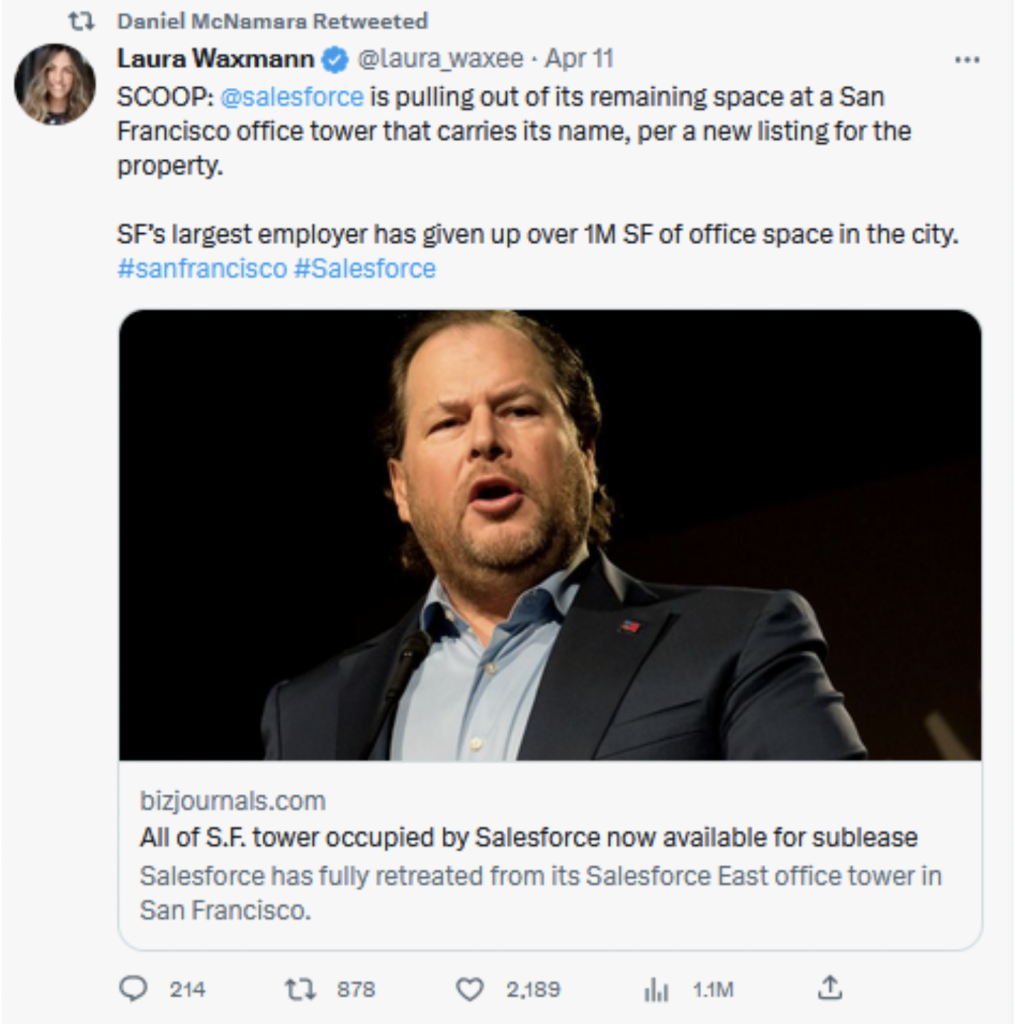
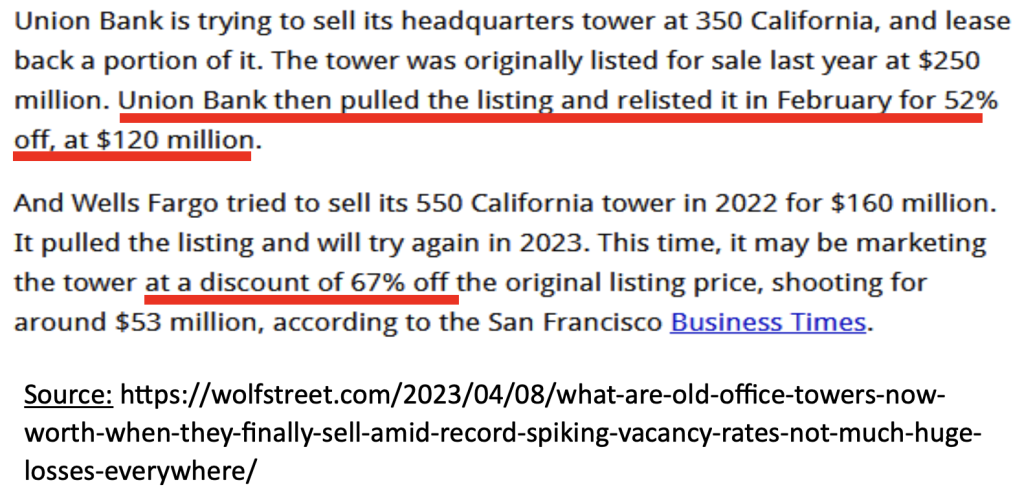
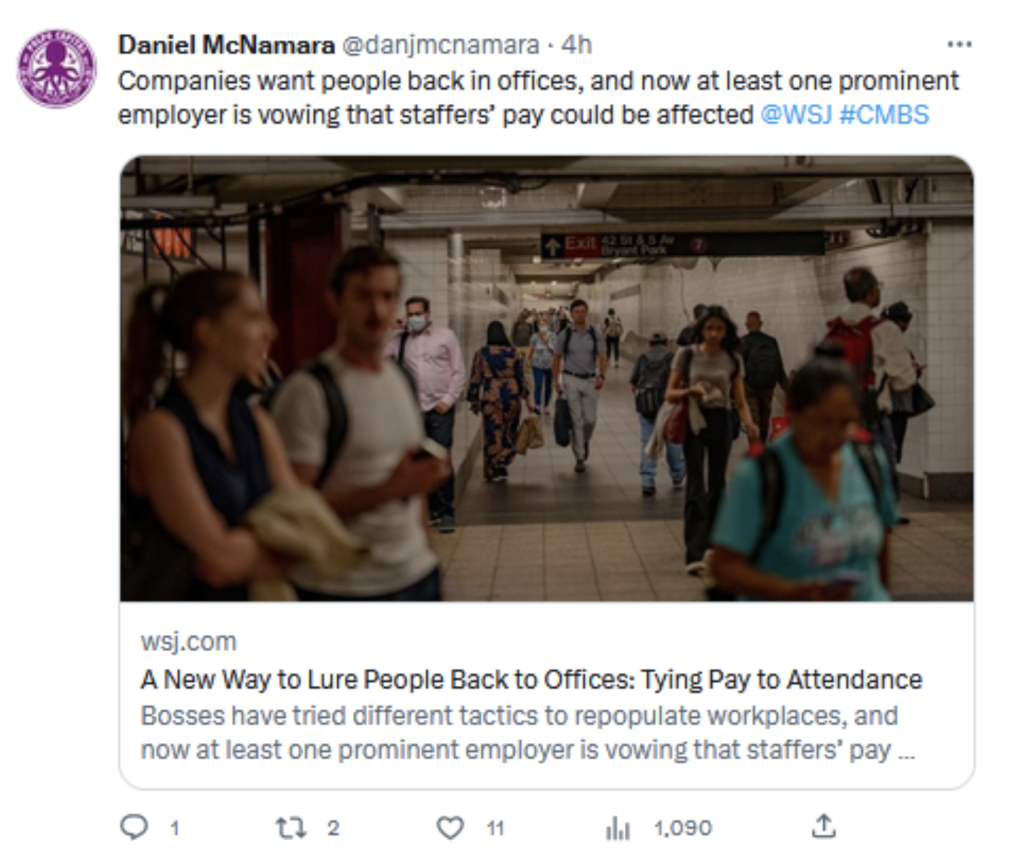
    I wanted to ask you about what your thoughts were on commercial real estate, because literally, if you go on FinTwit right now, everything is you are all going to die. Commercial real estate is going to crash. We have nobody going back to work in office buildings. New York. You’ve got New York. Even you’ve got San Francisco. That’s a whole different story. So what are your thoughts on that as far as how it factors into this real estate narrative?

    David

    In terms of the economic cycle, I really don’t pay a whole lot of attention to the commercial real estate part. And here’s why. The construction activity of the actual building of a construction of a building does feed into GDP accounting, but what we’re seeing now is a collapse in commercial real estate prices. And some people are going to take their lump. There will be some tiers, there will be some PNL losses. As long as it doesn’t feed into the credit markets and into the broader economy. As far as the cycle goes, I think it’s for the most part, not an issue. Investors will get burned, someone will get hurt. But in terms of GDP accounting, I just don’t see it really being a factor. Now, again, I mentioned actual construction. So fine, maybe new building development takes a pause, but we have record amount of money going into other types of non residential construction. Back in May, we got some data for the April release on non residential construction, and these numbers were completely off the charts. I have some threads up. I can’t recall them right now. But the idea was that with the Onshoring and the IRA, the Inflation Reduction Act, we’re going to see a lot of infrastructure, a lot of money pumped into infrastructure development.

    David

    And I think that’ll fill the hole that’s being left by any development in the commercial real estate space.

    Albert

    That’s interesting because a while ago we noted that when we’re talking about layoffs, one of the most robust sectors was the construction industry, specifically housing. We mentioned that verbatim. We’re like, where are all these layoffs? If we’re going to a recession, where are the layoffs in that sector? They just weren’t coming.

    David

    That’s right. So one of my recessionary indicators is the thumb rule where you basically get a 1% I’m sorry, I believe it’s a 0.5% increase in U three within six months of its most recent peak. And then there’s other recessionary studies, but my basic metric is 1%. If we see a 1% loss of non farm payrolls and employment, basically 1.6 million jobs, that’s where you start getting recession. Not just recession vibes, but it’s pretty much you’re into recession because history has shown it doesn’t stop at 1%. Once you have 1% job losses, it keeps going. But the question in my mind is what’s going to trigger this employment extinction event? What’s the economic media that’s going to come out here? Have you tried hiring a contractor? Have you tried getting someone to fix anything? Good luck. I’m looking personally. We’ve got three bathrooms to do. In our best case scenario, they’re going to be done in the spring. Okay? That’s our best case scenario. Between backlogs and supplies and just bodies that can hold a hammer and use a drill, they’re just not there. The bodies aren’t there. So what’s going to trigger the employment extinction event?

    David

    It’s not going to come out of construction. It’s not going to come out of any other sector that would have that much of an impact.

    AI

    With CI Markets, you can access AIpowered market forecasting for as low as $20 a month. Get 94.7% market forecast accuracy for over 1200 assets across stocks, commodities, currencies, equity indices, and economics. With weekly updates and one-month and three-month error rates, you can rely on CI Markets to help you make informed decisions. Join a growing number of satisfied users who already transform the way they invest and trade with CI Markets. Don’t miss on another opportunity. Start forecasting with confidence today for as low as $20 a month. Visit completeintel.com markets to learn more.

    Tony

    So when we hear about tech job losses, you’re not really all that worried about that.

    David

    Just on the numbers alone. The answer is no. If you go back to weekly payrolls, you go back to continuing claims. It’s just not there. It might make it for a great headline, but we’re not seeing the numbers. Obviously, weekly payrolls have softened a little bit, but the four week moving average is still well within my comfort zone. My comfort zone is when we see the four week moving average break at 330,000 and we’re, I think right now at 245 or something like that. So we’ve got a while to go.

    Tony

    And your answer on hiring contractor David is I’ve been watching a lot of YouTube videos, so for anybody who follows me on Twitter, I replaced my wife’s brakes last weekend. So that’s an incredible amount of trust from her to allow me to do that. But I think people are coping. They’re trying to cope to figure out how to do things for home repairs and for their car and other things when you can’t find I kind of joke about the brakes thing. I was just more curious about how to do it. But I think a lot of people are trying to figure out how to do it on their own because they don’t want to wait for seven to nine months to get something done right. And mean, that’s just that.

    David

    But I mean that’s for planned things. But you also have unscheduled things. What if you have a broken window or you need locksmith? I think is pretty easy. But something that happens and your HVAC goes down in the middle of winter, your heating goes down, what do you do?

    Tony

    Yes, very expensive. Okay. So if you just take a different position and let’s say there were something to happen in the next, say, three to six months to break down your thesis, what could some of those things be? Because a lot of people out there going, oh, this can’t continue to happen, it’s not this strong, things are going to break down. What could it be to break down your hypothesis in the next, say, three to six months?

    David

    I think the problems that we saw in the banking sector, if they were to expand and roll over into the general economy and really cause a credit contraction, but we’re just not there. I mean, part of that is just structural. After the global financial crisis, all the rules were rewritten the banking system and the economy had somewhat of an existential moment. The adults in the room said, never again, we’re just not going to allow this. We’re going to rewrite the rules. So now you’ve got the two big to fail banks that control most of the credit in radiation. A lot of some credit is local, particularly construction. Construction lending, real estate lending is very local. But for the most part, the credit flows that drive the economy come from the g SIBs. They’re too big to fill banks. So it’s out there as a possibility, but I see that more of as an economic meteor. Can it happen? Yes, likely. I don’t place high odds in it right now, is the answer. Okay, so that’s one area of concern though. Things did get a little dicey back in March, but it seemed like it’s contained for now.

    David

    I know that’s a four letter word after 2008, contained, but I think that’s where we are now.

    Tony

    Okay, so we could see a gradual deterioration in economy, but you’re not really seeing any near term shocks. That’s a question statement. Yeah.

    David

    I think the other shock could be obviously an energy shock because that energy is very inflation is very energy sensitive, and Headline in particular. So if you recall back to 2008, we were looking at $140 a barrel oil. That was, I think, the primary catalyst for a policy mistake with the ECB when Trisha raised through Europe into a double dip recession. I’m sorry, not double dip. First step was in 2008, the second was in 2011. But oil was really the catalyst. So we’ve been lucky where if you look at the price of oil and gas, they’ve come down significantly. I know Core is separate from that, but headline has been helped tremendously by a fall in gas. So if we have some geopolitical event or some kind of energy disruption, that could be another factor, I think.

    Tony

    Yeah, I think you’re right. I mean, geopolitical events, these are things that really can’t predict. Even geopolitical forecasters, it’s really hard for them to predict this stuff. Right. Except Albert, of course, because he’s got a great record. But I don’t know of anybody else who really predicts them as well as Albert. Okay, David. Thanks so much. For that. It’s an incredible call you made. You’ve stuck with it even when it was really not popular. And so I really wanted to highlight that and really underscore, how did you come up with this? And I think I’m hoping people look at that and really kind of check their initial conditions and look at their assumptions and then really run their own data, because we can’t take it from social media. We can’t take the narrative from other people. We have to check this stuff out on our own.

    David

    I think that’s absolutely right. I could have taken the Lemur study at face value and just gone with it. I think forcing myself to replicate the study made me get into the weeds and understand everything that I had to understand to make the call.

    Tony

    And every time you dig into methodologies, you find flaws and you find things where in some cases, it’s more detailed and effective than you assume. I love tearing apart methodologies so you understand that stuff. So that’s great.

    Tracy

    Okay.

    Tony

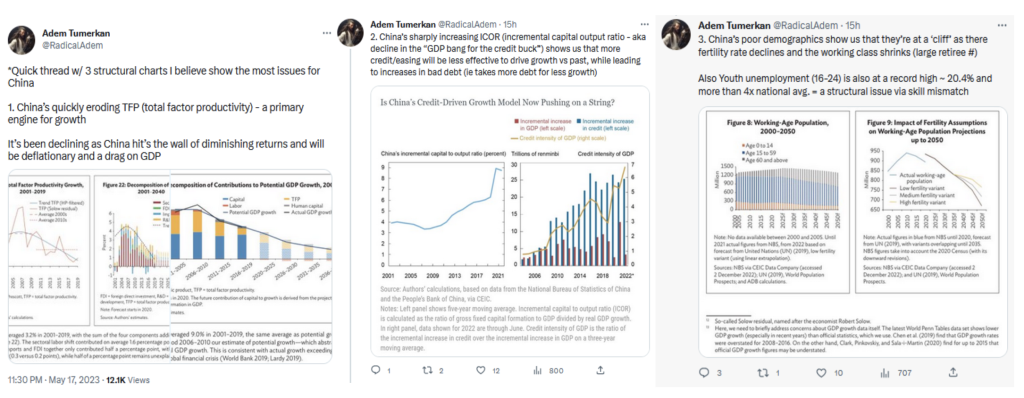
    Thank you for that. Hey, Albert. Let’s move on to China. China kind of seems to be in a little bit of kind of an inertia state. I mean, there’s just not a lot of movement. There’s not a lot of movement politically. There’s not a lot of movement economically. We saw the kind of sputtering restart in Q One. They’re still kind of not moving that much, although we saw retail sales grow, like, 14% or something like that. Although, admittedly, it’s on a closed economy. But we have things like youth unemployment over 20%, which should terrify the Central Committee. And we have this Blinken trip coming up this weekend, which I don’t really understand the point of this. And we have things like China’s foreign minister. We’ve got a story on screen where China’s foreign minister pretty much spanked Blinken on Wednesday before the trip, saying that the US.

    Needs to change and other things. So, first of all, I know there’s a lot to cover here, including the plunging CNY. But first of all, is there a point to Blinken’s trip to Beijing this weekend?

    Albert

    I mean, in Blinken’s mind, there might be, but not in anybody else’s. He’s not going to be meeting with anyone of significance. I mean, she certainly will meet with him, and I don’t even think the foreign minister might meet with him. They might give him to, like, a third or fourth string official just for photo ops, but that’s about it. Blinking has shown that in the foreign affairs world that he is a lightweight and destructive to the United States interest. So I don’t care, and I don’t think anyone else in the world cares about Blinken’s visit to China.

    Tony

    Right. And I just want to kind of direct people back to, say, 2021, when he went to Anchorage and we were talking about this, and he really didn’t look strong in that meeting. He really didn’t look like he was carrying a potent message then and again, the the foreign minister kind of spanked him in front of everybody, and he really hasn’t come back from that. He’s tried to take a hard line on things like Taiwan and other things, but he’s really looked more like an academic than a secretary of state.

    Albert

    Is that fair to yeah, that was intentional. I mean, the Chinese tested him and he failed, and he never recovered, and nor will he recover. He’s failed pretty much everyone in the world. So, like I said, besides Blanking, there’s a lot of things going on in China right now.

    Tony

    He’s done well in Europe, though.

    Albert

    Yeah, well, I mean, it hasn’t blown up yet, so I guess that’s okay to say.

    Tony

    Right? We don’t know. Right? Exactly. Okay. So I wanted to cover that off really quick, just in terms of what to expect from the blinken trip. Maybe there’s some surprise, but I don’t have huge expectations because I don’t think the purpose is clear, really, to anybody. As we look at China on the economic front, they’re desperately trying to get things back on track after that slow reopening. And we spoke in December and agreed that it would kind of sputter, and that’s what we’ve seen happen. As I said, retail sales came in strong. Youth unemployment is pretty terrifying, and we see the PBOC coming in with kind of a small loosening.

    But why has China been so slow to act? And what moves do you think Xi’s regime can do to accelerate things?

    Albert

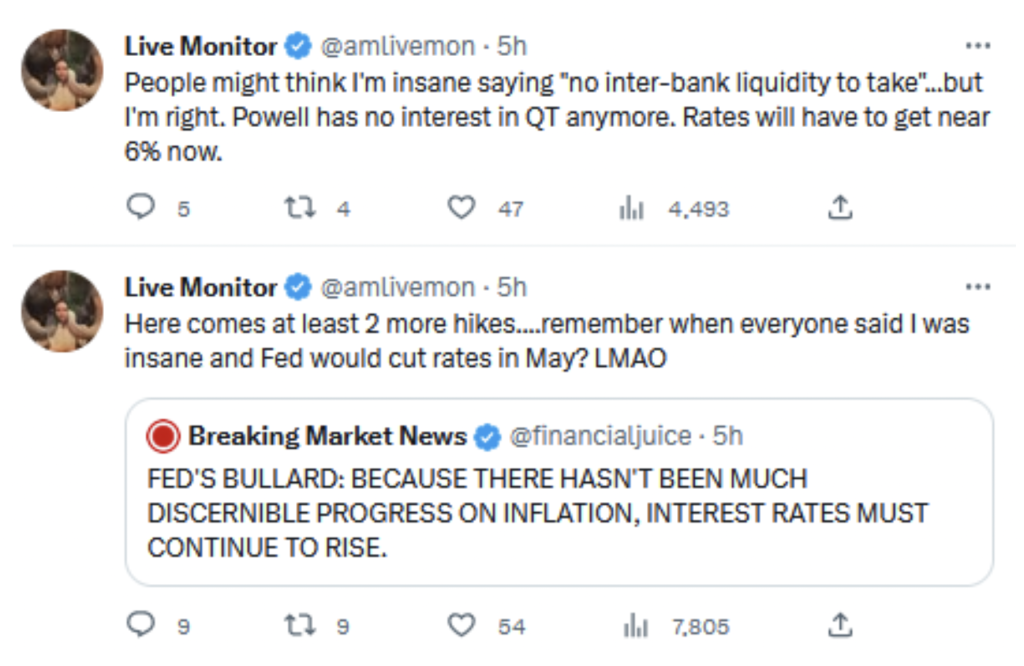
    Well, they’re right now facing an economic warfare against the United States. The Federal Reserve, with Powell and Yellen at the treasury and some of the blinking officials, along with Wall Street, have a concerted effort to push China down for political and economic reasons. How are they doing? Well, because they’re keeping rates up so high right now, 4.5% on the tenure is game over in China. I’ve been told by analysts in China and Singapore that it’s game over. They certainly weren’t ready for 6% Fed Funds rate, which everybody in Wall Street is talking about right now. And I think that’s absolutely coming. We’ve talked about it on this, that 6% should probably be where they stop, and it looks like it’s going to right now. The Federal Reserve with Yellen can keep us here at 5% rates for the long run, maybe two years, keep the economy between zero and half percent growth, and maintain where we are right now. And hats off to David that saw this data well ahead of anybody else in terms of keeping a recession away from the political scene here in the US.

    David

    Can I jump in there on your point, Albert, about the US. Economy? The strength, I think, is being underestimated, underappreciated. So going back to the housing call, I looked at fixed residential. I went to the GDP, national accounts line by line, and fixed residential investment was the catalyst for it. Was net GDP subtracted from GDP in 2022 in late winter early spring I did a thread discussing fixed residential investment. My hypothesis was that we didn’t need it to get better. We needed to get less bad. And if it got less bad, given the resilience of the economy, that could potentially moonshot. Things fair enough. Q one GDP comes out. We were expecting I believe -0.6 subtraction GDP and we got -0.4 so there was a marginal less bad, marginal improvement and I think that’s going to continue. And if that continues, I do think that this whole idea we’re going to cut rates that gets kicked out farther than we think. So I’m just trying to go back to your point that this economy is going to run a lot hotter than people think rates will stay higher and that’s going to put the pressure on that you were discussing.

    Albert

    Yeah. Let’s be clear here. Four and a half percent on the ten year and 6% Fed fund rates means that all the money in Asia is going to come right back into the United States, which is bullish for equities. And we can discuss about what that really means for the market, I mean, for the economy overall, but that’s what’s going to end up happening. And from their perspective, it’s better for China to defend themselves from going over in the abyss than actually take on the United States globally. And that’s the general thinking right now. When it comes to inflation, they got it somewhat handled because they have a team that deals with commodity inflation in the futures market.

    Tony

    Chinese or the American?

    Albert

    No. The US. Has a team of like two dozen guys that handle this in terms of commodities in the futures market. And it’s under the whole national defense sort of mantra. But with inflation somewhat in the four and 5% area and wage inflation gaining steam, that keeps the populace at least at bay and not have pitchforks and torches coming for congressional members.

    Tony

    When you say economic warfare, is that intentionally against China or is it something where US. Economic officials are really just trying to keep the job market in a good position and put a damper on inflation? And then a secondary effect is the impact on China.

    Albert

    I’m 50 50 on that one. Right, because it’s certainly directed towards China. But Yellen knows that if you attack China and Asia in general, all that money comes right back into the US. Economy and the US. Market. It’s a little bit of 50 50 from my perspective.

    Tony

    Okay so from your perspective what can China do to all these headlines over the past couple of weeks talking about China needs to rally they need to circle the wagons and figure out what they’re going to do with their economy. What can they do just spend more money domestically build more bridges and high speed rail and all that stuff or.

    Albert

    Devalue the one that’s the only option to do it. That comes with other ramifications that a little bit over my pay grade, but that’s their only option is to devalue.

    Tony

    Well, it’s domestic inflation in China. Right? So they’re going to goose their exports to compete with Japan and Taiwan and Korea. But that comes with more inflation at home. Is that fair?

    Albert

    Yeah, it is. But inflation there is kind of tame. They have control over the economy more so than anybody else does. So they can tame inflation, at least on a numbers basis of what they put out, because we all know that data. That data is all the time inflation.

    Tony

    Data in every country. There is no country inflation data is accurate.

    Albert

    Yeah, of course. Even in the United States. I mean, they manipulate things with unemployment, inflation data and CPI all the time. But it’s interesting you mentioned Japan. This is eerily similar of what Japan went through in the 80s.

    Tony

    Tell us more about that.

    Albert

    No, I’m just relaying what I’ve been discussing with clients and friends in Wall Street, and this is exactly what the Japanese had gone through in the they’re pushing it onto the Chinese. The Chinese could have an inflation problem. Their growth is stagnant at the moment. Their demographics is not that great, and they’re fighting against the juggernaut in the United States.

    David

    China looks at the past 25, 30 years and they see two things that they don’t want to be. They don’t want to be the Soviet Union and they don’t want to be Japan. And I think both those things terrify them for a host of reasons. But those two things are the third row that they want to stay away from.

    Albert

    Yeah, that’s exactly right. And that’s why I’ve always dismissed any kind of Taiwan invasion, because that bring back the Soviet mentality of taking on the United States geopolitically. They don’t have the money for it. Let’s just be honest. They don’t have the money or even the nerve to do something like that. And when it comes to the Japan comparison, they really don’t want an economic collapse of their manufacturing sector.

    Tony

    Right.

    David

    David. What?

    Tony

    You mentioned about the Soviet Union in Japan. That’s absolutely true. They’re terrified of that. But when you talk to their bureaucrats, particularly, they’re also somewhat arrogant about we won’t be that because we’re different. And so there’s kind of both arrogance and fear about becoming either one or both of those. And it’s kind of weird because they’re moving in the direction of both. They’re going to fight really hard not to become one or the other. And I’m not saying they will, but I think that the possibility of that is becoming more real by the quarter, let’s say.

    David

    I think that’s right. China’s biggest problems are problems that they can’t resolve through war or through geopolitics, whether it’s their demographics and their birth rate that’s falling off a cliff, whether it’s water, their environmental issues are horrific. The Gobi desert. Continued when I was in Beijing, back when I was in graduate school, living in Singapore. Took a couple of trips to Beijing. There are always sandstorms in Beijing because the Gobi Desert is encroaching upon Beijing. It’s just one environmental catastrophe after another, going back to water. This is why they got their eyes on the Himalayas, for that Himalayan clean water source, which, aside from food, you also need for manufacturing. And I think this is where the United States has a huge geopolitical edge. We are very geographically advantaged versus most of the world, if not the entire world. Our water resources. We got the Great Lakes. We have the watershed that goes through the Appalachian Mountains, the watershed that runs through the Rockies. We have all these massive watersheds that we could leverage off of for both food and for manufacturing. China does not have that, not even close.

    Tony

    Well, and as China tries to take the Himalayo Mountain watershed, they’re upsetting everyone in India. And all of those tensions taken together are just a nightmare for China. China as a governance subject is incredibly difficult. I think most people on this side of the world look at China and believe it’s this monolithic government, and Xi Jinping makes a decision, and then it happens. It’s not that way at all. It’s just chaotic. And so, given all of these challenges they have, as well as the challenges within governance, it’s incredibly, incredibly difficult for them to tackle one of these, much less the gamut of all the challenges.

    David

    They have their governance. Really, the basis of governance in China is patronage, whether that patronage is family or whether it’s friends or political cronies, but it’s patronage. So the things that make governance good, such as competitive politics, don’t really exist in China. Obviously, the Communist Party’s monopoly on political power. But without that kind of competition, you have a lot of patronage favor occurring that might not lead to optimal outcomes. And then you magnify that across the country, different levels municipal, provincial, national it’s just like a real cluster bomb of bad governance and bad incentives.

    Tony

    Oh, it’s a competitive political environment, all right. But if you lose, you die. Like, literally.

    Albert

    I’m glad David pointed out all those things. Very few people actually in the financial sector actually take into consideration all these other things like water, fresh food, defense, and all these other components that make a superpower what a superpower is. I mean, all we’ve been hearing is that China is the next superpower. It’s taken on the United States, ABC and D reasons and so on and so forth, but they completely forget that they don’t have any kind of arable land at the moment to feed themselves. They’re in a battle with India, which is a nuclear power, for God’s sakes, for water that supplies a billion people on one side and a billion people on the other side. And these things are not to be taken lightly. I mean, you can’t just gloss over these things and say, oh, well, China is just going to take over Taiwan and US can’t do anything about it, and so on, and they’re going to move into Africa and South America and this and that. It’s far more complex and the details that they but actually pointed out, it’s spot on.

    Tony

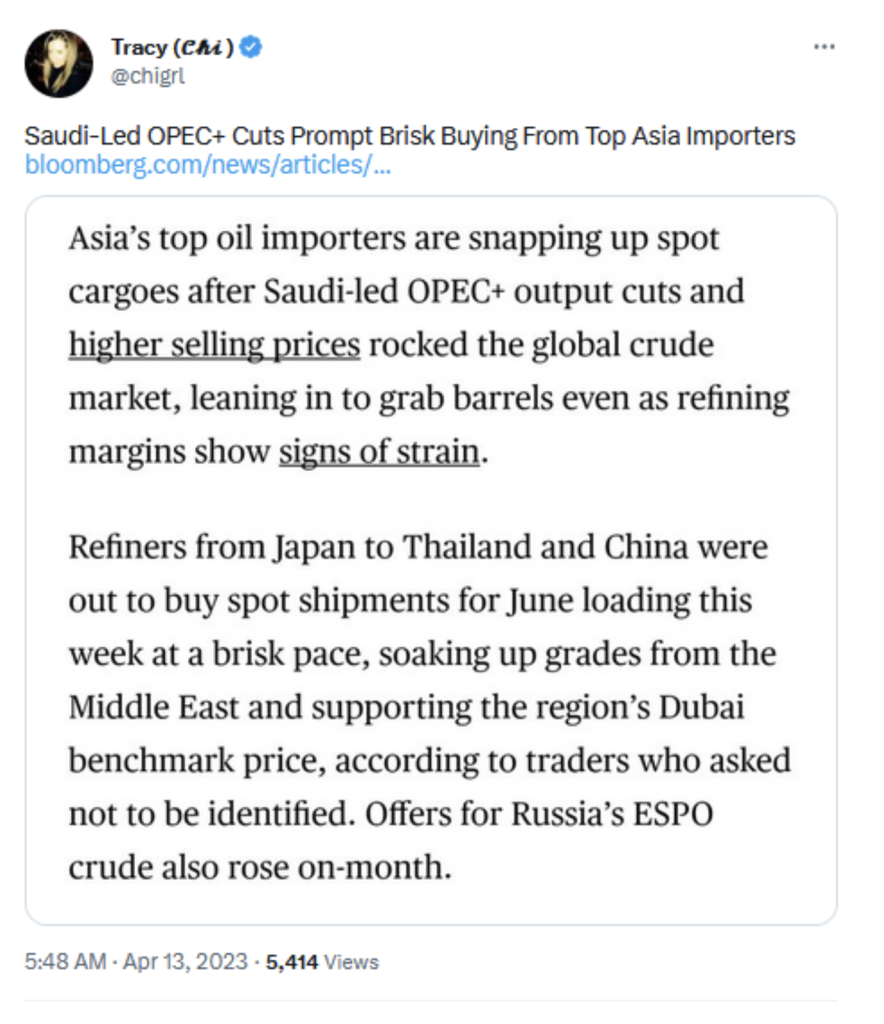
    Great. Okay, guys, thanks for that. Tracy, let’s move on to natgas because we’ve seen some real interesting activity in natgas over the last couple of days. We’ve seen an interesting bounce. And so you put out a tweet on China’s natgas traders this week, surprised by the bounce in the market. So that’s very interesting to me. It looks like they were caught off guard.

    We saw natgas up 9% this week.

    But if we put that in context, that’s kind of a slight rise. It’s not like it’s completely market changing. What are your thoughts on this? And are we finally seeing some strength come back into the Nat gas market?

    Tracy

    Well, I mean, to be honest, this is a non sequitur for the US. Market. At this juncture. We’re going to have to see major drawdowns in either Asia or Europe to really get this market going. Yes, we saw a bounce, but if you look over the long term out to the US nat gas futures markets when this contract started, we’re still in that same long term trend that we have started in since 1996, when this contract started. So we’re still in that very comfortable zone in the US. Where we’re one dollars, $3. We have seen spikes over the last 30 years, but we’re still in a very comfortable zone just because of the amount of natural gas we produced. Yes, we did see a spike in prices in the TTF contract, which is the European contract that was due to Norway. Norway had to shut down one of their processing plants. And then we also had that news that the Netherlands was shutting down their largest natural gas field, but we did see price rise 70%, but it came back down 20%. I think that altogether, if we look at this Nat gas situation altogether, I just don’t see still at this juncture where we’re going to see natural gas prices rise.

    Tracy

    The United States, if that’s where we’ll be looking at Nest, has nothing to do in the immediate term. Let’s just say that because we’re just still producing a lot of natural gas, and even though we’re exporting to other countries, we still don’t have those long term contracts. We still are spending money building out export facilities in the Gulf. The United States in particular is a very different situation than we would see perhaps in Europe right now. And so I think looking at their particular situation, we’re going to see higher volatility in those kind of markets. Because if production goes down in one country or is mitigated in one country, they’re going to see a price spike. Unlike the United States, if we see, say, the permian doesn’t produce as much as they usually do on one week, that’s really not going to change the overall situation in the United States just because of the amount of natural gas reproduces the whole. So if you’re looking for this bump in natural gas prices in Europe and in Asia, I don’t think that’s really going to manifest itself exactly right now in the US.

    Tony

    Okay, so let me go back to something you said. Why are the Dutch shutting down the largest field in Europe?

    Tracy

    Well, because without I don’t want to.

    Tony

    Make no, just be yourself.

    Tracy

    Say what the situation is. The climate activists are saying this is causing earthquakes and everybody’s dying. And we all know kind of where the Netherlands is kind of down as far as if we look at the farmers and what they’re looking at as far as shutting down farming and fertilizer production, ammonia, et cetera. So I think this is, again, without upsetting anybody, I think that this is just another step where we see a little bit of hysteria that kind of causes a backlash as far as what we’re looking at as far as energy security is concerned. And actually, if you go to Hilltower Resource Advisors, one of our analysts just posted a great post on that.

    Tony

    Okay, great. Hill Tower Resources. Advisors. Right.

    Albert

    Yeah. These are just born from bad political decisions for politicians in Europe trying to safeguard their seats and their parliament. That’s all it is. They cater to the Green parties and they come up with bad economic policies.

    Tony

    Okay, go ahead.

    Tracy

    Sorry. What I’m thinking is I’m addressing this towards you, Albert, actually, because you just brought this up, is that if we’re talking about do you think that with elections coming up, that we’re going to start seeing a backlash? Because we just saw like, say, the Green Party in Germany fall from 22% to 14% over a very short period of time. So do you think with upcoming elections we’re going to see sort of a change in stature of these parties because they’re going to lose votes?

    Albert

    It depends. It depends on the country and the situation and the parliamentary makeup of each of the countries. Let’s just take Holland, for instance, one of my non favorite countries in the world. But Root has a liberal majority in his parliament. For him to stay in power, he needs that liberal majority. So in order to keep those seats, he’s going to have to cater to those people, and that means more Green initiatives to the extreme. Now, of course, if the economy starts to tank and inflation takes hold in Europe and the banking sector starts to falter, those are scenarios where, yeah, it could tip a lot of elections over back to the right. But the problem is the European elections and the way they do their government is a parliamentary system. So they don’t necessarily need to win the majority for their party. They just need to have a coalition that takes a majority.

    David

    Albert, what impact do you think going on? What Tracy mentioned and this whole topic of Green politics with the war in Ukraine and Russia, I think it’s the energy dependence that Germany in particular saddled itself with with respect to Russia that just kind of blew up in their face. And that has implications for a lot of the Green policies that were championed, namely getting rid of nuclear. So do you have any insight on how the war is impacting? Is there going to be a revisit of these green policies to maybe not repeat the same geopolitical mistake or experience?

    Albert

    Well, that’s going to really depend on what happens in the winter of this year. They had a mild winter, so it kind of eased up on the pressure that the European politicians had to deal with. But let’s just be clear that Europe is, like I’ve said, for weeks now in a zombie state in terms of their industrial output. Right now, they’re not really working. There’s not very many things being built over there. They have a drought that’s still pretty significant in Europe and actually getting worse. So that’s going to affect the shipping, like Tracy mentioned, I think, like six months ago up the river of the Rhine. They can’t ship materials back and forth because the water levels are too low. So there’s a lot of things that have to be taken into account. So it’s not really, let’s wait and see how the winter goes and then we can readdress what policies they’ll probably have to look into concerning green initiatives.

    Tracy

    We’re already seeing problems as far as supply is concerned with summer coming along. Right. Although Europe is not a big consumer of air conditioning like the United States is, we’re still seeing a large drawdown because temperatures are over 20 C there. We laugh in the US. I know, but that’s a big deal for them. We’re seeing this in the UK, we’re seeing this in summer is just really starting. And again, I think I mentioned this and everybody was skeptical about it. I mentioned this on this podcast months ago, that we should look to summer because air conditioning would be a big drawdown for this. And I saw a lot of the comments saying, but they don’t have a lot of air conditioning. It’s not like the US. But yet we are seeing this happening. So I think we need to pay close attention to this. I think right now, especially again, we’re seeing a drought again. So from Rotterdam to Germany, we’re going to have a problem on the Rhine again this year that’s going to mitigate heavy vessels that carry crude and gas products to Europe. People don’t understand when water levels are low, you can’t have those heavy vessels coming.

    Tracy

    So this is what we had. This is part of the problem that we had summer of 2022. And this looks like this might be a problem again.

    David

    I was visiting family in southern France last summer. I was in Provence just outside of Avignon, and the Roan was really low. There are parts of the Roan where you could basically flatbed looking some boats that were just on their side. So this water crisis is not just in northern Europe, but it’s also on the more Mediterranean south as well.

    Albert

    Italy’s had a big problem, too, with water levels. I think the Pole was showing, like, historical markers from, like, four or 500 years ago of droughts. It’s a problem. And the mild weather kind of mitigated how much pressure the Russians could really enact on the energy market. But they get a cold winter and the Russians want to get nasty. Look out for Europe.

    Tony

    Yes. So, Tracy, if they can’t transport product by river, do they transport it by rail or truck or do they just not transport it?

    Tracy

    Well, what they do is they have to take that product and put it into lighter vessels. In other words, through there you can’t get an apple. You got to go the smallest. They start taking that product, they’re not going to let people go without energy. So what you have to do is you just have to start putting that project into smaller vessels that can transverse that river.

    Tony

    Okay.

    Albert

    If it’s not lighter vessels, it’s actually one third of the cargo capacity to keep the boat lighter and afloat higher. But that increases the cost of shipping.

    Tracy

    Which increases inflation, which also creates another problem. Exactly.

    Tony

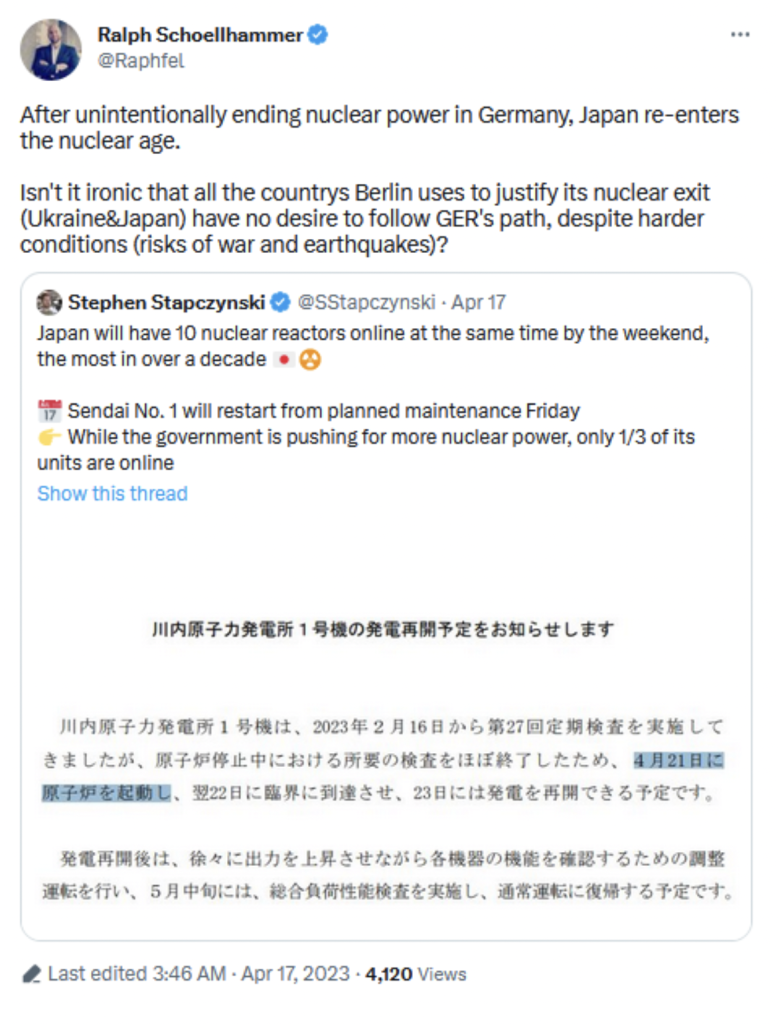
    Okay, then just kind of final question is I’m really interested in this closing of the field in Holland. And I know that sounds a little bit pedantic, but it kind of reminds me of the reactionary close of the nuclear stations in Germany in 2012. So are we watching Europeans do things that they may regret in 5678 years and then reverse trend on this stuff?

    Tracy

    Well, absolutely. All you have to look at is the deindustrialization that is happening exactly right now in Germany and then take that model and place that across every country in the EU that is following those exact same protocols. Right. And we’re seeing that we’re seeing chemical production flee to China.

    Tony

    Yeah, you’ve talked about BASF and other.

    Tracy

    Companies that have so we’re seeing all these people go to other countries that are much more amenable to this kind of business because it’s too expensive.

    Tony

    So when you talk about these guys moving, is it the access to energy? Is it the kind of environmental arbitrage they can go and do things in China environmentally, is it a number of things. Is it wages?

    Tracy

    It’s a number of things. It’s the cost of doing business as far as energy is concerned because obviously, industrial manufacturing, et cetera, is very energy intensive. So it’s the cost of doing business. They asked companies to limit their energy use 15% last winter. That hasn’t been lifted yet. And it’s costing them ten times the amount that they were paying before. So of course, they’re leaving to other countries that may incentivize them. And that’s not only China. This is what Europe is also worried about is that industry is going to move to the US. Even, right?

    Tony

    The Inflation Reduction Act.

    Tracy

    Well, yes, which is reduction, which is not reducing any sort of inflation, but it does provide incentives to companies to move over to the United States if they want to because they get a bunch of tax credits. Now, that doesn’t influence us as taxpayers. But as far as business is concerned, if you’re looking to pay less, your options are China and the US. Mexico mexico is great, but that’s a whole nother subject.

    Tony

    Love to dig into that at some point. So let me ask one final question of all you guys. Albert talked about how us Officials, Fed, treasury are either directly or indirectly conducting economic warfare on China. But as we’ve talked about with Europe, they’re a little bit handicapped with their drought and their electricity prices and power and all sorts of things. And we have the economic policies of the US. Is that same kind of economic warfare kind of activity is that also impacting Europe in either a direct or indirect way? And how do the Europeans feel about that?

    Albert

    Of course it is. I mean, the Europeans, let’s be clear, it’s really Germany and France and maybe Holland, but they’re the economic engines of Europe. And right now they’re so blinded to where they think that China is the only emerging market share that they have available to them, which is just incorrect. But that’s their goal right now, is to safeguard that market share in China by any means necessary. And that means it’s going against the United States, which they’ve been clearly vocal on for the past six months or so.

    Tony

    David, what do you think about that?

    David

    Yeah, I don’t have any real insights into that. It’s kind of above my pay grade.

    Tracy

    I don’t want to speak for the people. And all I can say is what we’re seeing in companies within countries is that we are seeing transverse from obviously we’re seeing industry move from Europe to China and to the United States. Again, I don’t know how these people in these countries feel about this. I can only speak to what we are seeing business wise and trends.

    Tony

    We are seeing great guys, thank you so much. This has been really fantastic. David, thanks for joining us for the first time. I appreciate that. Hope we can ask you back. And Albert, Tracy, guys, thank you very much.

    Albert

    Have a great week and a great weekend.

    David

    Thank you. Thanks for having me. Take care. Have a good weekend. Bye.

  • Stagflation in 2024 and the SEC’s Crackdown on Binance & Coinbase

    Be a smarter trader/investor with CI Markets. Learn more: https://completeintel.com/markets

    In this episode of “The Week Ahead,” Tony Nash hosts guests Doomberg and Albert Marko to discuss two key topics: stagflation in 2024 and the ongoing clash between Binance and the SEC.

    Tony highlights the survey results showing significant concern among respondents regarding stagflation. Albert discusses the impact of economic and political policies on persistent inflation and believes that the stagflation argument may be more of a “stagflation light” scenario due to the resilience of the service industry and ongoing market rallies. Tony adds additional points, including the IBD economic optimism index remaining below expectations and signs of cracks in the middle-class economy. They acknowledge that inflationary pressures, rising prices, and elevated interest rates contribute to declining optimism and a challenging economic landscape.

    Doomberg provides insights into the counterintuitive inflationary effects of rapid interest rate hikes and discusses potential impacts on oil prices due to changes in the US shale industry and rising housing costs. He suggests that global stagflation in regions like China and Europe could have a spill-over effect on the US economy.

    The conversation also covers arguments against deflation, with Albert highlighting wage inflation as a factor preventing deflation. They discuss the challenges of US debt, the impact of inflation on household costs, and potential signs of deflation in the commercial real estate sector.

    Shifting to the energy sector, they discuss the potential impact of stagflation on energy, mentioning challenges faced by the oil industry if prices fall below $65. They highlight the tight supply of oil and gasoline, contradicting claims of low demand, and discuss the role of electric vehicles and the divergence between physical and paper markets.

    In the cryptocurrency industry segment, Tony and Doomberg address the legal issues surrounding Binance and Coinbase. They discuss accusations of unregistered securities and criminal activities by these platforms. They emphasize the potential consequences of disregarding rules in the cryptocurrency industry and the need for stronger regulatory action.

    The discussion concludes with a focus on the recent actions of the SEC in relation to the cryptocurrency market. They discuss the challenges of regulation, the susceptibility of the regulatory apparatus to corruption and political forces, and the erosion of trust in the SEC. They also highlight the need to address pump-and-dump schemes and the potential expansion of investigations into the venture capital space.

    Key themes:

    1. Stagflation in 2024
    2. Binance & the SEC

    This is the 68th episode of The Week Ahead, where experts talk about the week that just happened and what will most likely happen in the coming week.

    Follow The Week Ahead panel on Twitter:

    Tony: https://twitter.com/TonyNashNerd
    Albert: https://twitter.com/amlivemon
    Doomberg: https://twitter.com/DoombergT

    https://open.spotify.com/episode/5QwownXwQuyDC9bRae96gl?si=ec641c59f74a419b

    Transcript

    Tony

    Hi, everyone. Thank you for joining us on the Week Ahead. Today, we’ve got a couple of great guests. Today, we’ve got Doomberg. We’re going to talk in detail about crypto and Binance and a lot of the crackdown from the SEC. We’ve got Albert Marko. We’re going to talk about Stagflation and expectations for 2024.

    Tony

    So, guys, thanks for joining us. I think we’re going to go a little deeper into these two areas than we normally do on our topics.

    Tony

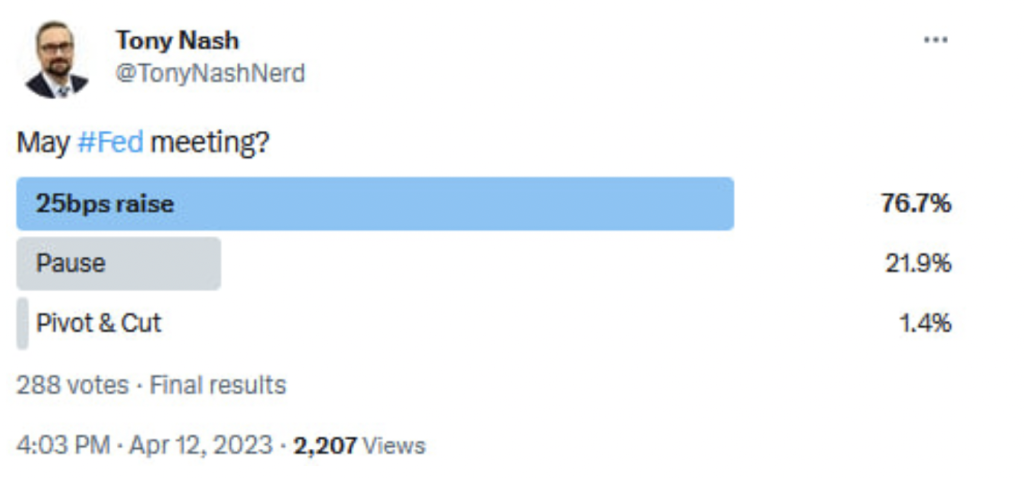
    So, Albert, let’s start with you for Stagflation in 2024. I ran a quick survey last week and I know this isn’t super scientific and whatever, but I was really surprised that Stagflation had such a large showing in the responses.

    Can you just help us understand why people are thinking that? And what is your view on Stagflation inflation deflation in, say, late 2023, going into 2024?

    Albert

    Well, I’ve been a proponent of inflation being sticky and staying elevated for quite a long time. I mean, the political policies, economic policies, have not fixed anything in the past two years. So, in my view, inflation just will stay elevated for quite probably next two, three years. The problem with the Stagflation argument I have, it’s more like Stagflation light, in my opinion, that we’re going into late 2023 and into 2024. The issue is unemployment. Sure, we can discuss the BLS manipulation of unemployment and job numbers and so on and so forth. However, the service industry is just banging hot still. It’s not coming down. It’s partly affecting inflation. Dewensberg is also going to throw in there some inflation comments, but the problem is now we have the treasury and the Fed shifting from tech stocks to growth stocks and pushing that up. And they’re pushing inflation and they’re pushing the market to rally. It’s hard to have a full Stagflation argument going forward when just unemployment is just not anywhere where we need it to be to see an actual recession.

    Tony

    Yeah, those are good points. Let me throw a couple of other things at you. We have this IBD economic optimism index that came out this week, showing the optimism is well below expectation. It’s at 41.7. Of course, that’s an arbitrary index, right? But on a relative basis, it’s not picking up.

    So we’re seeing employment officially looking pretty good, but we’re seeing optimism kind of flatline, even as other things kind of we see interest rates come up, we see the banking crisis hopefully getting resolved, all this other stuff, but we don’t really see optimism picking up, even as wages have continued to rise at least slightly. We also see Cracker Barrel, which we’ve talked about several times here.

    And Albert, I just want to acknowledge you’ve been very persistent on your view of inflation, even when it really wasn’t popular. You’ve been very persistent on that. But Cracker Barrel is a pretty good bellwether for what’s happening in the heartland of the US. So for people not in the US. This is kind of working class, middle class place that people go to eat and cracker. Bell had a lot of pricing power over the past, say, 18 months, when wage pressure, when when direct cost pressure and other things would really hit them, they would add that to their costs and they had double digit price rises in 2022 and it really didn’t impact their volume.

    Tony

    But now, based on their most recent quarterly report, they’re saying they’re seeing a meaningful traffic decline which negatively impacted their sales and profits. And they talk about their traffic being down as well. I hear what you’re saying about jobs, but I do think we’re starting to see some cracks in the middle of America where we just didn’t see that before. Say two months ago, the middle of America appeared to be super strong and we’re seeing some of these telltale signs that there are some cracks.

    Albert

    Yeah, of course. Inflation is such a headwind right now for normal people, you’re still paying 20, 30% more for items. On top of that, wage inflation is forcing companies to increase prices on products continuously. And let’s be real, once you increase product prices, you’re not bringing them down. You might bring them down 5% to be competitive, but they’re never coming back down to pre COVID levels. That’s just the fantasy. It’s simply not going to happen. So that’s most likely why we’re looking at this optimism trending down and on top of that is like the rate, the rate staying elevated, which I still think we’re going to go to 6%. Fed fund rate is also inflationary.

    Tony

    Yeah. Doomberg, what’s your thought on this?

    Doomberg

    Yeah, I think if you think about counterintuitively, and I should say in full disclosure, I first came across this concept reading Luke Roman’s work, great stuff at Force for the Trees. And he, of course, was quoting others. And that’s the way content works. You consume a bunch of it and distill it and create your own thoughts. But there are actually three reasons why the speed and heights with which interest rates have been risen to are actually counterintuitively pretty inflationary. One, we’ve never raised rates at this speed with this much debt before, and so the interest payments are actually just a different form of fiscal stimulus. Now. That stimulus goes to a different audience, wealthy investors, upper middle class and beyond. But still, with $32 trillion in debt and another couple of tens of trillions to be added in the next few years, a post debt ceiling deal, when you are at 5% interest, that becomes a pretty big slug of fiscal dollars going out the door into the economy. And that in and of itself is pretty inflationary, especially if you don’t trigger sort of the economic slowdown that you would want in order to beat back the forces of inflation.

    Doomberg

    The second reason why elevated inflation interest rates is actually pro inflation is the oil patch. So we all know that easy money and low interest rates caused a lot of sort of uneconomic projects to be funded in the US shale and shale has been responsible for 90% of the world’s growth in supply in the past decade and a half, and that’s coming to an end. And if we see production, particularly in the Permian Basin, begin to roll over as the best fields get exploited and there’s not as much cheap easy money to fund the incremental drilling project, we could see upward pressure in oil prices despite a potentially slowing economy. And then the third is actually this impact on housing. So you have all these people sitting on mortgages that are really attractive and so they’re not going to sell their home. If you’re sitting in Florida and you have a 3% 30 year fixed mortgage, you’re not putting that house on the market with mortgage rates at 7%, which means the incremental supply of housing is just not there. And so home builders and new housing costs are just skyrocketing. And that’s a big measurement into inflation as well.

    Doomberg

    And the only other thing I would add is this talk about whether the economy is slowing. Is this sort of the US. Participates in a global market and and the US. Might be doing well because of its relative energy advantages. But if you look at places like China and Europe, we are seeing pretty significant slides of stagflation on the global scale. And at least some of that will leak back into the US. As well. So that’s the only thing I would add to the great points that Albert was making.

    AI

    With CI Markets, you can access AIpowered market forecasting for as low as $20 a month. Get 94.7% market forecast accuracy for over 1200 assets across stocks, commodities, currencies, equity indices and economics with weekly updates and one month and three month error rates, you can rely on CI Markets to help you make informed decisions. Join a growing number of satisfied users who already transform the way they invest and trade with CI Markets. Don’t miss on another opportunity. Start forecasting with confidence today for as low as $20 a month. Visit completeintel.com markets to learn more.

    Tony

    Okay, so guys, why are we not hearing more? Like, why do you think deflation is not going to happen? Help me understand the arguments against deflation.

    Albert

    I go right back to wage inflation. I just can’t see as long as wages are coming down and unemployment isn’t really skyrocketing, I don’t think we even have a chance of disinflation or deflation or whatever, any kind of negative inflation. To go back to what I’ve said previously before, it’s like, hey, to get back to pre COVID levels, we need negative CPI prints.

    Doomberg

    That is simply not happening.

    Albert

    We’re nowhere near such a thing. So, I mean, all these CPI perks that are ongoing, just like Doomberg said about the housing market. And as I was pointing out towards unemployment, where do we see deflation even coming here. I can’t even make an argument for it.

    Doomberg

    Yeah. The only thing I would add is you would need a real substantial slowdown in the economy and perhaps even a popping of the everything bubble. But even then, imagine a world where the Fed has to monetize all the incremental debt. Like, we just look at the spending and the interest payments on the debt and the entitlements alone. We’re getting to the point where if we weren’t the reserve currency, you’d be sort of staring in the face of a typical emerging economy debt spiral. At some point, when you’re spending hundreds of billions of dollars a year just in interest payments, and then you have all these programmed entitlement increases that are tied to inflation, a lot of these promises aren’t monetary. They’re actually like the physical delivery of goods, these entitlement spending. And so it’s a real I don’t know how we get out of it.

    Albert

    Yeah. The benefit that we have being a reserve currency, there’s absolutely no competition in the world to hold us accountable for our misgivings. They can do whatever they want. It’s bad in the long run, but I don’t think that any of us will be alive to see it. But at some point, just like you said, the chickens have to come home to roost.

    Tony

    Okay. And again, I’m sorry to push on this, but if we take that from the national, say, accounting and monetary level down to, say, a household, okay, we have inflation that’s really risen, what, 20% over the past two years. Right. Things are generally is that fair to say, Albert? Say 20% higher over the last two years?

    Albert

    Yeah, absolutely.

    Tony

    Some cases more, but on average, probably 20% higher than two years ago. We haven’t really seen 20% pay rises across the board, necessarily, although we’ve seen some decent pay rises in pockets. We have household costs. Like the cost of buying a house is at. These interest rates are pretty expensive for, say, middle class and entry level people buying their first house. I hear the argument many times that people who are locked into a low interest rate, so they’re not going to move unless they have to. Right. But if people are so leveraged up, will we not see people refinance in order to tap that equity and that will cycle into higher interest rates or higher mortgage rates for those people? Do we see that as happening as a way for people to tap more equity to alleviate some of the short term credit?

    Albert

    No, I don’t think we’re going to see that only because I think the Fed and the treasury made it explicitly clear to a lot of the banks to stop doing stop lending. The credit tightening cycle is certainly upon us, and they’re really wise to that little game.

    Tony

    Okay. And then I saw an interview with somebody, I can’t remember who it was, saying that, really, housing has a lot of room to run given where interest rates are. Is that realistic or is that a silly argument? I mean, I just you know, I live in Texas where housing is doing continuing to do really, really well. I know on the coasts housing has taken a significant hit, but it’s relatively small in terms of the run up that it’s taken over the past couple of years. So is there room to run in housing in the center of the US or maybe in Florida?

    Albert

    I don’t think so. I live in Florida myself and the cash buyers are starting to disappear. Without cash buyers, I don’t think this housing market really has too much more run on. Just the interest rates are astronomical. I mean, I went to go buy a lot close to my house and they were asking for like 9.2% interest rate and I just simply not going to do that.

    Tony

    Right. What do you see?

    Doomberg

    Well, back to this. Where could we potentially see signs of deflation as long as we’re talking about real estate? I think if we look into the commercial real estate sector, it’s a completely different story. And as people are working from home and they’re not going back to the office, there’s a wave, and I mean a wave trillions of commercial real estate loans that need to be rolled over that are basically underwater. The equity tranche is effectively wiped out even if they haven’t marked it yet. And this is going to put a lot of stress on regional banks in particular because they do most of the heavy lifting in this sector. And so if you’re looking for the seeds of a potential deflationary crisis, once we get through this pulse of inflation, I think a good place to start would not be in the housing market, but in the commercial real estate market. And this has obviously been on everybody’s radar for a long time. And so then one wonders, maybe it won’t be that bad because if everybody knows it, it can’t be important. But at the same time, it does sort of have that feel of between Bear Stearns and Lehman Brothers back in the day.

    Doomberg

    That was an awfully long time in hindsight, and it feels like it was a week when you look back a decade plus later. But the pin on this CRE grenade has been pulled and one wonders whether that grenade is a daughter alive.

    Tony

    Yeah, so let’s talk that through. So, CRE, you say regional banks will be hit, but who does most of the investing in commercial real estate?

    Doomberg

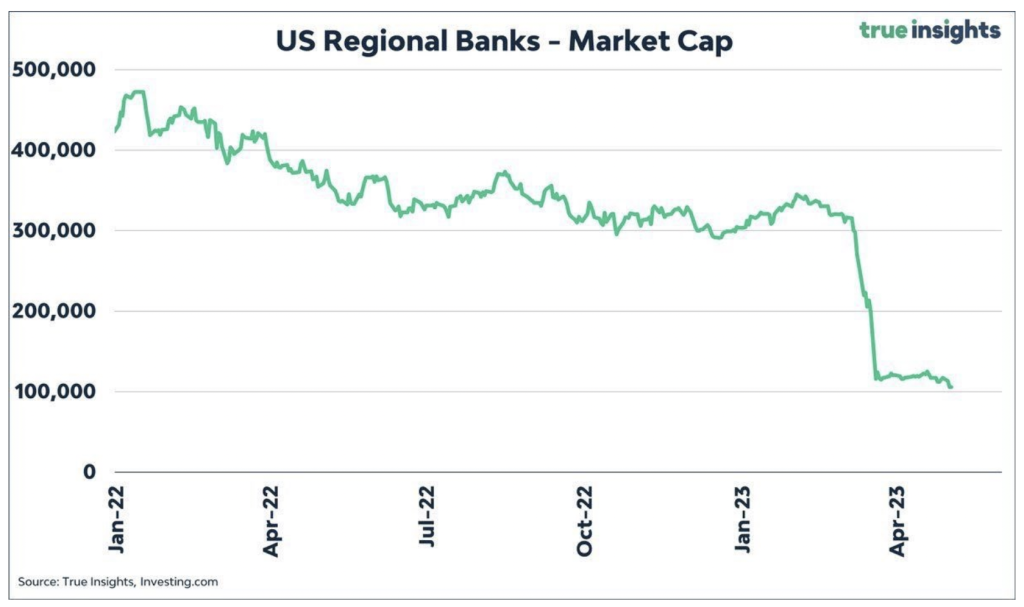
    Well, I mean, where does the potato end up? Right? And so a lot of these things are securitized and so on, but people are chasing yields. So it’s pensions, it’s the Blackstones Fund, which has obviously been gating, was a real sign. It’s been gating outflows for several quarters now. And the trot on the bank, as one would say, it doesn’t seem to be abating anytime soon, the whole consequences of Zerp has to be manifested somewhere. And when you take Zerp plus COVID lockdown, plus a complete reorientation in the way the vast majority of America works, then you have because this is a really big part of the sector. And so I think something like 55% of all CRE loans in the country are underwritten by regional and community banks. And this is really the role they were meant to play in our society. We wrote a piece on this several months ago called Regional Fallout. And if we lose the regional banks, which is why this little mini crisis that we’ve gone through was so brought with peril, in our view, for the US economy and potential source of sort of a deflationary type recession.

    Doomberg

    If small banks stop lending, the economy stops working. It’s just that simple. Like, JPMorgan Chase is not doing the hard work underwriting risk assessment that small businesses need. We have a banker for the Doomberg Project. This person exists. They’ve come to our office before we launched. They understand the timing, the flow, and the size of the cash that’s coming in from our business. They’ve done their personal know your customer AML. We would never get that with JPMorgan Chase. We would be sent to a call center or an algorithm would randomly shut our account down without any appeal. And if you take away, like, the local car wash, the construction company, the plumber, the electrician that needs to finance some working capital, they’re not going to get the attention from a JPMorgan Chase that they will get from their local community credit union, for example. And if all of these smaller regional banks are on the hook for these loans that the old expression I first heard from Kyle Bass was a rolling loan collects no loss. If they can’t roll these loans, they can’t refinance these buildings, these construction projects, and they have to take the hit.

    Doomberg

    These leveraged regional and community banks could be in a world of hurt.

    Tony

    Okay, so that’s what happens then potentially is a credit crunch based on community banks, right? And then that hits small businesses and they’re the major employers and then correct, have to reduce headcount. And that’s the fall on of the CRE debacle right now, just to add.

    Albert

    A little bit to the regional bank issues, a lot of them issued out SBA loans for COVID, and those loans are now starting to start to get paid back. But these small businesses can’t pay those back because I mean, they’re talking about up to $2 million piece. Those come as a wave and start defaulting. The community banks even have a bigger problem to deal with.

    Tony

    Okay, so that’s interesting. So the impact on small businesses could actually be CRE to regional banks, to small businesses could actually be a trigger that could start the stagflation wave.

    Doomberg

    This is why we keep a close eye on the Blackstone B REIT or whatever they call it. We wrote a piece on that a while ago and Blackstone came out and made all the typical sort of denials that you would see, of course. And we have great properties and the market just doesn’t understand us. And yada yada. I think the market understands exactly what’s embedded in that portfolio. And they did again, they marketed this retail with and it has pretty severe lockup and people see the losses coming and are trying to get out. And so quarter after quarter you’re seeing these redemptions. This feels like two Bear Stearns hedge funds has a certain feel pattern repeating itself in eight here and we shall see. I don’t know what the solution to that is. I mean, there’s an awful lot of dead money walking in that space, an awful lot of hesitancy to mark to market the true value of the underlying cash flows corrected for probability of default. Big city politics. Not to get political, but a lot of people just aren’t going to San Francisco offices anymore. They don’t want to run the gauntlet of homelessness and mental health issues that you have to see every day when you go from your home to the office.

    Doomberg

    And why would you when you could do all your work from home? And so this is a real sea change and we’ve not yet swallowed that pill and we don’t really have a good recent history of taking the L at the national level. We extend and pretend everything. We just keep sticking fingers and holes in the dike and trying to keep all the water back and at some point something’s going to break.

    Albert

    Yeah, speaking of that, one of my base cases is another economic back coming in the fall. So I would look to probably see Congress address this issue before it gets out of control.

    Tony

    So you think there could be another package in the fall?

    Albert

    Oh, yeah.

    Tony

    So commercial real estate hits regional banks hits small businesses, and then there’s another commercial package in the fall to alleviate some of that problem, which then becomes.

    Doomberg

    Really inflationary because it’s very clear to the market then that we will just print our way through everything and we will basically go through the self default route of inflating away our debts.

    Tony

    So we have the Stagflation blueprint. To me that sounds like the Stagflation blueprint right there.

    Doomberg

    Yeah. So the counter is we had 40 year epic bull run in bonds. Right. And that was pretty deflationary. We went around the world and found cheap labor and we financialized everything and we hollowed out US manufacturing and the US military has decided that that’s probably not good for national security. And so if that 40 year run is over and we are going to do a lot of reshoring or safe shoring or moving things to allies out of the sort of cheaper labor, that in itself is both inflationary but not necessarily sort of feeding the recession narrative. And so you have to sort of balance the flows here, like the different forces and the flows. And I do think that you could see significant inflation without necessarily a strong US recession if the forces of reshoring outweigh any sort of crises that we might be able to paper over in the regional banking sector. And so this is sort of the ultimate challenge with trying to analyze these things. Which of these forces will, when you square them all up, which one will be the sort of determining one? Because we are if you just look at the reshoring of manufacturing, the numbers are pretty strong in the US in the past 18 months, and that offsets some of the sort of the declining forces that might traditionally signal a recession.

    Doomberg

    A lot of these indicators that we’re looking at that we’re used to seeing, of course, were born and worked in a different regime. And if that 40 year regime truly is over, then some of these indicators might not work.

    Tony

    Yeah. So I would recommend, if you guys haven’t read it, and if yours haven’t read it, there’s a book called The Price of Time by Edward Chancellor. It was recommended to me by somebody who is really knowledgeable. I’m about two thirds of the way through it. It is a fascinating book, and this time is never different, and that’s the main lesson. And we see central banks go in, try to intervene, try to alleviate things, and there’s always some sort of fallout. So, Dubric, as you say, if this is the end of the 40 year cycle, there’s going to be pain. And if CRE is acute enough so let’s say 30% of the value has fallen out of CRE, that’s acute enough to cause some real pain, right?

    Doomberg

    Yeah, just to give that chance for a plug. Actually, I heard him on the Grant Williams podcast discussing that book. It was a really great episode. And I agree wholeheartedly. It’s a fantastic book to read.

    Tony

    Great. Maybe I’ll see if he’ll come on our little podcast. That would be amazing. Albert, can you talk us through a little bit of the impact on energy? If we’re in a stagflationary US economy, what do we see with energy?

    Albert

    Energy is complex, Tony. It’s really complex. I mean, under $65 becomes problematic for the oil industry in the United States. They’re not going to produce. And that, again puts the oil back, parts of oil back up over $80, which is where the Saudis want it. But of course, the United States, the Biden administration, certainly doesn’t want to see that because it’s inflationary. It’s really a tough call with the energy sector in this. It really is. I mean, I could see this going to stay in here at 60, $70 for six months, or I could see it going to $100 pretty quickly.

    Tony

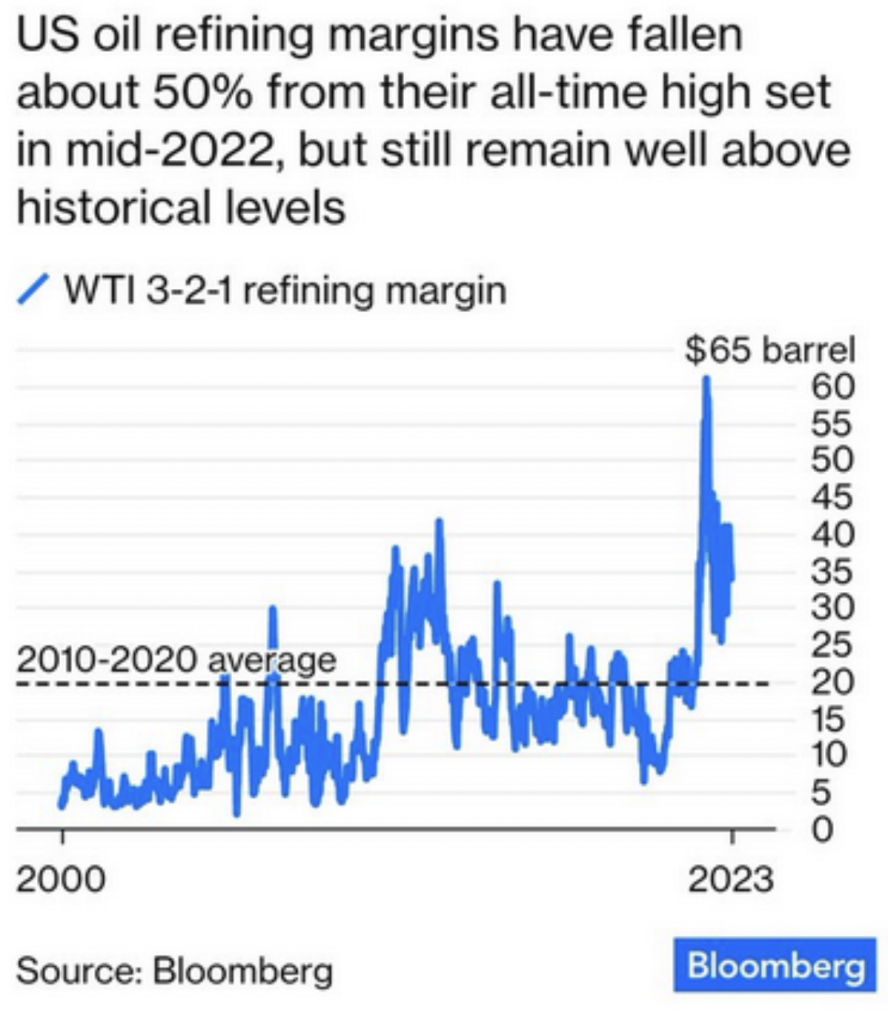
    Yeah. And what’s also interesting is the refining activity in the US. Refineries that are almost 96% capacity utilization tracy talked about that this week earlier. And so we have some of these refineries down for maintenance, but going into potentially hurricane season at 96% utilization, there’s really not a lot of movement or flexibility there for gasoline and other distillates. Right. So we had our first tropical storm of the season off of Florida this week. So if that turns into a hurricane, or if something soon turns into a hurricane hits Louisiana and Texas, we could have some real spikes in gasoline in the US. That could really aggravate at least the perceptions of inflation, if not inflation itself.

    Albert

    Yeah, the oil and gasoline supply is so tight. I have an oil brokerage firm, and we’ve been running around the globe to try to find supply, and it’s tight. Forget about what people are trying to tell you about the Saudis or the OPEC is hurting because demand is not there. That is absolutely not the case. The demand is extremely high and the supply is very tight.

    Tony

    Yeah. Jimberg, what are your thoughts on energy and stagflation?

    Doomberg

    Yeah, I would say the world was saved from an energy catastrophe with the unusually warm winter in the Northern Hemisphere, and in particular in Western Europe. And I don’t know how the weather patterns with Al Nino foretell what the next winter will be like, but it does seem like our leaders, especially in Europe, are learning all the wrong lessons. They’re confusing good fortune with good strategy. Prices are really low right now. The wind is at their sails, pun intended. They certainly seem to be heading into this winter with far more confidence than we think the facts on the ground would warrant. To the question about refiners, we wrote a piece one of the big ironies, of course, is that a lot of this Russian oil is flowing to India, which then gets refined into gasoline and distillates and finds its way to the US. And relieve much of the diesel crisis in the Northeast, for example, that was beginning to break out. US. Refining capacity at 96% is mostly testimony to the fact that we’ve not built a new major one in 40 years. You just can’t get them done anymore. And so we’re going to rely more and more on imports.

    Doomberg

    I would say just back to this whole concept of electric vehicles putting oil out of business and such nonsense. I mean, that gasoline is just one important cut of a barrel of oil. But we’re still going to need diesel, we’re still going to need jet fuel. And ultimately, this is byproduct economics. And so if the price of diesel skyrockets, and that makes the price of gasoline cheap because refiners have to keep operating, then somebody will pick up that gasoline in a developing world. It’s a global market. It trades, and it’ll all be used. And so every drop of oil needs to be used. That’s why our roads are paved with asphalt. That’s all byproduct economics, and ultimately we’re not going to be kicking our oil habit anytime soon. So as it pertains to Stagflation, I think the move by the Saudis was interesting. Proactively cutting a million barrels a day of production. One wonders whether their fields just don’t need a rest anyway. A lot of OPEC has been stretched to their main capacity here, and they’ve never really been able to operate at their allocated production levels anyway. But I do think there is a big divergence growing between the tightness in the physical markets that Albert’s referring to and then the complete pessimism in the paper markets.

    Doomberg

    Gold investors are rolling their eyes and seeing this play out again. And now you have to be careful that you don’t need to look for conspiracies everywhere in the market. But the Saudis are certainly convinced that the price of oil needs to be higher. Well, they needed to be higher for their own internal domestic needs. And in fact, I would say the equilibrium price that keeps the shale patch doing well and Saudis and OPEC happy is around $85. Brent 82, $83. WTI we’re about $10 below that today. Again, as I would say, the shale patch has gotten more disciplined. They’re not chasing growth for growth sake, they’re focused on cash. And so I do think that there’s sort of a natural range bound sort of sweet spot for oil in that with, with a median around 80. And that’s probably where we’ll end up.

    Tony

    Very good. Okay. Still higher than today. So it doesn’t help that stagflationary discussion. Okay, good to know, guys. Thank you very much. Let’s move on to Binance. I know there was a lot of movement in crypto this week with, you know, Binance and Coinbase and, and other things happening from the SEC Doomberg, you put out an intentionally seemingly nonspecific tweet about Binance, and I’m curious what your thought is about Binance, about the CEO, Zhao Chungpeng or CZ. Can you tell us kind of what’s happened there?

    Doomberg

    Sure.

    Tony

    Dig a little bit more into Binance and Coinbase. It doesn’t really seem like they’re exactly the same issue. I want to understand some of the accusations that they’re operating as an illegal exchange, this sort of thing. Let’s really dig into that and figure out what’s really happening there.

    Doomberg

    Sure. Let’s partition the discussion into sort of two categories. One, the whole question around whether crypto tokens are in fact unregistered securities. And then two, beyond that, Binance and FTX are being accused of basically running what amount to criminal enterprises where they’re commingling customer funds, enriching themselves, lying about their internal controls, and so on and so on. I would say Coinbase is not accused of doing any of those things. Right. Coinbase is a US based exchange that trades in the public stock market. We have no position in Coinbase, just FYI, but they do stand accused of trafficking in unregistered securities. And we’re putting out a piece on this on Friday. It’s pretty. Clear cut if you read the filings and so I wouldn’t commingle the fraud. The Sam Bankman freed CZ accusations of fraud which make the accusations of them trafficking and unregistered securities almost quaint in comparison. But the unregistered securities question is a life or death situation for Coinbase. And I do think when you read the filings these things don’t. How we test would indicate that Salona is a security like money was raised in exchange for tokens. The value of those tokens depends on the work of others.

    Doomberg

    It’s a common enterprise. They illegally, I think, listed them on these exchanges both domestically at Coinbase and offshore on FTX and Binance and pick your favorite. And these coins were picked up by venture capitalists for twelve cents and twenty five cents and they sold them out at $250 to unsuspecting retail. When it comes to the SEC, the brightest of their red lines is you do not sell unregistered securities to unaccredited investors. They stand at the gateway between the private and the public markets. And anybody who spend any time in venture capital knows that you don’t get to monetize on the back of retail without running the gauntlet of the registration process of the SEC. And they cleverly figured out that they thought that they’d invented the cheat code. We’ll call it a token even though it acts an awful lot like a stock and we’ll have a lockup period, but it’ll be a year. It’ll be this simple agreement for future tokens. Matt Levine put out a great column on Wednesday. These are stocks. They’re essentially very much analogous to the equity tranche in a company and a bunch of vents of capital, including a bunch of very high profile ones, not only dumped these tokens for thousandfold returns on the backs of retails, they went and filmed themselves on podcasts bragging about it and laughing about it.

    Doomberg

    It’s really amazing to me and I do think the thrust of our piece is venture capitalists should know better, they should have known better, they knew what they were doing. The SEC has been paying very careful attention and now that look, you have a motivated enforcement agency that is being openly disrespected all over FinTwit, all over YouTube, all over social media. They have the power of the subpoena. Sure, maybe there’s a few Republicans have been bought off to sing for the industry and even a commissioner or two, but Gary Gensler knows the crypto space well and we have, so we call it the Doomberg test. Is the underlying activity legally dubious? Check. Are you making a stupid amount of money off it? Check. And is the government therefore going to be paying attention to you? Of course, like you don’t get to cross that red line. In my mind the how we test is definitive and Bitcoin is not a security ether. Different story. But the rest of these tokens that basically found lawyers to advise them on how they could technically not make it the same as an initial Coin offering, but in reality, they really didn’t change that much.

    Doomberg

    They invested in a common enterprise in the hopes of making a profit on the work of others. That is a security. All of these tokens are securities. Coinbase for listing them, I believe, is in big trouble. There’s also another thing here. It’s not just a question of securities itself. These exchanges were actually operating as exchanges, custodians and clearing houses all at the same time. And that’s a big no no in the US. And so there’s far more legal jeopardy here than the market is pricing. And it’s shocking to me. The most shocking price on my screen today on my Bloomberg, is Coinbase bonds. I can understand equity, I can understand the reddit crowd and trying to generate a short squeeze. Coinbase is the most highly shorted stock on interactive brokers. That’s all fine. If AMC can go to where it went, then Coinbase can stay here. Even though their entire business model has been effectively declared illegal by the SEC. Why the bonds aren’t acting is a real mystery to me. These things are still priced at a pretty reasonable 15% yield is distressed, but you would think that the bond market would be sniffing out that the SEC is serious about this.

    Doomberg

    People just don’t read the complaints. Like, if you read the Binance complaint, it’s not like it’s 130 pages. It’s a bit of a heavy ask in today’s hyper short attention span environment. But just go and find the Binance complaint and read pages 88 to 92, four pages on why Salona is a security. It’s just so clearly a security. And they listed them knowing that the SEC was basically telling them, hey, guys, you got to clean this up. These things are securities. And so it is a real mess. And I think it’s going to become political, it’s going to become ugly. But again, the bifurcation here between the question of what’s the security and the question of fraud, I want to be very clear. There are serious accusations, compelling accusations of fraud at Binance that don’t exist at Coinbase. But Coinbase’s entire business model has effectively been declared illegal by the SEC. And to us, that should matter.

    Tony

    Yes. So everything you’re saying, I think both Albert and I, probably through different processes, but have been very vocal about this for the past couple of years. My biggest question or biggest statement has been, this is not a currency. These things are called currencies. They’re assets and they’re securities. Right. And so I haven’t understood it from the I feel like I’ve understood it, but I haven’t really understood how people could call them currencies or tokens when in fact they really are Securitized assets. Right. And so that seems very simple to me and I’m just surprised how long it’s taken the SEC to get here. But they’re a bureaucracy. It takes some time. This all makes sense. I don’t understand how they got securities lawyers to sign off on this.

    Doomberg

    Well, it’s a funny thing about lawyers. So in my corporate experience, we come at this from the corporate side, not the finance side. And I had a couple of decades in corporate America in various roles and a couple of expressions that were always near and dear to me, to my heart. Lawyers advise and leaders decide. But the second is there’s a vast difference between having a case and having an argument. And the lawyer will tell you you have a case right up until trial, at which point it magically becomes, oh, we have a pretty good argument. And look, lawyers are in the billing business and so they will give you advice and they’re fully protected by their own sort of insurance and they’re just doing their best as professionals. But if you could find a lawyer to basically tell you just about anything and it’s amazing to me, it’s just again, the Doomberg test is it probably illegal and are you making a ton of money at it? You got a problem to brag about making a billion dollars like who did on what podcast? It’s just really amazing to me that people would be so and just.

    Doomberg

    Even the CEO, brian Armstrong. Let’s circle back to Coinbase here. Their stance towards the SEC boggles the mind. They’re going to walk into the SEC and dictate to them how they need to change their regulatory framework to make Coinbase work. When the SEC again, I’m old enough to remember when people were afraid of the SEC, like getting a subpoena from the SEC was a BFD. If the SEC doesn’t drop the full hammer and looks like they are on these people, we need to see DOJ raids at this point in my mind, or else people are just not going to respect the SEC and we’re going to basically have a free for all.

    Albert

    Why should they respect them when Elon Musk is out there?

    Doomberg

    Ridiculous. It all starts with SEC middle words, Elon. In my view, that was the moment Jay Clayton really said all this in action and Gary Genzler is trying to sort of close the barn door. But yeah, like pumping dogecoin. Everybody knows what’s going on when he changes the Twitter to the doge. Right. The Winklevoss twins. Like all this mania that we saw, we all know what we’ve all been around. We’ve been around market cycles. And the reason we can avoid such traps is because there’s nothing of economic value occurring at the center of these things that would justify anywhere near the types of prices that we saw on the screen. And people should know better, right? And look at this. It matters. The reason why the US has deeply liquid really well functioning markets is because the world assumes the rules will be enforced. If we’re going to dissolve into a casino where how much money you spend coinbase literally threatened the SEC in a response by saying, if you sue us, you will face a well resourced adversary that will fight you all the way to the Supreme Court. Can you imagine the stones it would take?

    Doomberg

    And by the way, when Coinbase became public, they didn’t do an IPO in the traditional sense. They did a direct listing. And it was basically insiders selling in to create the float. And Brian Armstrong owns $130,000,000 home. Like, he’s not a sympathetic defendant here. And why the government took so long and why they don’t take the steamroller out and just make examples of some of these people is baffling to me. Maybe it’s coming, but, man, like, when I was in corporate America, you got a note from the SEC, the hair on your back stood up. Everybody stood at attention. You stood in line and you did what they told you because the two otherwise was the end of your career. And you could look at jail time. I mean, selling unregistered securities to millions of US investors is the brightest of red lines at the SEC. Everybody knows it could be. It should be. And we’ll see if Gary Genzle has the political wherewithal to see this through. If he doesn’t, the other side of it is going to be pretty ugly.

    Tony

    Doom do you think the SEC is just trying to give people time to get out? I’m baffled by why this took so long, but do you think they’re just trying to signal to markets, hey, you really need to get out of this. You really need to get out of.

    Doomberg

    This, or is the market’s not listening? Right? I would say let’s put this in the proper political context. The amount of money that FTX and others in the industry have spread around Washington, DC, is really one of the challenges with our political system. Like, you can become too big to regulate who’s going to step up to Elon Musk in this environment. One of the reasons he bought Twitter, I believe, is to become politically unregulable. He can’t regulate the man. He’s got the giant megaphone and he’s doing some things well. It’s not a conversation about elon, but the regulatory apparatus in the US is susceptible to corruption, is susceptible to political forces.

    Tony

    This is new information.

    Doomberg

    Doom this is, yes, breaking news, the more corrupt Washington becomes. But there’s a cost to that. Again, the US markets are the US markets for a reason, which is compared to all the others. The SEC was a cop on the beat that people trusted. And if that erodes away, imagine a world where the definition of security is so stretched and abused that something like a crypto token is not a security man. All bets are off, right? I don’t know. The investor protections are a key part of the efficiency of the US capital markets. The US capital markets are a key part of the reason why the US economy was as strong as it was for many decades. We are really eroding the core here. If we let huxters and fraudsters take over the reins and run the show.

    Tony

    Yeah. So I remember running around China in the late, early teens, 2000s, early teens, and I’d go into all the brokerage houses. They would say, hey, we want you to teach us about financial innovation. And it was just shocking to me. Like, they weren’t even trying to build credible markets. They wanted to incorporate some of the things that the US was doing before the financial crisis and then even after. And what it makes me think of, and I’m curious of your thoughts on this anybody who talks about, say, doing an ICO or something related to, say, finance like activity, they immediately start talking about Singapore, and they immediately talk about the regime in Singapore and the financial innovation in Singapore, these sorts of things. What do you think about those types of jurisdictions where this stuff is really encouraged and they’re trying to cultivate these types of securities?

    Doomberg

    There are no financial innovations. First of all, every scam is as old as history. And look, financial innovation is a euphemism for “let me launder money.”

    Tony

    Absolutely, yes.

    Doomberg

    That’s basically what it comes down to. Kycaml exists. And look, we’ve been critical of the US Treasury and the if Soren and Ben Hunt’s model on that, and they do go too far sometimes. But you’re talking about places like Dubai. Okay, what’s going on in Dubai? I wonder? Why is Dubai suddenly the headquarters of crypto Singapore? The amount of money, illicit money, flowing around the world is huge. It’s staggering. And our friend Markahotis would say the rise of these offshore crypto exchanges came in the aftermath of the collapse of wirecard, which was facilitating an awful lot of money laundering. He would say crypto is a money laundering scandal with a crypto wrapper. And we would tend to agree. It’s just undeniable that trillions of dollars of illicit money flow around the economy today. And crypto was a convenient way for a lot of that money to be moved instantaneously. I mean, there is no real innovation in trying to hide money from governments. You might use a bit of technology and put a technical wrapper on it to add fuel to the pump and dump fire, but money is money. Money laundering is money laundering.

    Doomberg

    I could create a really fast-growing financial services company, just give away easy terms. There is no new tricks in the finance world. There is no such thing as financial innovation. They’re just new tools and tricks to circumvent the rules that everybody knows and should be playing by.

    Albert

    This is all music to my ears as I’ve been screaming at the top of my lungs for years about these pump-and-dump. I have taken so much flak from people with the “stay poor” comments. This is just absurd. I mean, everything that’s happening in the crypto space is absolutely absurd. Newsroom is right. It’s like the SEC has to drop the hammer here. They got to really hammer some people and throw them in jail. Take their money, throw them in jail, just take their firms, collapse their firms. Something’s got to happen.

    Tony

    That’s a good point. Albert, how far do you think this goes? I mean, do you have high-profile billionaires who get ensnared in this without naming names? No, you don’t get high profile billionaire. So do you get celebrities who’ve been ensnared in this? I think that’s already happened a bit. But does that become more widespread?

    Doomberg

    Yeah, sure.

    Albert

    You’re going to have some scapegoats out there, a couple of middle management guys, some Shaquille O’Neill and whoever else is in trouble with the FTX pumping and dumping advertisements. Yeah, you’re going to have those people. But the guy sitting at the top lined Washington’s pocketbooks and campaign finances, and they’re not going anywhere. Simple as that, right. They get tipped off. They get protection from the DOJ, Biden’s DOJ. The Democratic donors are fine. It’s as simple as it is. The Republican donors just didn’t play this game at the moment, so they really don’t have that much to worry about. But everybody else, they’ll be fine in Santrope and San Barts and whatever.

    Tony

    So, as usual, it’s the second 3rd, 4th tier of people. Of course you go to jail.

    Albert

    Of course.

    Tony

    And if you’re not American, it helps to facilitate that as well.

    Albert

    Of course. Living in Singapore, Dubai, Monaco, all these other areas. Gibraltar. Name your small little enclave of financial services providers.

    Tony

    Doomberg, what do you think about that? How far does this go?

    Doomberg

    I don’t know. We’ll see. That’s the piece we’re putting out. I think it’s very possible that it goes into venture capital.

    Tony

    I hope so.

    Doomberg

    And there’s some big names and some big firms. They all knew what they were doing. They did. And if that money wasn’t coming in from VC, none of this would have grown to this level. And so I think exchanges are just the first domino. It depends on the politics of it. Venture Capital. Silicon Valley bank collapsed. A lot of their behavior over that weekend is also being scrutinized, I think. And of course they’re trying to blame it all on short sellers. But in reality, we all know what really happened. And so it’s no coincidence in our mind that Silicon Valley Bank was among the early failures here because they were, of course, knee-deep in all of this crypto financing on the venture capital side, signature and silvergate coming thereafter too. So we shall see that the piece we’re putting out is sort of planting a flag that this could spread to the VC space. And if I was in the VC space and had participated in these, I’d be lowering up.

    Tony

    Oh, absolutely. And donating.

    Doomberg

    Yeah, well.

    Albert

    Throw some money around, right?

    Tony

    Exactly. Protect yourself. Albert, thank you so much for this. This has been really informative, guys. Please look out for Dunberg’s piece. And there’s a lot more to come on this, so thanks, guys. Thanks so much for your time, and have a great weekend and a great week ahead. Thank you.

    Doomberg

    Thank you.

  • Realignment: Crude market, Trillions of $USTs & US-Middle East

    Be a smarter trader and investor with CI Markets. Learn more: https://completeintel.com/markets

    In the latest episode of The Week Ahead, Tony Nash leads an insightful discussion with industry experts Tracy Shuchart, Markets & Mayhem, and Albert Marko.

    One of the key themes explored in the episode is the low crude prices and the upcoming OPEC meeting. Tracy Shuchart analyzes the factors contributing to the downward pressure on crude prices, despite expectations of a seasonal increase. She highlights recession fears and limited market participation as major factors hampering the rise in prices. The OPEC meeting, scheduled for June 4th, becomes a focal point of discussion, particularly in light of Russian overproduction. The experts discuss the potential outcomes of the meeting, including the possibility of production cuts and their impact on countries like India that heavily rely on affordable Russian crude.

    Mayhem delves into the issue of U.S. Treasury debt issuance and its implications for market liquidity and financial conditions. The recent passage of the debt ceiling prompts an exploration of the upcoming $1.2 trillion of U.S. Treasury issuance. Mayhem provides insights into the expected timing of the issuance and its potential impact on the markets. The experts also touch upon the decline in investor home purchases, questioning whether the rise in interest rates is the sole cause or if other factors are at play. They contemplate the extent of this trend and its potential future implications.

    Albert Marko leads the discussion on the changing dynamics of the Middle East and the implications for the United States. The UAE’s withdrawal from a maritime agreement with the U.S. serves as a catalyst for analyzing the broader challenges in the region. Tensions with Saudi Arabia, Qatar, and Turkey, coupled with evolving U.S. policies, shape the geopolitical landscape. The experts emphasize the need for the U.S. to build strong relationships with important countries like Turkey and Indonesia without excluding other global powers. They acknowledge the complexities of navigating the Middle East and stress the importance of long-term efforts in rebuilding relationships.

    As the episode concludes, the participants share their expectations for the week ahead. They look ahead to the OPEC meeting and its potential outcomes, considering the impact on global energy markets. Additionally, they discuss the upcoming Federal Reserve meeting and the decision on interest rates, offering diverse perspectives on whether a rate hike is imminent or if the Fed will adopt a more dovish approach.

    Overall, this episode of The Week Ahead provides listeners with a comprehensive overview of crucial economic and geopolitical developments. The insightful analysis and diverse viewpoints offered by the experts shed light on the intricacies of global markets and highlight the challenges and opportunities that lie ahead.

    Key themes:

    1. Why is crude so low? (and OPEC)
    2. UST Tsunami
    3. Middle East (UAE)

    This is the 67th episode of The Week Ahead, where experts talk about the week that just happened and what will most likely happen in the coming week.

    Follow The Week Ahead panel on Twitter:

    Tony: https://twitter.com/TonyNashNerd
    Tracy: https://twitter.com/chigrl
    Albert: https://twitter.com/amlivemon
    Mayhem: https://twitter.com/Mayhem4Markets

    Transcript

    Tony 

    Everyone, and welcome to The Week Ahead. I’m Tony Nash. Today we are joined by Markets inMayhem, Use, macro analyst and trader, of course. We’re also joined by Albert Marko and TracyShuchart. We’ve got a wide variety of items to cover this week. The first is why is crude so low?I’ve been talking with Tracy about that all week and trying to understand those mechanics a littlebit better. And obviously we have an OPEC meeting coming up, so we want to talk throughwhat’s going to happen there. I want to talk about the UST, US Treasury tsunami that’s coming.We’ll talk to Mayhem about that and understand some of the implications of this tighteningactivity that we see, particularly on things like real estate. And then we want to talk about theUAE and I guess the broader Middle East with Albert, some of those relationships seem to bespoiling a bit with the US. And so we want to understand, is this kind of finally the Middle Eastpivot to Asia or is there something different going on? So guys, thanks so much for joining us. Ireally appreciate your time. I know it’s very valuable. 

    Tony 

    Tracy, let’s start off with you. With crude. Why is it so low? We saw things really head down fora couple of weeks. We saw things start to perk up on Thursday and so far they’re doing well onFriday. So what’s happening with it? You hit the 60s, it’s back up above 70, I believe, right now. So what factors are keeping crude down at a time when we’d think seasonal factors would reallystart to push crude prices up a little bit? 

    Tracy 

    Yeah, absolutely. I mean, really, it’s the broader macro environment. What you have here is thatglobal supplies are tightening, right? We are draining global supplies. Iran’s done dumping theirfloating storage. So markets should really tighten up here this summer, particularly with the newOPEC cuts, the voluntary cuts that went into effect this month. But there’s still these broaderrecession fears. You wouldn’t think at that looking at the market right now, but there’soverwhelming thoughts of there’s still these recessionary fears. We had terrible manufacturingdata come out of the EU this week. We had terrible manufacturing data, one of the data sets inChina that really set the tone at the very beginning of the week when we saw that dive down into67. US. Manufacturing also contracting a bit as well. And so I think that traders are looking atthose numbers and spooking the market. We also have the participation in this market is done.There is no participation in this market. 

    Tony 

    Basically, you say participation, you’re talking about trading volume. 

    Tracy 

    So open interest. 

    Tony 

    Open interest. Okay. 

    Tracy 

    Right. So open interest. There’s just not really a lot of open interest. Most longs have exited themarket. And it’s not that really shorts are adding. It’s that nobody’s engaging in the market. Andso there’s just really a lack of interest right now in this. Even though fundamentals are still tight,it’s just this economic macro backdrop that’s really kind of pushing people away from. 

    Tony 

    Okay, so I’ve seen some people talk about like a bull whip effect. We saw things fall so far withthings like the unemployment data coming out on Friday being above expectation. Could westart to potentially see some sort of bull whip whip effect where we see crude rally on a notablebasis? Or will it take a lot more than something like that? 

    Tracy 

    No, I think we absolutely could. First of all, we just started having these OPEC cuts right, inMay, even though we haven’t really seen Russian exports up until this month. I think I imaginethat it would take like a month or two really, for those cuts really to filter into the fundamentalanalysis. I mean, OPEC is looking at by the end of June, we’re looking at a 2.3 million barreldeficit keeping these cuts online. So I think that as these markets tighten, people will not be ableto kind of ignore that any longer. 

    Tony 

    Okay, very interesting. 

    Albert 

    Real quick, what about a cap on Russian seaborne exports or existing cuts going mandatory forOPEC meetings? Is that possible? Either one of them? 

    Tracy 

    Yeah, absolutely. I mean, I think there’s a lot up for the discussion in the OPEC meeting. I thinkthey’ll focus on compliance. So anybody that’s been over producing will have to stopimmediately. I’m not sure that they’re going to make additional cuts just because those cuts arejust now starting to filter in again, it’s only been a month, and so really, that hasn’t really filteredinto really into the supply side situation. I’m sure that Russia will get a talking to because I thinkthat even though they have cut some production, they said 500K, it’s about 300K. Their exportsstill have not really gone down. That said, over the last couple of weeks, according to Bortexadata, we are starting to see those exports come down a bit. 

    Tracy 

    That again, I’m sure they’ll get a talking too, but I think it’s too early to really to make additionalcuts. That said, OPEC is known for surprises, and so you don’t really know 100%. I wouldn’tcount it out 100%, but I would lean towards probably no change. 

    Tony 

    So they’re meeting on the fourth. You don’t think there’s going to be a change. But you do thinkthey’re going to focus on compliance by Russia. So OPEC is pretty patient with their memberstates, right, generally. And it sounds like Russia has really had its run. They’ve overproduced. Alot of the stuff is going to places like India. So once that Stern talking to happens, and if Russiadecides to comply, what happens to places like India? And Saudi has been importing Russianbarrels too, right? 

    Tracy 

    Yeah, they’ve been importing Russian diesel and then selling their higher priced diesel to Europe.Obviously, if oil prices go up, obviously that’ll put some pressure on, say, India and China buyingreally cheap barrels. But Russian oil is still trading at a large discount to Brent as it is, and OPECreally wants to see at least Brent in that range. And so I think they’re going to try to manipulatethe market, but oversee the market so that they can get those prices that they need. If you look atkind of the OPEC nation’s break even, fiscal break evens, they’re all in that $70 to $80 range. Soreally they want that $80 to $90 range. 

    Tony 

    I love that you said OPEC isn’t manipulating the market. I think that’s great. What do you say?I’ve seen a lot of people over the past couple of weeks say, look, OPEC only controls 30% ofglobal markets, so they don’t really have control over crude prices. What’s your response to that?Is that true? Are they immaterial? 

    Tracy 

    It’s OPEC and OPEC plus, right? Between US. Russia and Saudi Arabia, we’re the top threeproducers in the world. And so that is quite significant because a lot of these other countries,there’s a lot of countries producing oil, but in much smaller amounts, by far, those are the threelargest producers. And so they can with the plus part of OPEC, it is easier to manage the market,especially when shale is not really a threat to them anymore, because our production isn’t reallygrowing at this point. They don’t have to worry about Shell going crazy overproducing andbringing oil prices down. 

    Tony 

    And we know there’s a floor to shale, right? We know there’s a floor of 65, 60, whatever to shale.Right. So if they can be prepared for that, which we’ve seen over the past couple of weeks, thenit’s not really as far as it goes, but it’s kind of as far as it goes on a sustainable basis. 

    Tracy 

    Right. 

    Mayhem 

    Tracy, does it seem like the oil markets, if there was a pretty meaningful disruption to supply, orif the Chinese reopening story really does start to take shape, that this tightness could lead to apretty significant rebound in price? If there’s any catalyst on either side, a disruption in supply oran increase in demand, it kind of seems like we’re priming the pump, so to speak. 

    Tracy 

    Oh, absolutely. 100% agree with that. And what’s interesting is, though, we have seen theproperty sector and manufacturing in China is still horrible. Right? Or manufacturing lesshorrible. But we did see them come out overnight and talk about how they want to try torevitalize the property sector. That did give oil a little boost. But also interesting, China has beenimporting a lot of crude. In fact, our all time high was just in April at 16 million barrels a day,which is huge. And so even though their imports keep increasing, there’s still this overwhelmingsentiment that’s weighing on the markets, particularly with what is going on economically withinChina. 

    Tony 

    Very interesting. Okay. It seems to me that tell me if I’m wrong here, but we’ve kind of seen Iwouldn’t say the absolute floor, but at least temporarily, we’ve hit where we’re going to hit andthings may muddle around for a while, but generally there’s an upside expectation for crudethrough the summer. 

    Tracy 

    Yeah, I think that we will see that. I think, yes. Again, those cuts filter in. We’re going to seemarkets significantly tighten over this summer. 

    Tony 

    Great. Okay. Very interesting. Thank you for that. And so speaking of tightening mayhem, let’stalk about US. Treasuries. You put out a piece, I think, a week ago or so, maybe less than thatabout no, a few days ago, I’m sorry. About now that the debt ceiling has moved forward, we’regoing to see $1.2 trillion of treasury debt issuance. So can you talk us through that and help usunderstand how that will impact markets, what’s the timing of that expected and so on? 

    Mayhem 

    Sure. So the first thing is going into this year, treasury Secretary Yellen issued a warning in midJanuary saying that they were reaching the statutory limit to what the US. Could borrow withouta change in the debt ceiling. And so at that point, issuance of debt for new debt was suspended.And it was only debt that was being refinanced that continued to be auctioned off in the market.So we still saw treasury auctions, but they weren’t nearly the same size. And with TGA accountspending into bank reserves that helped to add some fast moving liquidity. We also had positiveboosts from central banks like the People’s Bank of China and the bank of Japan, adding inaggregate a pretty significant amount of liquidity, more than offset QT by the Fed and later bythe European Central Bank that started in March of this year. So now we’re getting to the sort ofother side of this where the treasury general account is essentially drained. There’s less than, Ithink at this point, $30 billion in the account. So it’s very crucial that they do pass the increasessigned in and that they move forward with everything. 

    Mayhem 

    I never thought a default was a risk, but there’s a lot of kabuki theater that happens around here.And the one thing I just wanted to say as I get into the next part is that when people start saying adefault is imminent or if we reach this date, a default is going to happen and it’s just sort of cutand dry. That’s never been true because the executive branch has the authority to delegate whichpayments are going to be prioritized, and they can continue to do that with debt repayments oninterest in maturing bills and otherwise. But on the other side of it, they can shut down thegovernment furlough workers, defer payments. The whole idea that we were ever going to have adefault was a bunch of noise. And it was really more about what potentially happens at the otherside of the resolution of the debt ceiling, which is all but inevitable. Right. And it’s good wedidn’t have it shut down because that would have been a drag on the economy if it lasted a while.Government spending has been pretty important to GDP the last two quarters. And so avertingthat shutdown is constructive. 

    Mayhem 

    But what it means is that over the next, say, five weeks or so, there is about 700 billion of billissuance that needs to happen before we end out the second to last quarter for this governmentbudget. And then we also have by the end of the fiscal year, which is September 30 for the USgovernment. There’s a total, including that 700 billion of 1.2 trillion that needs to be issued. Now,it sounds like a lot because it is, but it really wouldn’t have been as much if we were issuing itstarting in the beginning of the year, right when we started to run into that ceiling. 

    Tony 

    Okay, so let me just stop you there. So 1.2 trillion by September, what is the typical run rate over,say, a four month period? Is it close to that? Is it 1.2 trillion? Is it 500 billion? What is the debtissuance on a normal run rate? 

    Mayhem 

    There’s nothing normal about the times we’re in. So there are a lot of good historical analogues tolook at. We can look at last year and say for the last quarter of the year there was about a halftrillion dollars of issuance, I believe. But at the same time, that was when a lot of spending wasbeing kicked up significantly, right? This was when there was funding necessities for the Chipsand Science Act and the Inflation Reduction Act, whether it’s ironically named or not. And a lotof that stuff started to come online and then interest expenses are coming up too, because the Fedis doing QT. And that means that the interest free kind of borrowing that the treasury was able todo, where the Fed would buy at auction, they were the biggest buyer. And when they did, theypay back the interest at the end of the year minus any Fed expenses that’s over while interestrates are also rising. So interest rate expense is set to hit over a trillion dollars. That’s anotherreason that debt issuance is increasing, to be able to offset that. We’re essentially paying off theinterest on our debt by issuing more debt in an environment where rates seem set to stay high forsome time. 

    Mayhem 

    So I think that all that being said, on a typical four month basis, it would be much more, I wouldsay, average to see 100 and 5200 billion, maybe 250 if it’s heavy spending. But we’ve also seenthat over time, all and this kind of goes back to the debt ceiling. Should we even have one? Allthat we’ve ever seen with our debt is that it goes up. And the debt ceiling, if you look at it overtime, especially the last, say, 25 years, it’s more like a debt elevator doesn’t really stop any of thefrivolity or any of the excess or any of the pork barrel spending. So I would say that there’s noreal normalcy we’re in this post COVID era. There was helicopter money, there was so muchspending. They’re continuing down that path. It takes $1 of you get one dollars of GDP growthout of every $4.5 of government debt incurred. Right. So it’s not a very efficient way. But back toyour question, what does it do to the market? What does it do to the economy? So this ispotentially a liquidity sponge. It really depends on how the plumbing of the markets handles it. 

    Mayhem 

    There is some chance that if the rates on the bills are high enough, that it could tempt somemoney out of other sources. So it’s not as big of a liquidity sponge. Maybe if we see rates onthose bills getting closer to six, six and a half percent, you start to see some money coming out ofreverse repos. You start to see some money coming out of some of the equity accounts as peopleare looking for that sort of ongoing great rotation into fixed income and out of equities that we’veseen as a bit of a theme. But I think if it’s not as tempting, it does have the potential to start topull liquidity out of bank reserves. Either way, it’s going to have that impact. It’s a question as toscale of impact. 

    Tony 

    This is interesting. So you mentioned the liquidity sponge, and you also talked earlier about howthe TGA activity was kind of offsetting the QT activity that the Fed was doing, right? 

    Mayhem 

    Yeah. 

    Tony 

    So if this debt issuance is acting as a liquidity sponge, it’s almost an acceleration of tighteningbecause you don’t have the TGA necessarily offsetting QT anymore. Right. You’ve got thisliquidity sponge that’s taking dollars out of the market unless the US government can acceleratetheir spending. Is that fair to say? 

    Mayhem 

    I would say that even if they do accelerate, the net impact is likely to offset. And I don’t thinkthat the way things are lined up now, that we’re not going to see too much acceleration. But Icould of course, be very wrong about that. But the main takeaway here that I have is like yousaid, really from October of last year until present we’ve had a lot of flows from TGA, PBOCand BOJ. Now the BOJ and PBOC are probably going to continue being aggregate adders ofliquidity. They have to, yeah, I think so. And they’re trying to kind of decouple their credit cyclethe best they can from credit cycles that in the west are being ended intentionally by centralbanks to try to offset this inflation wave that we’re experiencing which is now concentrated morein services. I think that that vacation is kind of coming to an end and what we’re seeing now isthe inverse that not only is the TGA not going to be spending as much in all likelihood, but alsothat that issuance combined with QT by the ECB, by the Fed and to some extent by the bank ofEngland. 

    Mayhem 

    That is more of getting back to what monetary policy had intended for, which is to tightenfinancial conditions. And then the other additive to that is also that credit conditions aretightening. Right. Banks are lending less and to whom they’re lending, they’re lending at higherinterest rates. And so there’s aggregate impacts, there are cumulative impacts to what’s happeningwith rates rising as much as they have because more and more people have debt that they have torefinance. There’s also small mid sized businesses and a fair amount of consumer debt that arerevolvers that as rates rise, the compounding effects of those higher rates are starting to reallyhurt. So I think that when you put that all together, it does suggest that there is some potentialfattening of the left tail going into the back half of this year in terms of how risk assets and ratesmight behave in an environment where liquidity goes from being rather abundant to rather scarceduring a time where seasonality has a similar effect. 

    Tony 

    Right. So in terms of the impact of say, the credit crunch that’s coming, whatever normal is, arewe returning to kind of a normal balance or is it extraordinarily tight? Do you think things willget extraordinarily tight? I know that no matter what happens it will feel extraordinarily tightcompared to where we’ve been for the last few years. But are we returning to a normal or will itbe tighter than normal? 

    Mayhem 

    That’s a really good question and I’m going to imagine that it will gradually become tighter thanwhat we’re used to. But what we’re used to was also a rather unprecedented time. It was severaldecades of disinflation of a really overall pretty strong economy, lower and lower interest ratesalong the way, very abundant liquidity and credit ever increasing over really the better part of thelast 14 years to unprecedented levels. So in comparison to what most people are used to, I wouldsay yeah, it’s likely to be tighter. The question is for how long? And the question is what otherunintended consequences will happen along the way. I think one of the most interestingdiscussions on the other side of this is that as rates go higher and stay higher for longer, it notonly helps to subdue demand, but it actually also starts to constrain supply. Because if you’re theCEO of an energy company or a metals company or an agricultural company and you’re hearing,okay, wages are going up and they’re high already, costs of capital are high and availability ofcapital is dwindling and business conditions aren’t so robust moving forward, am I going toexpand supply into that environment? 

    Mayhem 

    So then what do things look like as we approach and get into the next credit cycle when we startfrom a place of higher prices but less availability of supply, when demand comes back andthere’s not supply able to absorb that and credit still, it’ll loosen, but it’ll likely be tighter thanwhat we’re used to. It seems like there’s not the capability to address that in a timely manner, thatinflation has become a little bit more structural. And some of the irony of that is part of that’sdriven by the Fed’s policy. Now, to their credit, they can’t do much to offset the fact that thegovernment, not only at the federal level, but various state governments and other countriesgovernments are sort of providing this inflation relief right, checks to people to offset the impactof inflation. But that just in aggregate adds money to the system. 

    Tony 

    That’s like your 02:00 P.m. Sugar high, right? Like it just gets you through dinner. It doesn’treally keep you going. Right? I mean, that can’t be permanent. 

    Mayhem 

    No. And it’s just kind of extending some of the issues and making them a little more structural innature, I feel like. So for the first time since the 1930s, we’ve seen M two money supply fall yearover year. But then if we look at it just as a number rather than a year over year trend, we can seethat it’s just really reverting back to the trend that it’s had that money supply growth wasextraordinarily high. During COVID that they really flooded the system with money, helicoptermoney, liquidity for the financial system while simultaneously shutting everything down andthen kind of scratched their heads when prices of everything went up, when there wasn’t enoughsupply. But some of the supply constraints that we’re dealing with, and Tracy could speak to thismuch more than me, is a lack of investment. We haven’t been investing in so many of theseresources for such a long time. And that’s also created some structural potential for inflation tomove higher. And as we get into another credit cycle, I think we’ve probably seen the worst ofgoods inflation. This credit cycle barring any kind of meaningful disruption in supply. 

    Mayhem 

    But then services inflation is also quite sticky. And one of the recurring themes we see in ismdata and employment data is the services industry is very strong. Wages continue to rise there,and those wages are being passed on to consumers in the form of rising prices. 

    Tony 

    Yes, Albert’s talked a lot about the structural nature of inflation and expects it to rear its headagain. But what’s interesting, from what I’m hearing from both you and Tracy is tightness. Tracyis talking about tightness in crude. You’re talking about tightness in credit. And it just feels likewe’re on the precipice of this snap change where we’re transitioning from this world ofabundance for the last few years, setting aside the supply chain aspects of things world of kind ofrelative abundance into a world of scarcity. And that’s what happens when interest rates rise,right? That’s what happens when credit markets tighten, is you have scarcity, then you have realbidding for the price of things. Right. So that’s really interesting. So, Ma’am, let’s move on to realestate. You posted a really interesting chart about investor purchases of real estate. So you saynew home purchases by investors have fallen by the most ever. Is it BlackRock kind ofphenomenon where they stop buying homes, or is that real people stopping to buy investmenthomes as well? 

    Mayhem 

    It’s both. And I mean, it’s driven by some of the same factors that we’ve talked about becausehome prices are stubbornly high. There is a lack of supply from existing homes because whowants to move when mortgage rates have more than doubled from where they may have financedtheir mortgage at? So there’s a lack of supply there. Homebuilders are trying to keep up with thenew orders, but they’re struggling because they’re facing rising wages, rising capital costs, lessavailability of capital, lower in aggregate new homes pricing. So their orders have gone down,their backlogs have gone down. We’re starting to see that in some of the homes data, but I thinkthat it’s both sides of the coin because if you’re an individual home flipper or someone whoaspires to be a landlord or whatever else, banks are going to be more skeptical lending to thosesecond and third mortgages, right? Your initial mortgage, they’re still churning those out, butthey’re much tighter with their credit. But for the folks that are hopeful investors, most banks arenot willing to do that for a rate that is favorable. So you look at the disparity between rent andhome ownership in a lot of areas. 

    Mayhem 

    It’s hard for a new landlord to get in because with the mortgage cost and insurance, propertytaxes are all going to pay. They’re not going to be able to compete with some of the otherlandlords unless they’re in a really hot up and coming area. Like, you might be able to do it inNew York, you might be able to do it in Miami, you probably won’t be able to do it in a lot of theUS. But in terms of what’s going on in real estate, it’s an interesting dichotomy because then onthe other side, we’re seeing prolific weakness in office buildings. Right. There’s the lowestamount of utilization we’ve ever seen. So there’s at least one place in the market where there isn’tscarcity. 

    Tony 

    Yeah, I think a couple of things. I think Meta just announced that they want their staff back threedays a week or something soon, which it’s going to be really interesting to see how that playsout. But also in terms of people moving gosh, I was just in Austin last weekend, and I thinkprobably six to 8% of all the license plates I saw were California plates. So there are a lot ofpeople who are selling their places in California and moving to Austin. I don’t see that as muchwhere I live, but that seems to be one of those markets that seems to be defined gravity, which isjust crazy to see that as the rest of the US. Seems to be at least holding or maybe selling off.Okay, that’s great. Ma’am, thank you so much for that. Your stuff is great. I really appreciate yourfeed and all the stuff you always put out. It’s really balanced and really smart. So thank you forthat. Albert let’s move on to some geopolitical stuff. And there was an announcement this weekabout the UAE that you tweeted about where UAE is pulling out of a maritime coalition that theUS set up for security and Gulf waters. 

    Tony 

    And I know that the US and UAE have been partners in security for the region, very closepartners for a couple of decades, and it seems like that may be breaking up. But we’ve talkedabout this several times before. Like, the State Department in the US. Is very ineffectual. It’sactually DoD that conducts the more important diplomacy on behalf of the US. So when we seethese defense things break up, it’s significant. So can you help us understand that a bit more? 

    Albert 

    There’s two reasons for this. One is the Biden’s administration of continuing Obama’s theories oflead from behind in the Middle East, which is absolutely nonsensical. It just doesn’t work.Vacuums get filled. Turkey had to stabilize the region by looking towards other nations like theUAE, qatar and Oman and Saudi Arabia. And this is just a natural progression of the US.Stepping back. If you ask the Biden administration, they continue to say that they’re engaged, buttheir level of engagement and the way they go about it is questionable at best with the Saudis justwith lack of respect towards Biden and Blinken. This is nothing of a surprise to me. In fact, Iforesee Turkey being a much more regional player in the coming decade than the US will be. 

    Tony 

    It’s really interesting. About 20 years ago, a book came out called The Next Hundred Years, andGeorge Friedman wrote about how Turkey was going to be a regional power again. And at thetime, it. Seemed not intuitive. And I know Friedman has a lot of things that haven’t necessarilystuck, but to see Turkey reemerge as a regional power is very interesting for me. And to seeErdogan reelected, I don’t think it’s a complete surprise, but it’s interesting to see the leadershipthey’ve taken. So can you give a couple of examples of how Turkey is taking leadership in thatregion? 

    Albert 

    Well, they’ve been setting up military bases, I believe, in Qatar and the UAE. They’ve beenworking hand in hand with the Iranians, believe it or not, in Africa. And the Russians, they’vebeen pushing out their drones to pretty much anyone that was willing to buy them. 

    Tony 

    Including Ukraine. Right? 

    Albert 

    Of course, the Ukraine, everybody, they push it out to anybody they can buy. And they use thatas leverage for trade deals. And right now, a lot of Russian money goes through Turkey. Andthey don’t really care what the United States has to say because the United States still and theworld has to deal with Turkey as a geostrategic place in the world. Look at Map, for God’s sakes.They have the Prosphous, the Black Sea. They touch Europe, they touch the Middle East.They’re active in Africa. They’re everywhere. 

    Tony 

    And they have relationships with China, too, that are positive. Right? 

    Albert 

    Yeah. Well, of course, the Chinese need to push their materials through Turkey, the bots forstraits, and through train rail. And they’re a force that you just can’t get around, literally. Now,they do have big economic problems, and I have disagreements with them concerning the USdollar, but once that reality bites them, they turn back and actually build some reserves. Theireconomy should be fine and get away from this hyperinflation threat that they’re facing. 

    Tony 

    I see countries like Turkey, India, Indonesia that are pretty independent, diplomatically. Theyhave a foot in the US sphere. They have a foot in the Chinese sphere. Some of them, like India,turkey especially, have a foot in the Russian sphere. What does that mean? Can the US. Kind ofmend fences and build relationships with those guys? Because there are three very importantcountries. You don’t hear about Indonesia a lot in the US. But it’s one of the largest countries inthe world. Turkey is strategically placed, and India is the largest country in the world. So howcan the US. Build those relationships without having kind of a binary, say, bilateral partnershipwith them? Meaning it’s the US. And no China, no Russia? What’s the best approach for them? 

    Albert 

    Well, I think, first of all, we need to get an entire new administration, starting with the StateDepartment and the DoD. Without that changing. Nothing’s going to change. First Obama, andnow you have the Biden administration continues to push on the Indians and given themultimatums on dealing with Russia and whatnot. India is a billion people. They have their ownconcerns, economic concerns. They need that cheap oil, and they. 

    Tony 

    Have a long history with Russia, too. 

    Albert 

    And they use Russia as a counterbalance with the Chinese. Now Indonesia has the same oppositeeffect. I mean, Indonesia is food security. They have their own food security, so they don’t reallyneed that. They have a bustling manufacturing center just gaining more steam, and they interactwith the Chinese because they have to. That’s the regional power. So you can’t really expect Idon’t understand why people expect pick them or us. It’s never like that in the world. It justdoesn’t work like that. Like I said, things will change when we have a new administration, andit’s probably going to take a couple of decades to rebuild those relationships, but. 

    Tony 

    Couple of decades, you think, well, you can’t just. 

    Albert 

    Turn something around in one administration. Let’s just say, theoretically, DeSantis wins andcleans house, and it takes two years to be able to shift things around properly and see somethingstarting to materialize. And that’s not enough. Then you’re up for reelection after four. If he winsagain, you have eight. Maybe at the end of his second term, you have some kind of fruits thatwill be blossoming between those relations. But until then, this is just not good news. 

    Tony 

    And they’re just looking out for their own self interest, right? I mean, it’s not every nation does. 

    Albert 

    It’s national self interest. I made this argument about the EU for so many years. Everyone keptsaying, oh, the EU is unified and we’re this and we’re that. Well, when you add a little stress tothe situation, the rift between Berlin and Paris starts to show its ugly head and the NorthernEurope versus Southern Europe, and everybody’s in for themselves. It’s just the reality. 

    Tony 

    Go ahead, Mayhem. 

    Mayhem 

    I would just say that the issue that Albert mentioned about countries, governments, that you guyswere talking about them having their own self interest, always in mind, that’s also an issue withpoliticians individually, and that’s a huge problem as well. 

    Tony 

    Yes. Are you talking about America? Are you talking about everywhere? 

    Mayhem 

    I can only speak to America, but I’m going to say it’s likely everywhere. And one of the problemsthat we do face in America that’s a big challenge is that money has the rights of free speech, thatcorporations are treated as people, and unfortunately, that doesn’t necessarily bode well for theinterests of the citizenry being represented by the political elite. 

    Tony 

    Absolutely. I agree with you. And we could have a very long conversation on the voices that getheard in, say, the State Department, and the voices that get heard in DoD and the voices that getheard in these different departments. It’s, I believe, fully money backed 100%. 

    Albert 

    Just look at the Fed and the Treasury. Where do those guys go to work after they’re done withtheir wall? 

    Mayhem 

    Exactly. 

    Albert 

    You’re telling me that Yellen and Powell don’t take calls from market makers and brokerages onthe side? I mean, that’s just a joke. It’s literally a joke, right? 

    Tony 

    Let me just get back to Geopolitics for a minute in the Middle East. So the US relationship withSaudi Arabia has really started to change a bit over the past couple of years, and I think it reallystarted changing during the Khashoggi stuff and it’s kind of deteriorated since then. So Tracy,what are you seeing with in energy markets? I know this nuclear thing was just announced withSaudi, but with regard to energy, we’ve seen Biden go to Saudi and ask him to release more oilwhile restricting oil here. 

    Tracy 

    As far as energy is concerned, the US. Doesn’t have any pull there anymore. And again, that’sbecause shale is no longer a threat to them because it’s not growing for a lot of reasons, right?You have heroin acreage gone. You have no capex for the last seven years. You have oilcompanies beholden to shareholders at this point, buybacks dividends, capital, discipline, payingdown debt, et cetera. And so really, you’re not going to see shale go crazy anymore. So it’s not asbig of a threat as it once was. And so that factors in as well. And the current administration iscertainly not helping by any stretch of the imagination as far as trying to get these companies togrow whatsoever. He wants to shut it all down tomorrow. So I think that’s really this nuclearthing that came up, what they’re calling kind of the nuclear Aramco, I think that’s very interestingbecause it does point that I think Saudi relations with this particular administration are at the lowlevel, but they know that this current administration is not going to be here forever. We still needthose ties, and we’ve had tumultuous times with Saudi Arabia since we really started having thatalliance in the 1930s. 

    Tracy 

    But we’ve been longtime partners and have gone through bumps in the road. So I don’t think thatrelationship is I wouldn’t count on that being gone whatsoever. It’s just right now, this particularadministration particularly does not have any pull. 

    Tony 

    Albert, what are your thoughts on that? I do kind of actually worry about the US relationshipwith Saudi Arabia. Is that something where you think the Saudis are just kind of biting time untilthe administration? 

    Albert 

    Yeah, they’re buying time. They still listen. They still know that the US dollar is a reservecurrency and not changing in anybody’s lifetime. They know that they have to rely on the UnitedStates as a defense partner. They have these realities that they go through. Obviously, they haveissues with the current administration. There’s no question about that. They don’t like howrelations have been handled in public. So inevitably, the Saudis were going to push back a littlebit and at least give a little bit of tension towards DC to push back and say, hey, we’re not justpushovers. You just can’t use us as a punching bag for whatever political situation you have backhome. It doesn’t work like that. But until I don’t think anything really dramatic is going tohappen. Like, they’re just going to say the hell of the United States, we’re going to China, oranything like that. There’s too many other realities that play here. 

    Tony 

    Okay, guys, let’s wrap it up just really quick. The week ahead, we’ve got the Fed meeting comingup. We’ve got OPEC meeting on Sunday, this sort of thing. Tracy, let’s start with you. What doyou expect for the week ahead? Do you see strength continuing to come back to crude anddissolates, or what do you see happening? 

    Tracy 

    I think the OPEC meeting kind of set the tone for the week, right? If they do nothing, we may seea little bit of a pullback in oil. But again, this market is heading for tightness, and that’s just afact. So really my weekend is spent on OPEC, and that’s really what I am looking forward to,obviously, their macro events. 

    Tony 

    Albert, what do you see for the week ahead as we tee up for. 

    Albert 

    The Fed, definitely starting with OPEC, I want to see what they do. I actually think that they’regoing to probably announce some surprise cuts. I think markets run up based on that. I thinkthey’re trying to create a buffer because tension because of OPEC oil probably rising andprobably the Fed coming in there. And Jerome snap slapping 25 basis points on us again. I thinkthis might be the last one, but I’m not sure until the fall. 

    Tony 

    Okay. And Mayhem, you can come in here too. I think the 25 seems all but guaranteed, but whatdo you expect the tone will be? Do you think it will be a relatively hawkish tone given the jobsnumbers, or do you think it will be a relatively kind of dovish hike? 

    Mayhem 

    I’m going to be, I guess, a bit divergent versus what’s been expressed so far. I don’t think the Fedhikes in June. I don’t think they hike in June. I think that they’re going to go into more of a hikeskip, hike, skip pattern. If there are to be more hikes, I think the next hike is likely to come inJuly, and I think that they’re going to leave the door open to additional hikes, and they’re going tosay they’re continuing to monitor data. But one thing Powell specifically mentioned watching isjolts. And with the data that we’ve gotten recently, we can see that we still have something like1.71.8 jobs available for every person seeking work, and that’s a metric that displeases this Fed.So at the very least, whenever they are done hiking and it’s sooner than later, maybe they haveone, two, maybe three. I kind of doubt it, but I’m leaning pretty heavy on at least one hikes left intheir plan. But the bigger and I think more important question and this is something that Powellhas even expressed to the press, is that the bigger question is how long do they leave rates high? 

    Mayhem 

    How long do they run down their balance sheet? And I think that is a really important questionthat the market continues to misprice the answer to. The answer is generally thought of, oh,they’re going to start cutting as soon as September or November of this year and we’re going tojust automatically go back into a complete easing cycle when inflation has become much stickierthan I think anyone wanted to see. My thought is that and I saw Albert laugh, and I agree. Imean, it is laughable, but my thought is that it’s much more likely next year and probably in thesecond half of next year that the Fed considers really easing. And the caveat there is if they breaksomething big enough, because that’s been the classic Fed turnabout, their real dual mandate, Ilike to say, is creating and destroying bubbles. They haven’t yet destroyed this bubble and thelagged impacts of monetary policy. That hiking cycle having really just started early last year,they’re only starting to hit. The first hike was in March. The first bout of Junior QT was in Juneand then it went up to full throttle in September. 

    Mayhem 

    We haven’t yet felt the entire tightening, nor have we felt the tightening of credit conditions frombanks. So I still think there’s more to kind of go through and I think the Fed is going to strike ahawkish but balanced tone and say that don’t misinterpret this skip for an actual pause, a hawkishpause. 

    Tony 

    I like that. It’s not consensus and that’s why I like it. Very good. So we have a little bit of adifference here, so let’s see what happens. So, guys, thank you so much for your time. I reallyappreciate it, all your insight. Have a great weekend and have a great week ahead. Thank youvery much. 

    Mayhem 

    Thanks for having me. 

  • When Expectations Fall Short: The Bitter Reality of EVs, Trading the Debt Ceiling, & Anemic China

    Explore your CI Futures options: https://completeintel.com/futures

    In this episode of the Week Ahead, Tony Nash hosts a panel discussion with Albert Marko and Adem Tumerkan, covering the economics of electric vehicles (EVs), trading the debt ceiling, and China’s post-Covid opening.

    Albert delves into the economics of EVs, highlighting Ford’s significant losses of $2.1 billion in their EV unit for FY 2022 and an additional $722 million loss in Q1 2023. Tony references insights from Robert Bryce, revealing that Ford incurs a hefty loss of $66,000 on each EV produced. The panel discusses the EV drive on Capitol Hill and among car manufacturers, linking it to influential donors invested in ESG and carbon credits. Tony raises questions about companies’ motives, while Adem expresses concerns about the saturated EV market, Ford’s losses, and Tesla’s price cuts. They explore strategies such as spinning off EV units and meeting emissions standards with carbon credits.

    Shifting the focus to trading the debt ceiling, Tony highlights a sense of optimism and hope despite previous negative news. Reuters suggests a debt ceiling rally is on the horizon. The panel anticipates an agreement unlikely before mid-June and assures that a default is not expected. They interpret Janet Yellen’s varying statements as a strategy to create market turmoil and pressure Republicans for a better debt ceiling deal. The influx of California’s income taxes in mid-June may affect the Republicans’ stance. The panel predicts market volatility and suggests a potential stimulus package later in the year to appease voters during the election season. Adem analyzes the impact of the debt ceiling on bank reserves and liquidity, predicting potential fragility in the system. He recommends focusing on the longer end of the yield curve and discusses the possibility of a credit crunch and its consequences.

    Adem sheds light on China’s disappointing post-Covid opening, highlighting structural issues, high debt levels, defaults on infrastructure projects, and a weak consumer base. Tony emphasizes Adem’s recent tweets revealing the reasons behind China’s weak reopening. Adam elaborates on China’s weak reopening, explaining the negative impact of its current account surplus on consumer demand. Tony contrasts Asian economies with high savings due to historical volatility to credit in the West, which is based on stability. Adem highlights the Chinese government’s repression of consumption, leading individuals to save, which funds state-owned enterprises and infrastructure projects.

    Looking ahead, Albert focuses on the debt ceiling while also mentioning the importance of monitoring oil prices and the potential for a secondary inflation event. Adam emphasizes the significance of China’s retail sales and current account data, as well as the crowded trades in the tech and regional bank sectors. He expresses contrarian views on shorting tech and recommends investing in longer-term bonds.

    Key themes:
    1. Economics of EVs
    2. How to trade the Debt Ceiling
    3. Anemic China

    This is the 66th episode of The Week Ahead, where experts talk about the week that just happened and what will most likely happen in the coming week.

    Follow The Week Ahead panel on Twitter:
    Tony: https://twitter.com/TonyNashNerd
    Albert: https://twitter.com/amlivemon
    Adem: https://twitter.com/RadicalAdem

    https://open.spotify.com/episode/2sXfoh7xfwlG3MUBoSB6xe?si=21022c6d30874b71

    Transcript

    Tony

    Hi, everyone, and welcome to the Week Ahead. I’m Tony Nash. This week we’re joined by Albert Marko and Adam Tumerkan. There’s a lot going on with debt ceiling and Fed, and obviously we’ve seen markets late in the week start to it really accelerated a bit. And we have a few things to talk about this week. First, we’re going to start with EVs. We saw some numbers come out with Ford over the last couple of weeks, and I wanted to cover this. So we’re going to go to EVs a little bit, the economics of EVs. We’re also going to talk about how to trade the debt ceiling. We’re getting into that part of the debt ceiling discussion where it’s kind of on and off again, and so this is where it gets really fun. So we’re going to talk a little bit about that, what’s going on in Capitol Hill, and kind of how to trade it. And then we’re going to talk about China. We’re going to talk about kind of anemic China, and Adam’s going to go into that a fair bit. So, guys, thanks so much for taking your time today. I always appreciate this.

    Tony

    Albert, I wanted to talk to you about EVs. We saw that Ford reported a $2.1 billion loss for their EV unit in fiscal 22. And then with their Q1 earnings, they reported another $722,000,000 loss. So if they keep that up, that’s almost a $4 billion loss for this fiscal year. If they keep that up we’ve got some Tweets up from a guy named Robert Bryce. I don’t know him, but it’s a really good thread. So I wanted to put it up, and I’m sure he’s a great guy. So if you guys want to follow him, that’s fine. But what he’s saying is that Ford loses $66,000 on every EV it sells, which just seems crazy to me.

    So we see the reality of Ford’s P and L, and then we hear kind of the unicorns and rainbows of EVs. And I’m just curious, can you walk us through some of the economics of EVs? And we see Tesla making a profit now, but we see Ford kind of having a tough time with it. So how does this work out?

    Albert

    It doesn’t work out. They’re all lost. They don’t make any money. I mean, Tesla doesn’t make they can report that they’re making money, but they’re not really making money on the cars. They might be making a little bit of money with tax manipulation or services subsidies. Yeah, that’s one of the things. The costs are so high that without government rebates, no one can afford EVs. Porsche, I believe, was they said that their cars are about 140,000 for the base model take on EVs. If you were to buy them right off for them making no money, that’s what it would cost. But a lot of these companies, they need government rebates to be able to be in this game long term. And that’s where this little drive or the EV push out of manufacturers is coming. The reality is that manufacturers need government subsidies, government help, stimulus bills, so on and so forth. So they have to play ball. Politically, the material that is needed for EVs is much higher than normal combustion engines. So there’s just no value add, there’s less jobs that will be produced. So that’s a little bit of savings on the manufacturers.

    Albert

    Now, the big one that absolutely nobody is talking about is recalls, depending because of the fire risk to the manufacturers once fires start popping up. I mean, you saw a couple of Tesla, but once they start happening because of certain defects in the materials or the engineering, those costs are unknown right now to manufacturers. Nobody wants to talk about that yet.

    Tony

    Yeah. In the neighborhood next to mine last year, we had a Tesla autopilot crash and it burned and the fire was so hot that it melted the pavement below the car. Both people in the car died, and the fire department could really do nothing but wait for it to burn out.

    Albert

    Yeah, I mean, you even have instances of spontaneous combustion of Teslas and other EVs in the garages as they’re charging overnight. And they’re just this is really an unknown thing that manufacturers are going to have to struggle with, and investors are going to have to try to figure out how to price in when they’re talking about going long. EV companies or GM, Ford and Tesla.

    Tony

    Yeah. I guess one of the questions I have in terms of the economics is on some level it’s a little bit more like a laptop manufacturing process than a traditional car manufacturing process. I mean, when I talk about EVs and people, I say, look, it’s a laptop with wheels. And I know that’s a huge oversimplification, but you’re sourcing a lot more electronics, you’re sourcing batteries, there’s a lot of code, there’s software updates, all of this stuff. Right. So I’ve always wondered, for the traditional automakers like the Fords and the GMs and the Porsches and these sorts of guys, I don’t really know that it’s necessarily something that they have an advantage for. Maybe they have an advantage on the distribution. I have no idea. But the manufacturing process is very different. And Ford even now has three different business units, one for commercial, one for consumer, and then one for EVs, because the entire process is so different from the traditional auto manufacturing process.

    Albert

    Yeah. And the costs associated with retooling factories and opening up new factories really still hasn’t been factored in, in my opinion. I think in the future you’ll start seeing some massive drawdowns in finances from these companies.

    AI

    With CI futures, you can access AIpowered market forecasting for as low as $20 a month get 94.7% market forecast accuracy for over 1000 assets across commodities, currencies, equity indices, economics and stocks with weekly updates one month and three month error rates and top ten and bottom correlations. You can rely on CI Futures to help you make informed decisions. Join a growing number of satisfied users who have already transformed the way they invest with CI Futures. Don’t wait. Start forecasting with confidence today for as low as $20 a month.

    Tony

    Yeah, and so a couple of things. So Inflation Reduction Act. Without the Inflation Reduction Act, would the earnings of guys like Ford look a lot worse?

    Albert

    Oh, absolutely. Without those rebates kicking in and all these other inflation tailwinds, it’d be a lot worse. It’d probably be a third of what they’re reporting being just wiped away.

    Tony

    Okay, and so what is the drive on Capitol Hill for this? I mean, I know we have the AOCs in that group who are pushing the Green New Deal. I understand that, but say, you’re generic politician, why are they pushing for this? Because EVs are typically bought by people who make $150,000 a year or more. Okay? And so it’s not a broad base of the population who can actually use this stuff right now. So why are politicians angling for this? And as I asked that question, I live in Texas, and this week, Texas has started discussing putting a tax on EVs because EVs don’t pay gasoline tax, so they’re not paying for any road care. Right? Gasoline tax? Part of what gasoline tax goes for is road maintenance and new roads and that sort of thing. So Texas is looking at, I think it’s $300 a year for EV owners, and that will go for maintenance and upgrades of roads. But on Capitol Hill, why is there such a push for this?

    Albert

    Mainly because the donors behind the politicians are so heavily invested in ESG and carbon con, I mean, carbon credits programs and whatnot. So that’s where the push comes from. It comes from Wall Street.

    Tony

    Okay? And then the companies like Ford and these other publicly traded companies, are they just trying to get kind of the valuation uplift in the short term? I mean, that’s kind of what I assume is they’re getting a valuation uplift because they’re kind of doing EVs, and then by the time, say, the downside comes, that CEO will be out of the seat. Is that kind of the game they’re playing? Or is there something more and I know this sounds really cynical, I know there are people watching who really support EVs. So give us some comments or whatever, but I’m just curious, are they true believers that we have to have electric automobiles? Or are they more focused on kind of shareholder value, value creation short termism, and then they’ll worry about all the details later on?

    Albert

    That’s exactly right. They’re sitting there just to boost their stock price and then satisfy their investors. I mean, anything EV was just flying in the stock market, and they’re just playing it. I don’t blame them. I mean, I’d probably do the same thing if I was the CEO and sit there and raise money off of the stock valuations afterwards, there’s no question. I mean, if they really wanted to do something for the end for clean air and whatnot, they would have had bi fuel with natural gas like the Saudis and the Germans used to have, it’s clean burning.

    Tony

    I lived in Asia for a long, long time. Every single well, probably not now, but up until a few years ago, every single taxi in Hong Kong was natural gas powered. And so very clean, right?

    Albert

    Very clean. And there’s no cheap. Yeah. There’s no adjusting the factories. I mean, it’s just a couple of bolts, couple tanks and whatnot. It’s a kit that can bolt right on.

    Tony

    Right? Yeah. Adam, what do you think about this on the EV front?

    Adem

    Yeah. So I agree. I think the EV market is getting kind of saturated, especially at a pretty bad time, like you said, Ford, they reported huge losses on every EV they made. We saw the price I’m sorry. Yeah, the Tesla price cuts recently. And I think that there’s just going to be a glut of cars manufacturers trying to get sales going at a time where you have auto loans increasing pretty significantly. Negative equity is increasing on cars. These car prices are falling not as much, but in year over year terms they have so we’ve seen negative equity build. We’ve seen. Like Capital One, I believe. Wells Fargo. They already started closing and divesting their auto loan underwriting area. So I just think it’s going to be there’s only really two options you would have as a car manufacturer if they were able to restrict inventory the last couple of years to keep prices higher. But when you’re having others cut prices like Tesla, I think it’s just going to start leading to potentially a price war, which will be good for the consumer, but it’s not going to help these companies.

    Tony

    Right. So do you think we’ll see, and I know this may be a little bit early in the game, but would we see a company like Ford maybe spin off their EV unit and let it accept those losses and let the shareholders kind of hold it until it becomes profitable? Or do you think it’s so core to their business that they’ve got to hold onto it?

    Adem

    I think if it keeps losing money like this, they might have to do something like that. But I do think every car company kind of won’t. They’re banking on EVs for the future with probably more government subsidies. They’re going to do more infrastructure. So I’d imagine they want to keep those things. But yeah, it’s definitely a possibility.

    Tony

    And they help to balance out their overall emissions standards. Requirements, right. All the cafe standards. So I guess they have to keep it for that.

    Adem

    Some kind of net neutrality, like carbon credits or something. Yeah, they would need something. So them using EVs I think it can net out for them.

    Tony

    Yeah, okay. And you make a good point about auto loans. I mean, with that happening, and especially with the price point that EVs are at and with interest rates rising, I think that’s a huge factor that we see coming as people start to look at their spend every month and how to allocate it and what to do. I think it’s going to be a really interesting trade off that we see, and I hope these guys can figure it out. I hate to see the subsidies continue to pile on, but let’s see what happens there’s.

    Let’s talk about the debt ceiling. Obviously, we’ve got things going between, say, US. House of Representatives leader Kevin McCarthy and the White House with Joe Biden, and Biden has delegated a couple people to negotiate on his behalf.

    All that’s great. There was a lot of excitement this week that we may have an agreement by this weekend, which seemed really kind of silly when people got excited about it. But this debt ceiling debate comes up almost every year. Not every year, but almost every year. I think we saw back in 2011 and even more recently than that, where national parks people and other federal government employees were kind of furloughed and all this sort of thing.

    Tony

    I haven’t expected it to. We also hear Yellen say that the US. Government will be out of money by June 1. I’ve never expected a debt ceiling agreement by June 1. We’ve always expected volatility toward going into the end of May and in early June. Most of the people who I see who’ve been around the block a little bit expect the same thing, although we hear a lot of kind of hand wringing in a lot of the financial media, which it’s serious. If there really is a default, that’s serious, but default really isn’t on the table. So, Albert, you know Capitol Hill a lot better than I do. Can you kind of give us an idea of what’s happening on the ground and what some of the implications are of the discussions that are happening right now?

    Albert

    I’ve tweeted this and said this many times, but both sides are let me put it in a way that one of the GOP guys told me. Both sides are in World War II and entrenched in their positions, just waiting the other one out. Normally, I would say the debt ceiling thing, it’ll get done, bunch of grandstanding, so on and so forth. The problem this time around is that the majorities in the Congressional, in the House and the Senate are so thin that it’s a problem, right? It’s a problem from actually finding a deal because you could always get 1012 House members to defect just because they got elections coming up and it wouldn’t be a problem. But the numbers don’t work this time around for that. And the failsafe for some of the hardcore Republicans in the House is that they can call a vote for McCarthy’s leadership, which would stall any kind of legislation from going through. On the flip side, in the Senate, you don’t really have the Democrats unified to get the debt ceiling done because of some of the because some of the details involved of workers worker rights, I think it was like, that requirement to find work for unemployment.

    Albert

    Some of the EV stuff, some of the cuts, and a couple of programs that the Democrats were actually venmo against. So, like I said, I don’t think the deal is going to be done until probably mid June. The whole June 1 deadline is complete nonsense. Just ignore that. The US. Will be able to pay their bills up until late August or early September in any case, but they’ll have a deal done well before that. It might cause some turmoil in the market, which you guys can talk about trading. It probably setting up stimulus or economic deal coming in September or October of this year.

    Tony

    Okay, so there’s a lot there. So I want to ask we can talk about the White House and we can talk about Capitol Hill, but Yellen is a key player here. And depending on the day, either the treasury finds money we found $10 billion that we didn’t know we had or it’s super urgent and they don’t know where they’re going to get the money. Depending on the news flow and the day and the time of week and how negotiations are going, that sort of thing, how do you think Yellen will play this, and why does she continue to come with messages that differ by the day or every other day?

    Albert

    Well, I mean, things are fluid both economically and politically at the moment. They want a scapegoat for a little bit of market turmoil because of political PR narratives that they need to push out for the election. So Yellen wants the market to sell off a little bit and have the Republicans take blame for it so she can get a better debt ceiling deal done and a stimulus bill or an economic package in the fall. She wants to recharge her TGA account and use it at will.

    Adem

    Right.

    Tony

    Now, California also had a three month delay on their income taxes for whatever reason, cold winter or something like that. So that money will start coming into the treasury in mid June, right. Or should be in the treasury by mid June. So could that potentially be a reason for the Republicans to drag their feet knowing that more money will be in the treasury in mid June?

    Albert

    Well, listen, I wouldn’t give the Republicans or anyone in Congress that sort of competence when it comes to those things. I mean, I’m seriously, like, I talked to a lot of them, and it’s mostly deer and headlights when you start bringing this subject up. Disbelief in deer and headlights. This is really reserved for the financial guys that see what the political side is doing.

    Tony

    So do the financial guys know what they’re doing?

    Albert

    I mean, a certain upper echelon certainly does. The guys throwing out zero day trade, zero day equity call options to rally the market, they sure know what goes on.

    Tony

    Right, okay. And then you talked about stimulus package in kind of late Q Three or early Q four. What do you have in mind there? Why would that happen?

    Albert

    It’s election season. They got to pay off the voters mainly. I mean, I say this all the time, and I’ve given this free advice to people. Look at corn and wheat and farmers in the election time when Senate when the Senate has a lot of races going up, that they always give them a big deal in 2020. Was it they gave them huge ethanol waivers to boost corn prices, pay off for voters.

    Tony

    Okay. Potentially. And tell me if I’m wrong here. Okay.

    Adem

    So.

    Tony

    The debt ceiling plays out. The Fed raises another one or two times, people get freaked out about a potential recession. We do see growth slow in Q Two, q two and Q Three. And so there’s such a feeling that we may have some recession or that certain sectors are hurting. So then that justifies some sort of rescue package. Is that generally what you’re thinking?

    Albert

    Pretty much. That’s the political script I’m going off.

    Tony

    Okay. Wow. Okay. So we could see Volatility over the next month or so, but then I guess going into August, September, as this stuff starts being talked about, no politician will vote down a package like that in election season. Right? Of course. Not likely to go through. Okay. Adam, can you talk to us a little bit on the tactical side? How are you looking at the debt ceiling as a potential trade? What are you keeping in mind and what are you looking at in terms of trading the debt ceiling?

    Adem

    Yeah, so I actually was writing about this yesterday. I think the debt ceiling negotiations right now happening, are happening at probably one of the worst times, because when the debt ceiling lifts and the TGA refills, let’s say they refill it by 500 billion, that’s a transfer of bank reserves from the primary banks to the TGA. So you’re essentially draining their reserves. And then over time, these primary banks who are pretty much forced to buy the Treasury’s bonds, they sell them out to foreign entities, institutions, whoever else wants the bonds. Because you don’t just sell 500 billion right off the bat. Right. I mean, the liquidity would be crazy. So they do it, like, slowly. Well, the problem to me that’s interesting is, one, the TJS, they’re expecting, the Treasury Department and some estimates shows they’re probably going to have to raise the debt ceiling by about a trillion dollars by the year end. It’s a big cash grab. They said about 550,000,000,000 in this debt ceiling raise alone. Problem is bank reserves, while still elevated compared to pre COVID, they’re down 25, 23, 25% over the last year. They’re down about a trillion dollars already because of the deposit flight into money market funds.

    Adem

    Fed’s quantitative tightening. Then on the other side you have global liquidity has plunged over the last year, mainly on the back of the G Seven tightening, doing their own tightening programs. I don’t know, it reminds me of so in 2019. Remember the September squeeze? The treasury had issued a lot of deadly suspended debt ceiling and then you had corporations do early tax filing. Bank reserves were down to like 1.5 trillion back then. And then the repo rate blew through the roof and the Fed lost control, essentially had to essentially restart QE and keep the repo market open indefinitely. So I don’t know if that’ll happen today. It could be nothing. But I find it interesting. I was reading a paper by the Fed and they’ve admitted that’s why they do QT so slowly monthly and they build it up because they don’t actually know what the right amount of reserves should be for stability. They’re like, it could be 1.5 trillion, it could be 3 trillion. They don’t actually know until in hindsight. So I don’t know, it could be nothing. But I do think they’re going to be doing the treasury is going to be doing a huge cash grab at a time where liquidity and bank stress, especially we’ve already had three of the largest US bank failures, credit Suisse went under.

    Adem

    So liquidity is not looking great and they’re about to just suck a lot of more liquidity out while the Fed is also doing their QT, rolling up bonds. So on the trade side, I would say it’s probably going to create some fragility in the system. I like the longer end of the curve. I just think that the inverted yield curve right now is just not sustainable. It’s killing banks funding costs, it’s causing deposit flight. With the Fed’s overnight, the overnight reverse repo is still above 2.3 trillion, which is what’s interesting because bank reserves have been leaving, but money market funds and the overnight reverse repo hasn’t dropped below 2 trillion. So it’s showing that the QT, which was supposed to take away from money market funds and overnight reverse repo, it’s actually just taken away from bank reserves. So I assume that the treasury will be the same thing when they do the cash grab. It’s just going to pull out reserves instead of cash. Overnight cash. For anyone who doesn’t know, the overnight reverse repo is a place where banks and institutions park money, like idle money or that’s something they need to invest in short term, high quality assets, basically treasury bills.

    Adem

    So they’re borrowing the bill from the Fed and then they’re collecting yields, selling it back at a little bit of a higher price because there’s a dearth of bills. So I don’t know. I mean, the short end might go up when they raise the debt ceiling because of the new supply, but I think the long end is going to just keep going down. I just think growth anemic the consumers tapped out, student loans coming back online one way or another. Mortgage forbearances are ending. I think they’re just starting to end. And household debt is already at 17.5 trillion. Banks are tightening loan demands down like every the last quarter. So in a credit based economy, it’s hard to see any momentum.

    Albert

    Go ahead. All reasons for an economic package in the fall.

    Tony

    Yeah, it sounds like it. And we talked about a credit crunch a couple of weeks ago on the week ahead and it sounds like a lot of that is headed our way. Probably late summer, right? I mean, we’ve already got it in the making, right?

    Adem

    Yeah. I was like arguing with people on a Twitter space in December. I was like, yeah, I think the Feds are going to be done by halfway through summer. Because the higher you keep the rates, even if they pause here, the unrealized losses on the bank balance sheets don’t go away or their NIMS are going to keep getting crushed. Because now you have money flooding out into money market funds. So you have to raise the short term deposit rates. Like I was looking at ally Banks quarters recently. Their NIMS are down, their profit guidance was down and they raised the cost for basically subprime auto loans, which basically the B’s through ease rating on the subprime ratings, it went up like 700 plus bips over the last year. It’s hard to see the consumers at this point who are pretty much getting tapped out. And you can’t refinance a car, you have to roll it into a new car. I fail to see what the momentum will be going forward without any kind of government cut. I mean, the only way that the Fed can fix the banking thing is by cutting interest rates, letting their assets appreciate, take pressure off the unrealized loss, let their share prices go back up so they can do some equity capital raises.

    Adem

    I mean, otherwise they’re just going to dilute themselves out here. Yeah, I don’t know if you guys have any different view all over again. Yeah. And on the credit crunch, actually, we already know US. Banks have tightened dramatically, especially commercial real estate. Commercial real estate? That’s not an if, it’s a when at this point.

    Tony

    Oh, yeah, we talked about that four weeks ago on the weekend ahead. We are on stuff.

    Adem

    Yeah. Yeah. You guys did a great job. I mean that thing, it’s a ticking time bomb. Not to mention there’s 125,000,000 sqft still under construction right now and there was another 200 million planned, but we can assume those will be cut. But the thing that’s really interesting to me is if you look at Europe, so they do their own bank lending like surveys and the recent moment, the ECB sorry, my cat jumped in my lap.

    Tony

    All right.

    Albert

    I got two of them. Trust me, they’re all right.

    Adem

    Yeah.

    Albert

    They just know not to go on my lap.

    Adem

    I’m sorry. The bank lending survey for Europe, it was terrible. I mean, it was absolutely terrible. The banks were tightening, but the loan demand, especially in the property market, the enterprise market, the consumer market, all of them, is down 80% in the property market. And it was one of them. I mean, they did it on the top four. Spain, France, Italy, Germany. And it’s just if you have no credit, right, credit drives consumption at this point. If you have negative or flat real wages, which technically the US real wage has barely budged in 40 years, you have to subsidize to achieve credit. That’s the only way you can get the consumer or the spending. If the house is too expensive or the car is too expensive and your wages can’t justify it, credit makes up the difference. And I just think credit, I mean, we learned from Jaime Minsky, right? Private debt can’t go up forever, and I think we’re starting to see that at this point now.

    Tony

    And it’s painful when we hit that. Very painful.

    Adem

    It’s a big deleveraging cycle. I mean, look at Japan, europe, 1929, after 2008, after every time you have a deleveraging cycle, it’s pretty painful. And I think that’s what to them, the Fed, that’s the plague scenario for the Fed, right? You can’t have any deflation. Yeah. So they’re going to probably do big stimuluses. I don’t think they’re done. I think COVID was like the new playbook.

    Tony

    Yeah. I spent a lot of time in Japan through that deleveraging cycle and would go there probably every couple of months. And I don’t really think people, especially in the US, understand what that’s like, to be pretty stagnant for decades. And I think if that’s what happens here, it’s going to be a shock to many, many people.

    Adem

    Yeah, I agree. Japan, what’s interesting is, if you look at, like, Japan and Germany, South Korea, China, and I know we’re going to talk about China, they all run these massive current account surpluses. They have no demand in their own economies. They have to export that rest to get their growth. Otherwise you’re going to have unemployment and deflation because you’re going to demographic nightmares.

    Tony

    Right.

    Adem

    Demographics on top. Japan has like a 30% net savings rate. China’s is like, what, over 40? Germany 30. Saudi Arabia 30. If you’re not consuming, you’re saving. Right? And I think America is low in the UK, too, have very low personal savings rate. And it’s like, well, yeah, because they’re buying everything. They’re absorbing all these countries Gluts, right?

    Tony

    And the retail investors save because where are they going to get return, right? So they just got in the habit of not getting a lot of return for a couple of decades and. That’s a hard habit to break. It’s a very hard habit to break.

    CI Futures is our subscription platform for global markets and economics. We forecast hundreds of assets across currencies, commodities, equity indices and economics. We have new forecasts for currencies, commodities and equity indices. Every Monday morning, we do new economics forecasts for 50 countries once a month. Within CI Futures, we show you our error rates. So every forecast every month, we give you the one and three month error rates for our previous forecast. We also show you the top correlations and allow you to download charts and date. You can find out more or get a demo on completeintel.com. Thank you.

    Okay, since you brought it up, Adam, let’s move to China. Okay, you had some really good charts on China that you published earlier this week around structural issues in China. And I want to look at the soft. We’ll say that kindly, kind of the soft opening that China had.

    Tony

    I don’t know that the word soft really fully captures it. So can you walk us through kind of these charts and why China’s reopening has been so weak so far?

    Adem

    Yeah. For context for anyone. Yeah. Basically, China was under COVID lockdowns. They reopened all the mainstream pundits. Everybody was saying it was going to be like unleash inflation across the world, and it was going to be like this huge thing. But I remember I just thought, like, since 2018, China has been deleveraging. If you look at their household debt to GDP, it’s been flat. And it’s almost as high as the US is actually. Their governments are pretty much tapped out. They’re in debt up to their neck. The BRI, the Silk Road, basically initiative, brick, whatever it was when they were their loans are defaulting like crazy. Yeah, Bellen Road. Thank you. I’ve heard, like, multiple names for that thing. But yeah, I mean, they have they’re dealing with defaults from these countries. And I see a lot of people, they’re like, oh, doesn’t China want to get their properties? And I’m like, well, but they defaulted for a reason. None of these infrastructure projects generate profit. They don’t generate returns. So you’re just transferring it from one country. Now China has to deal with it. I just think China’s consumer is very anemic. I mean, their current account surplus.

    Adem

    So for anyone who doesn’t know, a current account surplus basically, is when you export capital and goods relative to import. So the US. Is a big deficit nation. China is a big surplus current account surplus nation. But it also means weak consumer demand, because if you’re not importing and you’re exporting the rest, that means that you can’t fulfill your own demand at home. Like we just talked about, Europe, Germany, especially Japan, South Korea, all these countries have massive, chronic current account surpluses because they have no demand economy. They don’t have purchasing power for their consumer, so they find it abroad.

    Tony

    One of the other things that I’m sorry, just to interrupt you, that I think it’s really hard for people in the west to understand is there is huge savings in Asia, particularly because those economies historically have been very volatile. And credit is credit. There is implied trust in credit when you take out credit. And so Americans particularly are used to a very stable market, which is why we’re so levered up, because we trust the market to be pretty stable, right. In Asia, those markets have been so volatile for so long that you look at what is the crisis of this five years in, say, South Korea, right, going back 20 years, the LG crisis, all this stuff. There’s always something going on, right? And so this is part of the reason savings is so high. Of course they’re net surplus countries, but they also don’t really trust their policymakers and they don’t really trust their markets. So they always have to have something in the mattress to make sure that they can make ends meet when the next crisis comes.

    Adem

    Yeah, that’s actually a really good point because Michael Pettis wrote a really good book called The Great Rebalancing and recently, Trade Wars or Class Wars. But he basically was saying that these countries, like you were just saying, they have to have a high net saving. The government effectively steals productivity from its consumers, and it has no social safety nets. Like, in America, you have like, what, the 30 year fixed mortgage? You have Social Security, right? You have unemployment insurance. You have all these things that just always promote consumption. Like, they’re always there to just keep liquidity going. But in China, they don’t do any of those things. A lot of these countries don’t. So they depend on having a higher personal savings. But it’s also more insidious because the governments, like in China, the state owned enterprises, they take the money that the individuals are saving because they have a closed capital account. It’s not like America’s banking system. So they depend on their people. They force them to kind of save, meaning they’ve repressed their consumption so they save more, and then they use that money to fund infrastructure projects for the SOEs they’ve been doing it, though, for 20 years.

    Adem

    And that’s the kind of thing we’ve been hearing about China. Like, oh, China is going to take over the world. They’re going to grow, they’re going to become a demand driven economy. But we saw with Japan after their crisis in 91, they tried that. That’s actually what blew their economy up. They had trade tensions with America. They were running chronic current account surpluses. Their demographics started looking shady. They had asset bubbles, especially in property eerily similar to China today. And then America did the Plaza Accord. They basically said, hey, you and Germany, you guys are running mass chronic account surpluses, meaning we’re absorbing it. We’re running the deficits here, and you’re pricing out US. Manufacturing. You need to let your currencies appreciate. You need to allow more imports and less exports.

    Tony

    The end was, I think, at 220 or something then, or 240. I can’t remember the number.

    Adem

    Yeah, it had like a 40% appreciation between 86 after the Plaza Court and 91. And in the same time they started importing, their exports to GDP dropped, but it popped their asset bubble. And two, their household debt to GDP, because when you have a stronger currency, you’re promoting more imports. Their household debt to GDP went from like 52% to 70 in five years. It’s insane. So China, I just see these countries, and they don’t want to have their currency appreciate. They don’t want an open capital account.

    Tony

    Look at China this week. They devalued to over seven. Yeah.

    Adem

    Seven. Yeah, they went back to seven. To put it in context, I always see people say, like, oh, the BRICS currencies. But the US has run massive fiscal deficits. Huge. Right. 31 trillion in debt, massive bet easing, $9 trillion balance sheet, whatever, 89 trillion. But the DXY, the US dollar relative to foreign currencies is up 30% in that same time period. Meanwhile, China, which has run massive current account surpluses, which is supposed to be good because of the inflows, their currency, is actually down since in the same period, it’s been like flat. If you look at every bricks currency, they all run chronic current account surpluses. Brazil didn’t, but now it does. It’s actually becoming a huge one. All their currencies, they’re down dramatically since 2008. So it just shows you that these people, they don’t have the consumer to have the imports, and they want to promote the exports at all cost. And they do it by China. They maintain their currency. They keep it cheap on purpose. Cheaper on purpose. It’s like a currency mechanism.

    Tony

    Yeah. To goose their exports. Right. They need a little bit more exports. They see the value added manufacturing moving away to, say, Vietnam or Thailand or Malaysia or Mexico or something like that. And so you can still get really good basic stuff in China, but the value added stuff is going to be somewhere else because labor isn’t as cheap as it once was. Right.

    Adem

    And that was with those three charts I was talking about. But I want to hear if Albert had any insight on this or anything.

    Tony

    Yeah. Albert, what’s your thought on China?

    Albert

    Everything you said was absolutely correct. From China cash economy to the dollar and how it works in the world. There’s not really much, to be honest, that I could really add. I mean, the only thing I can add is I know that China had staggered their reopening on purpose to help out on inflation and with yelling. And domestically, they’re not stupid. They know the problems that they have. They know the problems that they face and what they could face repeating what Japan had made mistakes in the future. They’re not dumb but I don’t really like when people make assumptions where China is like, oh, China’s peaked and it’s just going to be the end of China and so on and so forth. Let’s just take a step back here because China still can stimulate their economy on a short term basis to the moon. What happens is long term is a different story, but it’s short term. They can do whatever they want. They’re just pragmatic and they’re not going to do something silly like that. Everything you said I agree with everything about it, especially the dollar stuff. It’s like everyone wants to dismiss the fundamental details of economies and their currencies and just say, oh, well, it’s going to happen because of political A, B, and C.

    Albert

    It’s just not the case.

    Tony

    And as you said, the Chinese bureaucrats and policymakers, they are not stupid. They’re actually very smart. But within the bureaucracy, there are just things that they can’t mention. There are policy directions they’re not allowed to go, all sorts of things. So we sit on this side of it going, why aren’t they doing X? Why aren’t they doing y don’t they know it’s because they can’t even mention these things or their career is over.

    Albert

    Yeah, they have a different dynamic. We can have congressional members say all sorts of stupid things like Bernie Sanders does all day long, right. Or whatever Republican you want to throw out there. Also, they just say dumb things all day long. Right. You cannot do that in China. There’s political repercussions. You will end up in jail if you do. You mentioned some things, right?

    Tony

    While we’re here, I want to ask you guys about this with China. We had this for a couple of years. We had this kind of China wolf warrior diplomacy, right, where they were very aggressive, diplomatically. They would say really abrupt things and China was the ascendant power and they really needed to assert themselves in diplomatic circles. Right before the COVID reopening, they switched on a dime and they became much more accommodative, much more collaborative. There are still moments of wolf warrior statements, but for the most part they’ve become much more, I guess, softer than they did than they were before. What are your thoughts on that in terms of kind of the political economy, I guess? How does that reflect China’s view of its economy? Albert that’s a good question, Tony.

    Albert

    Put me on the spot on that one. I mean, a lot of China’s rhetoric and political economics is twofold, in my opinion. One, to stabilize their domestic economy for whatever sectors they’re targeting, but also has aspect of how they’re going to be dealing with trade negotiations going forward with the European Union, in my view. So they do a balancing act of what rhetoric they can throw out there.

    Tony

    Yes, I think that’s right. Adam, what do you think about that?

    Adem

    Yeah, I agree. I think the Chinese government, they must know that they’re kind of in a little bit stuck right now. And I agree with Albert. They could, if they wanted to come out and say, hey, you know what, we’re going to completely rebalance our economy. We’re going to be demand driven here’s. Massive vouchers, massive subsidies, open the capital account, let the wand appreciate, go out and spend, import, blah, blah, blah. But yeah, they don’t want to do that. They’re doubling down on the supply side. We’ve seen I mean, look at, we were talking about EVs earlier. Look at China’s auto to exports to GDP. It already took over Germany. It’s about to surpass Japan in just the last three years. I mean, they really are subsidizing the export sector. And I think it’s a problem because if the rest of the world can’t absorb it, like we saw with Vietnam recently, they laid off 6000 workers. Vietnam is one of the largest textile countries producers, exporters. They laid off 6000 factory workers because they said demand is drying up for Nike and shoes abroad. And it just makes it interesting because they can’t consume that stuff at home.

    Adem

    They don’t have the purchasing power to buy Nike in their own country. So they depend on the exports. So now they have to deal with unemployment. And I just think China’s worried about that because you’ve got official youth unemployment.

    Tony

    Of over 20% official youth youth.

    Adem

    And the problem with the youth one is that I was reading there’s another 11 million Chinese graduating college this end of May or in this cycle. So you already have 20.4% youth unemployment and now you have a tidal wave of new graduates coming in. Yeah, it’s just a problem. I just think it just shows there’s a lot of mismatches in the Chinese economy. And I was actually looking at data from Kaikeson Cakes in Global and they were showing how the state owned enterprises wages growth has far outpaced the private sector’s wage growth in China. And it just shows they’re both sinking. Right? I mean, wages aren’t rising in that country over the years they have, but the growth of that wage increase isn’t going up that much at this point. They have a negative CPI, so they’re having deflation basically at this point, their PPI, their producer inflation, which is like wholesale prices, which is important for China because China is an export economy. So they’re essentially exporting that deflation that’s been negative over the last year and even in month over month terms. So yeah, I don’t know, I think that their leaders are aware of it because the CCP has like a social contract with people, right?

    Adem

    It’s like, hey, we’ll give you jobs, we’ll take care of you, security, and you keep us in power, we’ll take.

    Tony

    Care of you or we’ll kill a few million of you.

    Adem

    Yeah, it’s worth watching, right? China has always been really sensitive about civil unrest because I think if I remember China’s throughout history, each time their empires kind of fell. It was because of internal, like, strife, as most do. Yes, most do. And I think that when you have an economy or not economy that too. But a population that large, you really got to be careful. Half of them get the pitchforks out or something. It’s quite a lot.

    Tony

    So, Adam, you mentioned a really important phrase, and I wonder if it could be helpful for the world economy. You talked about China exporting deflation. Okay. So typically you export deflation when you overproduce something. And so could China exporting deflation help us get over the inflationary hump in the world economy right now?

    Adem

    Oh, absolutely.

    Tony

    Accelerate us getting over that hump.

    Adem

    Yeah, that was like my thesis back in December when everyone said China was going to unleash inflation. I was like, no, because their domestic economy is weak. I think even with the Reopening, they were going to have deflation on the CPI side six months later. That’s what happened. And then on the producer side, you had their supply chains reopen, not to mention internal demand week. And since their exports, I mean, their current account surplus in the first quarter, 2023, it was the highest ever in the same period. You would have thought that they would have seen soaring imports right, from reopening, but they haven’t had it. Their consumers, just anemic whatever the reason is, probably because of property prices, or like you guys said, they’re skittish. They’re wanting to save the money at this point. But if you’re saving, you’re not consuming. And the Chinese banks, the Chinese economy, you have to export that capital. You have to find some use for it because it can’t just sit in there. You owe interest on the deposits, right. So you need to make an asset to be able to pay it. Otherwise you’re losing money. And I think that’s why we’ve seen them very happily start buying US.

    Adem

    Bonds again. Same with Japan. I just don’t see how that trend will change. And which with them exporting the capital to America, I do think it’s going to push weight down on the long end of the curve, which is also somewhat deflationary in the long run. And also, like you said, with their manufacturing capacity, you said they’re overproducing compared to what they make. And perfect examples, cars like EVs. They’re just dumping EVs and autos, like.

    Tony

    All over all across Southeast Asia.

    Adem

    Yeah, and this is the problem. I was talking with someone, they’re like, oh, but the production side, it’s good, they’re importing stuff. And I’m like, yeah, but there’s always like another side of the coin. Right? And I don’t think Southeast Asia, Russia, especially now, they’re even getting nervous about it. You’re crowding out their manufacturing capacity. Right. Like, how do you compete when you’re subsidizing the hell out of your manufacturing export sectors, and then it’s flooding into these economies, and it’s pricing their own manufacturing out. And the ASEAN, the Southeast Asian economies in Russia, they’re all big exporters, too, so it’s hard to see them not doing some kind of trade barriers or then they’re going to start subsidizing their own manufacturing.

    Tony

    Well, that’s it.

    Adem

    That is it. And the problem is, though, you can’t and that’s why I don’t like the bricks argument, because if they’re all dependent on exports, they all run current account surpluses. Problem is, you can’t all run a surplus together at the same time. Right. Someone has to have a deficit. Yeah.

    Tony

    This is also where when people say China and Mexico are going to partner up on value chains or whatever, those guys are competitors. Those guys aren’t partners. Those guys are competitors.

    Albert

    Yeah, we’ve mentioned this so many times, especially the arguments that I’ve had where nation state interests take precedence over anything else. And you will see trade barriers pop up. Like Adam says, you will see trade wars happen in the next decade. It’s just the reality of it. As nations contract, they need to shore up their own domestic economy and domestic workers. And this is what you’ll happen.

    Tony

    Yeah, it’s the next wave of populism. It’s just survivalism, and that manifests itself in populism. Okay, guys, just real quick before we close up, what are we looking for in the next week or so? I mean, I know the debt ceiling, but say, Albert, you’re watching the debt ceiling. What else are you watching?

    Albert

    Oh, man, I was all about debt ceiling.

    Tony

    No, you can go into that, too.

    Albert

    Obviously, debt ceiling narratives are going to come out. They’re going to be up and down all week long. The only other things that I’d be watching is actually oil, to see what’s going on with oil at the moment. Because the debt ceiling narratives give a recessionary outlook or a bullish outlook, depending on what side you’re on. And oil is going topsy turvy. I honestly think at $65 of oil is probably the floor because under that, production issues come across. So I would love to see it at 68, 67. So I can go long, but I’m going to be watching oil because I also have a thesis of a secondary inflation event coming in the second half or late this year, early next year.

    Tony

    Great. Okay, Adam, what are you looking at with the next week?

    Adem

    Next week? I don’t think any big things I’m looking at over the next week, but things I am going to pay attention to. I think China’s retail sales and their current account data monthly. Japan’s as well. And Germany. Those are the three I like to follow globally. But I also think with the debt ceiling in the market right now, I think I was looking like tech has really bit up recently that trade has gotten really crowded. Yeah, US. Tech and then you have short regional banks has also become very crowded. And it’s hard because I don’t mind shorting tech. I don’t have anything right now. Into it, but like, Nvidia and these things, I mean, I think they’ve just gotten way out of control with the AI Hype.

    Albert

    With tech. Good luck. If the debt ceiling thing gets done, I’ll tell you.

    Adem

    No, I agree. And then the regional bank thing I do like as a contrarian that it’s so shorted and crowded. Same with bonds. The ten year bond right now is like near record shorts. So I like the longer end of the curve. I think yields are going to keep going lower. I just think there’s an incredible savings glut in the world overnight reverse. There’s just so much damn money deposits they pumped in. And now that the banks are starting to curb back lend loans, you got to do something with it. And the government is the last borrower at that point, right? That’s the idea. If businesses aren’t investing, if the consumer is tapped out, then the government steps in to borrow, and I think that’s what they’re going to keep doing, but it’s going to drain reserves. So I think even though regionals are extremely shorted at this point, I think looking at a few, I do think banks are going to have more trouble throughout the rest of the year.

    Tony

    Okay, very interesting, guys. Thank you so much. This has been huge. This has been such a great episode. So thank you very much. Have a great weekend. Have a great weekend. Thank you so much.

    Adem

    Thanks, everyone. I really appreciate it.

  • Market Chop: Rethinking Oil & ESG, Precious Metals, & Tactics for Navigating Uncertainty

    Explore your CI Futures options: https://completeintel.com/futures

    In this episode of “The Week Ahead,” our guests discuss key themes affecting the markets. Tracy Shuchart, Anne-Marie Baiynd, and Amelia Bourdeau share their insights on oil equities, diamonds and gold, and tactics for navigating choppy markets.

    Tracy starts the discussion by noting the decline in crude oil prices and the impact on oil equities. She expects crude prices to continue to fall, with institutions playing a crucial role in the market. Tracy highlights that investors should also keep an eye on geopolitical factors that could affect the oil market.

    Amelia talks about the diamond market and her work at Diamond Standard. She explains that the diamond market is different from other commodities due to its unique characteristics, such as limited supply and high demand. Amelia also discusses the recent sell-off of gold by Palantir and whether it’s an indicator of things to come. She notes that while there may be short-term fluctuations, gold is a good hedge against uncertainty and inflation in the long run.

    Anne-Marie shares her tactics for navigating choppy markets, pointing out that it’s essential to focus on the charts and technical indicators. She suggests looking at key levels and using them as a guide for trading decisions. Anne-Marie emphasizes the importance of risk management and encourages investors to have a plan for both bullish and bearish scenarios.

    In conclusion, the panelists agree that uncertainty and volatility are part of the market, and investors should be prepared for them. They suggest having a long-term perspective, keeping an eye on geopolitical events, and using technical analysis to navigate choppy markets.

    Key themes:
    1. What’s ahead for oil equities?
    2. Diamonds & gold!
    3. Choppy markets

    This is the 65th episode of The Week Ahead, where experts talk about the week that just happened and what will most likely happen in the coming week.

    Follow The Week Ahead panel on Twitter:
    Tony: https://twitter.com/TonyNashNerd
    Tracy: https://twitter.com/chigrl
    Anne-Marie: https://twitter.com/AnneMarieTrades
    Amelia: https://twitter.com/AmeliaBourdeau

    https://open.spotify.com/show/12lQ2oWEaYvvQn9yJ3L1rS?si=55386acf1f824f43


    Transcript

    AI

    You with CI Futures, you can access AI-powered market forecasting for as low as $20 a month. Get 94.7% market forecast accuracy for over 1000 assets across commodities, currencies, equity indices, economics and stocks. With weekly updates, one-month and three-month error rates and top ten and bottom correlations, you can rely on CI Futures to help you make informed decisions. Join a growing number of satisfied users who have already transformed the way they invest with CI Futures. Don’t wait. Start forecasting with confidence today for as low as $20 a month.

    Tony

    Hi, and welcome to The Week Ahead. I’m Tony Nash and today we’re joined by Tracy Shuchart, Anne-Marie Baiynd and Amelia Bourdeau. This week, we’ve got a few key themes. The first is oil equities. We’re going to talk to Tracy about what’s ahead for oil equities. We’re going to talk to Amelia about diamonds and gold, and we’re going to talk to Anne-Marie about choppy markets. We’ve seen quite a lot about that this week. So guys, thanks so much for joining us. I really appreciate your time on a Friday.

    Tony

    Tracy, let’s start off with oil. We’ve seen crude prices falling over the past month and with it we’ve seen share prices like Chevron, ExxonMobil.

    So where do you think crude prices are going? And I guess more interestingly, how will they affect oil equities?

    Tracy

    Well, I think right now what we’re really seeing is we’re kind of seeing this shift because people are expecting a rate pause into tech. So we’ve seen a lot of volume going to tech, especially the mega cap in the tech sector. We’ve seen a lot of money come out of value stocks, and that obviously includes oil. So that’s partially the problem.

    Tracy

    Also, oil equities tend to follow oil prices. So oil prices have been very soft lately and those have proceeded to follow. The thing is that the fundamentals remain really strong in this market, right. And so it’s more of a thing of there’s just not a lot of participation in this market and we’ve seen that over the last six months or so. So this isn’t something new necessarily. I think it’s going to take a lot for people to really get into this market. We’ve seen more Russian barrels on the market. They never came off. They said they were going to cut 500,000 barrels. We haven’t really seen that translated into exports. Exports still remain high and then China is still lagging a little bit as far as their recovery is concerned, even though they are they did just buy 15 million barrels a day of oil, which is an all time high for them.

    Tracy

    But the markets really seem to be more worried about the recovery in other sectors, particularly like housing and building and things of that nature, and of course, recession fears.

    Tony

    But we see things like travel doing really well, right? How bad do they think housing is going to get?

    Tracy

    As far as China is concerned, or as far as China or US?

    Tracy

    Well, I think that the property sector is imploded. Right. There’s just not really a lot of interest there. In fact, there was an article that just came out this morning on how I think it was a Bloomberg article on how foreign investors are just really skittish to get back into the China market after the housing implosion. And because of the whole COVID issue.

    Tony

    And the fact that foreign executives are now monitored and travel restricted and all that stuff, and that’s a huge risk.

    Tracy

    Yeah, absolutely. And so I think that is part of it as well.

    Tony

    So you just posted a piece this morning, I think, about exports from the US. I think six and a half million barrels a day or something like that?

    Tracy

    Yeah, the exports are all-time high. It’s actually four and a half million barrels on average for the month of March, which was unfortunately the EIA data lags two months when they come out with their monthly. But those are all time highs. So that’s excellent news for the US. I expect that to continue. There’s no reason why it shouldn’t. And that’s especially good news, obviously, for Texas, because Permian is the best basin right now. That looks like it can actually increase a little bit in production, where all the other basins are falling in production.

    Tony

    Okay, and then what about OPEC? What what are your expectations for OPEC? Do you think they’re going to hold? Do you think they’re going to cut supply even more? What’s your outlook there?

    Tracy

    I think we’re going to have to see. It’s just May is when they really started initiating these voluntary cuts. Right. So we’re really going to have to give that a month or two, I think, to really see if that filters into the market. And does that translate again to exports? We did see UAE say they were cutting back on exports, 5% for the month of May. So, so far so good. I know there’s a lot of talk that, well, it looks like Russia isn’t keeping to their 500K. We don’t really know because they stopped reporting numbers. All we can do is trace it by exports and those haven’t come down. And so there was talk, chatter that OPEC might just forget it and turn on the tax and whatever. But I am of the opinion that’s definitely not going to happen, because if you look at all these countries, particularly Saudi Arabia, they have a lot of big plans, like they have neom, and they’re trying to expand and make it. A tourist hub in Salmon has just a lot of plans, and so they need the money. I don’t think they’ll flood the market knowing that the demand is not there and risk crushing oil prices because they’re not going to be able to sell more if the demand is not there.

    Tony

    Right. So how does that translate to oil companies know of stocks?

    Tracy

    Well, what’s really interesting is I had a Spaces this week and I was talking to Jeremy McCray, who is the institutional energy advisor for Raymond James, which is a big institutional banking and investing conglomerate. But what he said, what he’s seeing with his institutional buyers is that he’s seeing institutional buyers with large amounts of AUM start to get really get interested in the industry again. And these are players that tend to hold for a very long time, whereas the hedge funds, the hedges and the CTAs aren’t holding for that long. They have a high turnover yearly of their stocks. And so we’ve seen a lot of volatility, even though it’s been upwards since 2020. Definitely stocks are well up their low equities, but it’s been a very bumpy ride. We’ve had 30% drawdowns a lot. Right. As far as investors are concerned, that’s a really promising outlook, looking for maybe perhaps more stable prices and not so much turnover in these stocks.

    Tony

    Okay, great. Do you guys have any questions?

    Anne-Marie

    I have a couple of them, Tracy. In terms of these institutional investors, which I was going to talk to you about because that Spaces was just incredible. Do you think that their decision to move into that sector again is a combination of them just being beaten down or the ESG noise just getting a little bit more quiet as we see a lot of people saying, well, I just don’t know about these ESG things if we’re going to be able to do what we need to do. What do you think the reason is that they’re focusing there?

    Tracy

    I think we’ve seen a big turn when we saw Vanguard in January come out of the ESG banking sector group. I forgot what it’s called off the top of my head, but that was a big turn of events. And then you’re seeing a softer stance from even people like BlackRock right, that were very adamant against it. And then you have Jamie Dimon, who is very pro oil and gas. And so I think what people are starting to realize, or at least these big banks, big institutional banks are starting to realize that we still going to need oil and gas for a very long time and that it’s proven to be highly profitable where some of these renewables are very subsidized. Right.

    Tracy

    And those stocks, if you look at solar and wind stocks, they haven’t been performing that well at all. And so there’s an opportunity in the energy sector. It’s not going away soon. And I think that you’ll have individual investors start to hop on that train once they see these bigger banks kind of coming around to the sector more.

    Anne-Marie

    Thank you.

    Amelia

    I wanted to ask about this was kind of a lot of talk in the macro world when OPEC or Russia, when they make these production cuts and then is it usual that they don’t always obey them or there was like this real debate in the macro community?

    Tracy

    Well, it used to be that they didn’t. Right? Absolutely didn’t. And that was part of the big debacle in 2020. What happened is there was a falling out between Russia and Saudi Arabia, and they turned on the taps. Russia turned on the taps, Saudi Arabia turned on the taps, and then COVID hit, and then we got negative oil prices as a result. But I think since that kind of disaster, we’ve seen a complete turnaround in the cohesiveness of this group. And so people, I think that it’s the old OPEC plus when it’s really not anymore, and they really have said how dedicated they are to this group and to keeping production levels at what they say they’re going to be.

    Amelia

    Right. Okay.

    Tony

    And is part of that, Tracy? Obviously, it’s internal group dynamics. But is part of that also, say, Europe and say the US kind of pushing back against one of their members very aggressively in Russia? Has that driven those members closer together?

    Tracy

    Well, I think in some respects, yes. I also think that the US. Is not really a threat to OPEC anymore as far as production is concerned. The all time highs were in 2019, that was over 13 million barrels a day. We’re not there, and we’re probably not going to see those highs again. And you’re not seeing oil companies. They’re not going ho crazy. Let’s just fly by the cedar of our hands. We’re going to just drill, baby, drill. Right. They’re more focused on keeping shareholders and share buybacks and paying down debt, paying dividends. And so that mentality is kind of gone in almost an impossibility just because of a lot of the tier one wells are gone, right. Just not drilling for them anymore. I think that OPEC feels a little bit more in control now as well.

    Tony

    Okay, so you said, drill, baby, drill. So I’m going to ask about this. Trump had a town hall on CNN this week, and one of his answers around inflation was drill, baby drills. So how realistic or how feasible would that be as a policy if we had maybe not Trump, maybe Trump, somebody else who said, yes, we’re going to clear all of the, say, regulatory and other issues. We’re going to encourage American drillers to drill. How feasible is it to get back up above, say, 10 million barrels a day in the US?

    Tracy

    Well, I don’t think you’re going to see, well, we’re above 10 million barrels a day right now. We’re at 12.3. But that said, I think government can only go so far, right. You can permit all you want. You can make things easier. You can open up acreage in Alaska. There’s a lot of things the government can do as far as things on federal lands, can’t really do anything on private land. So that’s more kind of really the bulk of that, Alaska and New Mexico, but they can’t really make companies. You know what I mean, so they can make things easier for them absolutely. Right. And they can provide incentives. But again, I don’t think just because they do that necessarily means these oil companies are going to do that. We’ve had a boom and a bust, okay?

    Tony

    I’m spending way too much on oil. I’m sorry, ladies, but just how much of the pullback in drilling is regulatory and how much of it is interest rates and how much of it is other factors? I’m just curious from your just in terms of broad strokes.

    Tracy

    Yeah, I mean, broad strokes, really? There are a lot of supply chain issues. There still are some supply chain issues. We have a huge labor problem still because there just aren’t enough people to work in industry. Right. And there’s not people we’re not seeing that younger generation interested in oil anymore, right, because they’re of the ESG movement. So that’s really huge. Those are problems outside of anything the government can do and that are hurdles for the industry right now.

    Tony

    Okay, great. Thank you for that, Tracy. That was really good. I appreciate that.

    Tony

    CI Futures is our subscription platform for global markets and economics. We forecast hundreds of assets across currencies, commodities, equity indices and economics. We have new forecasts for currencies, commodities and equity indices every Monday morning. We do new economics forecasts for 50 countries once a month. Within CI Futures, we show you our error rates. So every forecast every month, we give you the one- and three-month error rates for our previous forecast. We also show you the top correlations and allow you to download charts and data. You can find out more or get a demo on completeintel.com. Thank you.

    Tony

    Amelia. Let’s move on to diamonds and gold. I think it’s a really fascinating time for both right now, and I’ll admit I know nothing about diamonds. So could you talk us through the diamond market a little bit and help us understand what you’re doing at Diamond Standard?

    Amelia

    Yes, for sure. I’m going to start opposite. Let me just show you our diamond standard commodity and then I’ll go into the diamond market because I kind of need a reference of the commodity. So what happened at Diamond Standard is our founder, Cormac Kenny, and he comes from a background of computer science and building trading systems for hedge funds. So he’s from the finance world and he made a diamond commodity. And how he did that is he figured out about 94% of all investment grade diamonds, gem quality, above ground. And diamonds are obviously different from one another in terms of color, cut, clarity, and carrat and the size of it. So he found a way to group diamonds into these commodities that are geologically equivalent to each other. So let me show you. They’re kind of held in resin, and I don’t know if anyone can see this, but here it is. Here’s a diamond commodity. This one is worth the the bar is worth about $51,000 today. And this is a coin and that’s $5,100 today. So a coin to another coin is fungible, meaning it’s geologically equivalent. So they’re not the same as each other, but they’re, as I said, the geological equivalents.

    Amelia

    And so that’s what makes them good for delivery, for the CME, for CoMax. So they’ve already been rated as good for delivery. Then on the back they’re on the blockchain. So that’s a blockchain token. And what that allows a person who holds them to do is normally if you’re in the United States, say, if you wanted to hold the physical, you’d store it at vault and brinks. And then if you wanted to trade it, we have a spot market, you would just trade the token so you don’t have to physically move the actual commodity. So that was the breakthrough that diamond standard, and that’s why it’s called diamond standard. They created a standard for diamonds that is fungible and now able to trade. And as we want to, we want to move into financializing diamonds. So we have a spot market. We’re going to have futures and options and eventually an ETF similar to when gold we think of ourselves like in the precious metals category when the GLD was launched back in 2004 and kind of that position, build that. Took place into it and subsequently. But let me just kind of talk to you quick about the diamond market, because it’s really a fascinating market.

    Amelia

    I mean, diamonds are a $1.2 trillion natural resource and they’re under allocated financially compared in investment world compared to other precious metals. So investors hold about 2% of diamonds and they hold anywhere from 15 to over 30% in the case of gold, of other precious metals. So this is definitely a commodity that hasn’t been financialized yet. And we get this question a lot because there’s the rise of lab grown diamonds. I wanted to kind of address that in two ways.

    Amelia

    Natural diamonds are rare, so they’re from a supply standpoint. So most mining analysts believe that diamond production peaked back in 2005 at 177 million carats. So by comparison, last year in 2022, 115 million carats were mined. So that’s 35% lower. And that’s expected to hold steady for a couple of years and then dip again around 2025, 2026, because these major mines that have been operating some for 70, 50, 40 years are running out, they’re coming offline. And so there is a real supply constraint. There hasn’t been a new mine, a large find, one that could operate for say, over 20 years, there hasn’t been a mine in decades that’s been found. Petra Diamonds, which is a major diamond mining company, has said that when they explore, less than 1% of things that they find are viable.

    Amelia

    So there isn’t a lot of hope, I guess, on the horizon that some big geological discovery is going to be made in terms of supply. And so you do have that dwindling of the natural diamond. And then on the other side, you kind of have I wanted to address the lab grown. You have this big rise, especially in China and India, these manufacturers of the lab grown diamonds, and these new companies are popping up all the time, so that lab grown diamonds are really expanding. It’s interesting because some are really beautiful. When you look at them, you can’t necessarily tell that they’re not a natural diamond. It’s just that when you put them under microscopes and you have the graders, because Gia and IGI, the graders, they will grade a lab ground, and they will tell you it’s lab ground. It’s pretty much immediately apparent because natural diamonds are formed over thousands of years, and lab growns are made very quickly. So their molecular structure, when you look at that, is quite different.

    Tony

    How do you tell the difference? Are lab grown almost too perfect or something like that? Again, I’m not a diamond expert. I don’t know anything about it. But I’m just curious, when they look at it under a microscope, what are the tells? Do you know?

    Amelia

    It’s really the molecular structure of it.

    Anne-Marie

    Yeah. The refraction is also significantly different between the natural and the this is very interesting that you’re talking about these, because I have all kinds of thoughts around the diamond industry. So I’m interested to come on. Well, how would you combat the group that says still the De Beers hold the foothold, really, for diamond distribution in the world? Still. And a great much of diamond supply is still held by De Beers. Right. They keep it underground in great big vaults. Yada, yada, yada. And so a lot of folks have posted over the years that De Beers is actually in charge of that mass marketing event that propagates the notion of the diamond industry being a good one to be in. And of course, for many years in I think it’s is, it Amsterdam where they literally… Antwerp. There we go. The other a one.

    Anne-Marie

    They actually have done business for years and years with a handshake. If you’re not completely honest with everything, they’ll snuff you out and kick you out. So it really is one of the rare industries where contracts aren’t used. They feel like if you have to sign a contract and your word is not your bond, then you don’t belong in our business. And so that community has been really closed because they keep all those very highest quality in very low distribution environments. And so is there anything, if someone like me that says, oh, the diamond ETF industry has been trying to gain traction for quite a bit of time. And I love the fact that you guys have tokenized it and it’s on the blockchain, so I assume it’s contract. It’s got a contract thing on there, on the back end of that blockchain business.

    Amelia

    If you can see you can kind of see purple dots, those purple dots are all the certificates that go with you. Look it up. And also you can find this meaning when it’s activated, if you want to know, it’s like sitting in the vault, and what position in the vault is in, this will tell you.

    Anne-Marie

    So I know that’s kind of a probing question since there seems to be an organization, a couple of organizations at the very top of the heap that have always tried to keep supply constricted. Does it ever concern you that they might one day say, hey, listen, we’re going to let some of these out because of XYZ? I don’t think they’re going to, because there’s no benefit to them. But have you had people ask those questions?

    Amelia

    Yeah, for sure. I mean, it’s interesting that you bring up De Beer. So, in general, the mining supply is definitely the supply of natural diamonds is definitely on a downtrend. The largest supplier, which is almost equal to De Beers and slightly depends on what year you look at it. Slightly larger than the beers in the market is, of course, Alrosa, the Russian partially state owned diamond company. And so they mine about 40% of the world’s diamonds, and De Beers is just underneath at maybe 35%. So it’s very interesting because, as we know, the G7 meeting is coming up in Japan next week. So there’s been a lot of talk about further sanctions on Alrosa, the problem. So that would further shrink the supply. So when you mentioned De Beers controls the market, well, Alrosa actually mines as much or more than De Beers. So there is a more diversified diamond mining industry than there was, say, 50 to 70 years ago, for sure. And so that’s another supply constraint that’s likely going to hit the market. There have been various sanctions, but Russian diamonds, in theory, can get through because of the substantial transformation language in imports, basically.

    Amelia

    So if they were mined in Russia somehow rough mining, then the rough diamonds are sold to one of the Polishing centers, Antwerp, India. India is a huge polishing. You mentioned Antwerp, but most of the diamonds are polished out of India now, and so a substantial transformation can take place. It’s really difficult to trace the provenance of a stone, meaning where the the mine is mined and the country it’s mined. And that’s that’s just been a problem for ages with the diamond mining industry. Maybe now with technology and blockchain, they can solve it. But there will probably be some sort of announcement in a week to ten days time from the G7 about further sanctions somehow on these Russian diamonds. They’ve definitely been talking to the diamond dealers, but it’s a problem where it’s just very difficult to solve how they would implement this sanction. There are some major jewelry companies that have self sanctioned meaning they have told their suppliers, which are the middlemen, the middle people, the polishers and cutters, that they’ve made them sign legal agreements that they won’t take Russian diamonds, that they must be separated. So that’s a little bit more of addressing as well your concern or the point you brought up, which is a good one, about things being done on a handshake.

    Amelia

    I don’t really think that’s the case anymore. I mean, there’s been such Tracy kind of mentioned it as well, with, I think, the younger generation and more concerned about ESG or things like that. They’ve really demanded where this diamond comes from, making sure it’s not a conflict diamond, which is Kimberly processes for the Kimberly process works with the US. Go out, and they’ve been doing that since 2003. But I think that there’s more paper, more legal agreements in place that say Russia in an Indian supplier. Those diamonds need to be separated, and there’ll be more diamonds going to Western states, which will be supply constrained, and those Russian diamonds most likely will go to, like, China and the Middle East.

    Amelia

    So it’s interesting, I think, that the diamond industry in one way is very traditional. In another way, it’s really evolved, I think, because the consumers have demanded that it evolve, and especially now with the two of lab grown diamonds, and they need to be graded and separated as well. And that’s obviously very important. And IGI and Gia work to do that. Huge diamond graders. And I just wanted to get back to the point originally about because we get to ask this question so much about our lab grown diamonds a threat, I think we think, especially if we’re continuing to buy natural diamonds into physically backed ETFs and for financial purposes, those will be natural diamonds.

    Amelia

    And we have a diamond exchange, actually, that we made that one of the first electronic diamond exchanges for price transparency. We have 185 manufacturers on it. Those are the cutters and Polishers who sell diamonds to us. So all that pricing is transparent. And just like anything else, we bid low and we bid until somebody we buy about 10,000 diamonds a week to separate into groups for our commodity. But eventually the diamond industry will need the lab grown diamonds, right? Because what are Zales what are Jared going to do when the natural diamonds become so exclusive or obsolete that it’s really partier using them? Only a graph that can kind of the mall jewelry stores will all convert most likely to lab grown diamonds so that they continue to have jewelry. So that’s kind of how we see it progressing.

    Tony

    That’s interesting. I didn’t think about the mall jewelers or whatever converting to lab grown diamonds.

    Amelia

    Or tiny ones like in watches, when you just have tiny accent stones as opposed to

    Tony

    Fantastic. Now this is really great. Like I said, I know nothing about diamonds aside from Luluzi’s diamond in his forehead. So it’s a little mysterious.

    Amelia

    I just wanted to make a point, too. It’s kind of interesting because obviously right now, diamonds haven’t been financialized. We’re in the process of doing that. So the majority, like 90 over 90% of above ground diamonds are used for gemstone. So that’s personal consumption spending. And obviously there’s varying degrees of people calling for recession in the US. So that will slow because the US is diamonds largest market, where over 50% of the world’s consumer diamonds come to the United States. The second largest market is in China. But we just had Q1 results for luxury goods houses LVMH and Rishma, Advanced Leaf and LVMH, who owns Tiffany’s and Bulgaris, and they had extraordinary sales in Q1 and it was driven, of course, by the reopening in China from the Pandemic restrictions. But that reopening in China. We can’t expect the big lift from reopening all year, but that kind of acts as a tailwind. So it’s interesting when people talk about slowdown in consumer spending, at least for diamonds, it’s very high end, has just no stoping it right now.

    Tony

    Yeah, okay, great. So let’s move on to gold, because I know it’s super polarizing and with worries about the dollar and the banking crisis and all that stuff, it’s really pushed up the price of gold over the past month. So I’m going to make some enemies here, but our Complete Intelligence forecast is going to say that gold will likely fall 5% off highs over the next month or so.

    We also saw Palantir, who has nothing to do with gold, take $50 million of gold off of their balance sheet this month.

    So is that an indicator of things to come? Are people trying to kind of dump some of their gold at these high prices because they’re seeing some derisking around, say, the dollar, which you’ve seen rise over the past couple of days?

    Amelia

    Yeah, I definitely think people are taking profit on gold when it got to the high, like 2050, whatever, last week, and then it’s still above that psychologically important level of 2000. I think it’s just been chopping around with, I think mostly the banking, the regional banking headlines, like, how that’s going? And I had a chart of the regional banking index versus gold, and they’ve been following each other pretty closely since the turmoil back in early March. But I think what we have to consider here is just the World Gold Council is obviously all over this is the central bank buying. So there’s been a strong buy by the Central Cank of China monetary authority there in Singapore and Turkey all through Q1. They’ve led that central bank buying. And I think a lot of the answer to the question you asked depends on will these central banks continue to buy throughout the year? Because that’s definitely providing like, a base.

    Tony

    So when a central bank buys gold, to me, I could be wrong. So tell me if I’m wrong. To me, that doesn’t necessarily say they have a huge amount of faith in their underlying fiat currency. That tells me they’re buying gold. To imply strength into their fiat currency. Am I wrong there?

    Amelia

    Yeah. The World Gold Council has done a lot of research and reports on this. They are claiming it’s for diversification purposes and that these countries are worried about inflation for their fiat currency. They’re kind of arming themselves against inflation. They’re arming themselves against a possible dip in the value of their other reserves.

    Tony

    Right. And so when I see people on certain social media platforms claim that China buying gold means we’re all going to be spending CNY in ten years, I take the opposite side and it tells me that they’re actually worried about the value of CNY and need to spend dollar reserves to get gold while they can do it.

    Amelia

    Yeah, I would agree with you there. And plus the IMF, I mean, there’s been this big de-dollarization debate, which is I formally worked before diamond standardized fancy data who really followed capital flows. And if you look out on Twitter especially, you follow like Brad Saster from he’s an expert on this. He tweets a lot about it. It’s kind of interesting. Yeah. Reserves are China Yuan were like 2.4% and then last year, and then the dollar was still like, well over 50% and Euro was 20%.

    Tony

    Right.

    Amelia

    They’ve moved up over the decade, but not by much. I mean, they only have like, what, about two and a half percent of global reserves.

    Tony

    Right. And when we see people like Argentina saying they’re going to pay for all their imports in CNY again, what that tells me is they’re out of dollars, so they.

    Amelia

    Need dollars. Yeah, Brad made that point as well on Twitter. He had some figures behind it, but yeah, they’re out of dollars.

    Tony

    Yeah. They need some other fund ticket to pay for their imports. Right. That’s basically what it is. It could be anything, but CNY, it’s got the most behind it right now in terms of enthusiasm, I guess.

    Amelia

    Right, right.

    Tony

    They import a lot from China.

    Amelia

    Yes, exactly. And what would you rather have on your balance sheet, like Indian rupees or China Yuan. Because you can buy manufactured goods from China with the currency at least. Russia and India in the diamond industry, we’re trying to figure out a payment system for diamonds between them. But the talks they announced like a couple of weeks ago, the talks just fell flat because I think Russia didn’t want all these Indian rupees, like, on their balance sheet, basically.

    Tony

    Right, exactly. All of that is just telegraphing people’s confidence in the central bank. Right. And I’ve said this several times. I don’t know of many people who research the credibility of the PBOC in China, but I would encourage everybody to research the PBOC. How do they make their policy decisions? How do they decide on the levels of their interest rates, these sorts of things. If you can find the research, you’ll be really shocked at what you find. So again, I’d encourage everybody to do that. So Amelia, thank you for that. I really appreciate that’s.

    Tony

    Annemarie, let’s talk about choppy markets. Okay, so you’re pretty brilliant market tactician, and we’ve seen chop in the last really a lot in the last month on the S&P. We’ve got a chart on screen.

    So what are you looking at right now to make your way through the chop? Is it daily? Is it hourly? And what are you looking at to understand what the chop means?

    Anne-Marie

    So I like to look at the monthly charts, and what that ends up telling me mostly is that we’ve been caught in a fairly big range and every time we’ve tried to break out above it, when everybody goes, hey, it’s going to be a great long, everybody needs to buy, really? Even on a day like today, it ends up not happening. And so I think we’re in I like to look at the ES because I trade it every day. And so the ES futures, really, if we look at a composite monthly chart, we can see that we’re caught in a slog trying to break out. And so then my question becomes, all right, well, if we’re trying to break out and we can’t, where do I find the pervasive bid? And that really is what we are seeing. We’re seeing a pervasive bid. No matter how deep we go, somebody comes in and holds the floor. And so we can literally look at the last five or six months and see that we’ve got higher lows coming into the space. But if you’re holding on for a breakout, it’s just not the best thing to do.

    Anne-Marie

    So that makes me look at all trading very tactically right now. And I suspect there’s some kind of catalyst that’s happening here. And to me, because the macro voices are so negative and so loud, I mean, the bullhorns they have in the Twitter sphere, it’s incredible, right? And so what I believe is happening is that a lot of people are shorting and then as it comes into support, they have to buy to cover and it turns the market right around. And then people who are thinking about the breakout, they buy the breakout, they get slammed because there are more people, as soon as they get stopped out of their short, they’re looking for the next high to put on another short. Okay, go ahead.

    Tony

    How long does this last? And what are those things? You say you’re looking for some signs of a breakout. What are those things aside from a Fed saying, hey, we’re going to go completely dovish, right. But what are some of those things that you’re looking at?

    Anne-Marie

    So to be a contrarian, if the Fed were to say, hey, we’re going completely dovish, I’m looking for my blanket to hide under the bed, that’s something, right? And so I would suspect that if anything like that happens, it probably will turn the market on its heels and will get even the worse effect. So because I don’t have a good handle on how macro voices come together and make decisions, right? So somebody like Felix Zulov comes out and he says, well, I think DA DA DA DA DA. For me, being able to pull all those strings together and make a bow, it’s almost impossible because of our known unknowns and because of our unknown unknowns. We sit in such diametrically opposed environments with nothing that’s gravitating us into any kind of central sensibilities. To me, it seems like we’re just going to pull until the rubber band breaks. And whatever that rubber band is, maybe it’s war. Maybe it’s like Dr. Pippa was talking about, these Chinese and Russian guys are blowing their satellites up and creating these huge debris fields so that our ability to have satellite information really could be compacted because they just want to stop flow, right?

    Anne-Marie

    Just before the Ukraine war, they went down and tried to cut those Internet cables that were everything. Think about this. If we did not have great technologies that brought us together, the four of us could not be sitting here today. And so what I expect is that we slosh around and then we get up one morning and we’re limit down on everything because of some sort of whatever, and then the market tries to capture that bid and then we realize that we can’t break out again. And then something starts to unwind more dramatically. But I think there’s sort of a what is that? Is it William Faulkner that said, how do you go broke slowly and then all at once?

    Tony

    Oh, that was the guy who ran with the bulls. Yeah.

    Anne-Marie

    But anyways, my thought is what we have to see is some dramatic systemic jolt that makes things fade sharply and then people go in, oh, here’s my opportunity to buy. And they buy and we can’t recapture those levels and that gives us the unwind. And now, because I have this amazing faith in the human spirit, there’s also the thought that, hey, listen, we’ll just adapt, divide and conquer in a brand new space. And so we’re going to see that fourth turning, as it were, right where we have a lot of things break and then ashes come out and there’s a new Phoenix on the horizon.

    Anne-Marie

    And so to punt, I’m going to say I have no idea. But what I do know is as it sits, I must trade tactically. I must have my eyes completely focused on risk. And within that environment, although it puts me in a space where there are a lot of places I could make a ton of money, but I don’t because I’m not leveraged as strongly as I could be. I’m still seeing a lot of people looking at the fire doors, going, okay, do I have a clear exit just in case anything happens? So I’m not decimated for the next time. It’s a great buying opportunity.

    Tony

    Yeah. So it tells me you say you have no idea, but you’re kind of expecting for us to wake up one day to a big negative surprise and everything limit down, is that I would.

    Anne-Marie

    Say that the way things reset is usually by a floor giving way. I don’t think things reset with a continual drive to the north because then there’s no real desire to reset. Why should I reset if things are completely continuing upward? And so that’s where I think we are right now. I think that even though there are all these people that are short and all the volumes within the market continue to diminish because money is going to places that it’s being treated better and so with less risk. And so that grind up on that thinning volume is just a classic. It’s a classic pattern of that rising wedge under diminished volume. It’s going to have an air pocket that eventually fills in.

    Tony

    Interesting. Okay, so we keep seeing, say, supercore rise gradually. We keep seeing wages go up, and that continues to pressure the Fed. We saw a unanimous vote in the Fed this month. Right. And so that I hear a lot of people who want to be more dovish. But it’s really hard. It’d be really hard for the Fed to go from a unanimous rise towards some sort of pivot. They could potentially go into a pause if we saw some dramatic numbers, but I’m just not seeing dramatic numbers. We’re seeing some positive numbers, some negative numbers. If we look at, say, consumer expectations, they’re still expecting higher inflation, these sorts of things. Right. But do you have any idea of what that dramatic number could be for us to all wake up and go, oh my gosh, this is bad?

    Anne-Marie

    I don’t think it’s going to come from the central banks per se. We could have a sovereign crisis that makes something go bad. And so that is certainly key, particularly as interest rates rise and everybody has US. Debt and they need to pay back. It’s going to take more of their dollars than ours and so on and so forth. I don’t think it comes from the Fed. I don’t think it comes from the central banks in essence. I think we see something physically important to us happen. I think it might be caused by what’s going on. But again, my crystal ball is very dusty right here.

    Tony

    Okay? So if we saw a couple of countries pull a Sri Lanka right, where everything falls apart, the government loses credibility. They have to refinance everything. Let’s say a Turkey or Brazil or something like that, we’d probably see some dominoes fall there. And that could be the type of event it’s almost the regional banking crisis at a sovereign level.

    Anne-Marie

    Yes.

    Tony

    That’s a global level.

    Anne-Marie

    Yes.

    Tony

    Interesting. Okay.

    Tony

    Yeah. I’m going to keep an eye out for that. Okay, guys, given where we are in this kind of choppy land. What are you guys expecting? Tracy, let’s start with you. When you look at energy and commodities markets, what are you expecting in the next couple of weeks? Are you expecting any change of direction? Do we see some seasonal, say uplift in crude prices, something like that?

    Tracy

    I think that we’ll probably just be kind of chopping around in this area. OPEC is going to have their regularly scheduled meeting. They used to have monthly meetings, but their actual regularly scheduled meeting in June, 1 week of June. And so I think markets are kind of waiting on that, to be honest. Unless you see some huge catalyst to move this in either direction quickly or I think we’re in this chop zone and people are really traders are really waiting to see what they say at this meeting.

    Tony

    Okay, so we’re just looking for direction generally. Do all you guys agree? Amelia, do you see anything different or do you have kind of a strong, strong opinion? Either way?

    Amelia

    I agree with Tracy. I think we’re just going to be chopping around. I think Marcus need a catalyst, speaking to the other points we made here. But I mean, I’m a macro person, right? So I’m kind of like a doomsday prepper by nature. So with all of these risks out there, whether they’re geopolitical or a possible sovereign crisis or the US hitting the death ceiling or, I don’t know, inflation really turns around and goes down quickly, I’m not sure. But I feel like you do need to hedge. I feel like precious metals, you do need a safe haven component to your portfolio. Even like more regional banking banks fail here in the US. So I think the outlook is really unclear. And I just think, as you guys know, really smart people, whether from hedge funds, banks, central banks, like analysts, FinTwit, you see it everywhere. Smart and respectable people are really disagreeing with each other outlook and the timing of events. And so that just tells me, as a macro trader, use that uncertainty as an opportunity, right. And try to put your hedges on and be ready for that next break.

    Tony

    Great. Okay, guys, thank you so much. This has been really amazing. I really appreciate your time today and thanks so much. Have a great weekend. And have a great weekend. Thank you.

  • The Coming Credit Crunch: Banking Risk and the US Debt Ceiling

    In this Week Ahead, Tony Nash is joined by Deer Point Macro, Fabian Wintersberger, and Albert Marko. The discussion focuses on US banks and the credit crunch, ECB & Europe’s banks, and the debt ceiling.

    Deer talks about the recent market cap decline in US regional banks and highlights how the slow movement of bank deposit rates are causing depositors to push money into mutual funds. He also shares insights on how banks are provisioning for losses and discusses the potential impact on credit availability.

    Fabian provides insights into the ECB’s decision to raise by 25bps and Madame Lagarde’s cautious stance. He also talks about the recent drama in the US over regional banks and expresses concern about the possibility of more wreckage with European banks.

    Albert delves into the topic of the debt ceiling, which has recently been making headlines. He talks about whether most Americans care about it, whether US government employees go without pay, and the “full faith and credit of the US government” concept. He also explains why markets care about the debt ceiling and discusses how he expects the situation to play out.

    Overall, the Week Ahead offers a thought-provoking discussion on some of the most pressing topics of the week. Tune in to get expert insights from our panelists.

    Key themes:
    1. US Banks. Credit crunch?
    2. ECB & Europe’s banks
    3. Debt ceiling

    This is the 64th episode of The Week Ahead, where experts talk about the week that just happened and what will most likely happen in the coming week.

    Follow The Week Ahead panel on Twitter:
    Tony: https://twitter.com/TonyNashNerd
    Deer: https://twitter.com/deerpointmacro
    Albert: https://twitter.com/amlivemon
    Fabian: https://twitter.com/f_wintersberger

    Transcript

    AI: With CI Futures, you can access AI-powered market forecasting for as low as $20 a month. Get 94.7% market forecast accuracy for over 1,000 assets across commodities, currencies, equity indices, economics, and stocks. With weekly updates, one-month and three-month error rates, and top ten and bottom correlations, you can rely on CI Futures to help you make informed decisions. Join a growing number of satisfied users who have already transformed the way they invest with CI Futures. Don’t wait. Start forecasting with confidence today for as low as $20 a month.

    Tony: Hi, and welcome to The Week Ahead. I’m Tony Nash. Today, we’re joined by Deer Point Macro, Fabian Wintersberger, and eventually, we’ll be joined by Albert Marko.

    Tony: So, this week has not been a boring week. There’s been quite a lot going on this week, and we really haven’t had a boring week for quite a while. So the first thing we’re going to talk about with Deer is US banks. Is there a looming credit crunch coming? We’re next going to talk about the ECB and Europe’s banks with Fabian. Finally, we’ll wrap up with Albert talking about the debt ceiling, both the politics around it and the reality of it. Will we ever not have a year where there’s a dramatic debt ceiling crisis?

    Tony: So, Deer, let’s get started with you this week. Obviously, we can’t avoid it. We’ve seen a lot around US regional banks, right? This chart on the market cap of US regional banks was published earlier this week, and we’re looking at the value of regional banks being about a fifth of what they were in January, which I think is pretty shocking when we see it in one place.

    Tony: You put out a great tweet this week showing that deposit rates are pushing depositors out of banks and into money market funds.

    The reasons are pretty obvious. When we look at the rates that they’re getting in money market funds, I guess the real question is how do depositors catch up?

    Deer: That’s the real question. And I think if we look at what’s happened over the last 14 years, Mike Green actually touched on this a couple of days ago, and I quoted him in that tweet. What could banks have really owned to be able to pay 4-5% on deposits? The answer really is nothing, right? Because if you look at the only thing that has really yielded 4% over the last 14 years or so, it’s been in the high-yield market. And then obviously, you have all the credit risk that’s associated with that. What’s also now been exacerbated is the stickiness of those deposits. I touched on something last night as well on another post where I was kind of looking at some data that the New York Fed posted. Essentially what they found is that if you look at a 1% change in the effective Federal funds rate, the actual beta for deposits is about 26 basis points, and for money market funds, it’s about 88. So the elasticity of money market funds is much easier for them to fluctuate along with the change in the effective Federal funds rate.

    But like I’ve said, over the last 14 years, deposits have just become so sticky. I think that’s broadly a function of the fact that there hasn’t been anything in investment-grade paper or otherwise that would have allowed them to actually be able to pay 4% on deposits. And I’ll end that here as well. Even, I know some people say, well, they have the ability through excess reserves and the Fed’s rate.

    But as I have said, over the last 14 years, deposits have become increasingly sticky. I believe this is due to the fact that there hasn’t been anything in investment-grade paper or otherwise that would have allowed banks to pay 4% on deposits. I will end my point here. Some people argue that banks have the ability to pay 4% on deposits through excess reserves and the Fed’s rate. They can receive the Fed rate plus 15 basis points and pay deposit holders a rate below this to ensure net interest margins are suitable. However, even with the current federal funds rate at 525 basis points plus the 15 that they receive, banks would not have had enough to pay out 4% on deposits over the last two years. Therefore, I think this has been the problem for banks.

    Tony: I was on the board of a microfinance bank in Cambodia for several years. So the precision with which US banks are managed fascinates me because they can watch every move closely. One interesting thing about this flock to money market funds is that back in 2008, we saw money market funds break the buck. Although it appears to be a risk-free approach, there are downsides to both money market funds and traditional banking vehicles.

    You shared a great chart that shows how banks are provisioning for losses. Could you explain what this means? While we are not seeing losses as severe as those in 2007-2009 or 2020, what does this indicate?

    Deer: I think banks are engaging in practical cyclical risk management by increasing provisions for credit losses above gross impaired loans. Everyone has been predicting a recession for the past two years, and banks are preparing for a possible credit cycle. We don’t know how deep this cycle will be, but by positively provisioning, banks are building a buffer in the ratio between provisions for credit losses and gross impaired loans. This allows banks to be comfortable in case of risk. This strategy may reduce earnings, but many US banks can make up for this through capital markets rather than retail banking. Therefore, I think the current market conditions allow banks to make up for any losses resulting from positive provisioning on the capital market side.

    But obviously, if we have an overall slowdown, I just think that banks are being very, let’s say, tactful in the way that they’re actually going about preparing for any sort of credit cycle.

    Tony: Okay, that’s good, that’s respectable. So if there is tighter credit, who gets hit first?

    Deer: That’s a good question. I would say it’s probably going to end up being middle America, and then I would actually say that it probably flows through into Europe in kind of the offshore dollar funding markets. I mean, obviously, that gets a little into shadow banking. But what happens then is that, once this credit starts to contract, a lot of those European banks, actually the money market funds they have, outflows, and so, therefore, they’re not going to be there purchasing commercial paper, they’re not going to be there purchasing certificate deposits. And then obviously, that leads to funding issues on the dollar side for a lot of European banks. So I think that tightening of credit is actually probably going to have the biggest flow through into offshore dollar funding markets. And you can look at that kind of by dollar funding cost, which is the implied rate minus three-month libor, or I guess you could use SOFR now. Or you could look at that through cross-currency basis swaps as well, and that’s kind of a gauge of dollar shortage of dollars against other currency pairs.

    Tony: Okay, so we see the most dramatic contraction in the Euro dollar market first, right? So it seizes up overseas first. So that’s going to hit EM, then it’s going to hit other markets, then it’s going to come back to the US. Is that what you’re saying?

    Deer: That’s what I would believe would actually happen, and I would argue kind of what we saw in the beginning of COVID you saw a really seizure in dollar funding markets, and you saw the basis widen. If you were looking at cross-currency basis swaps, you saw dollar funding costs overall increase dramatically. And obviously, that puts a lot of strain on the global capital markets, but especially Europeans, just as a function of the fact that they don’t have access to US dollar retail deposits, but they use a massive amount of dollar-denominated, let’s say, assets to fund long-term portfolios and other kind of funding needs that the Europeans have. So, I would believe it would kind of flow through in Europe and then come back around. But we’ll probably see credit contraction, at least in middle America. But if you’re Apple, I don’t think even in a credit cycle you’re going to have a problem getting access to debt markets.

    Tony: Okay, but looking at those US markets is the first person that same.

    Albert: Same game plan as 2012, Tony.

    Tony: Same game plan as 2012. So then the guys who get hit.

    Albert: Over here.

    Tony: Okay, so domestically, is it mostly small businesses who will get hit?

    Deer: I would say yes.

    Tony: Okay.

    Deer: And even the NFIB, you can see that if you look at the NFIB, like, what is the credit availability next three months that’s contracted quite drastically.

    Tony: Okay, and so is this why the Russell is lagging other markets, and why it’s been so hurt over the last several weeks as well? Because small company credit conditions and small companies are tight?

    Deer: I would say yes.

    Tony: Okay, very good. Let me ask you another question about one of your tweets about credit default swaps. A couple of weeks ago, you put out a chart comparing five-year credit default swaps for US and European banks.

    What does this tell us about the risk in each of those banking areas compared to the US?

    Deer: If we look at credit default swaps, they are still elevated, at least in the US. However, they are not as bad as they were in the beginning of November 2022. There is still risk in the US, but I do think that people are relatively assured that the Fed will do whatever it takes. On the other hand, European credit default swaps lag what are called cocoa bonds or tier one capital bonds. We have seen a massive change in the underperformance of perpetual cocoa bonds, which are much more susceptible to changes and fluctuate. They are a leading indicator of what will happen with credit default swaps. Therefore, credit default swaps in Europe are just starting to catch up with where those tier one capital bonds were trading at.

    Tony: So is this what happened with Credit Suisse? All those AT1 investors thought it was secured and discounted, but the Swiss National Bank came in and blew them out? Is this why things are a little more difficult in Europe?

    Deer: Yes, that’s correct. It’s not a huge market, about $260 billion, but a lot of banks and pension funds hold these because they have outperformed holding European banking stocks. However, perpetuals perform extremely well when there are no bad macroeconomic data or problems in the financial sector. But now that we’re seeing that, a lot of these investors will be on the hook.

    Tony: Okay, great. Albert, Deer mentioned that the Fed will come to the rescue. I know you have said some things about this over the past few days. Thanks for joining us. Do you think the Fed will come to the rescue for these regional banks?

    Albert: It depends on the regional bank. Bigger banks that have small business exposure, specifically the SBA loans and whatnot, I think they’re going to come to the rescue of those banks. They sent out warnings maybe a week or two ago, where they said the coastal banks are doing their part and tightening lending and whatnot, and then called out the Midwestern and southern banks, not by name, but alluded to it. That signified to me that they want to press the banks to stop lending. That’s their way of tightening at the moment. They can’t tighten because there’s not too much liquidity in the market for the Fed to take. So what do they do next? They use the banks to do it. Credit is drying up, and that’s part of their game plan at the moment.

    Tony: Well, this is the traditional monetary transmission mechanism. This is how it was designed in the beginning, with the Fed providing liquidity and banks transmitting that liquidity out to borrowers. Then if the Fed wants to sop up capital, the banks are the primary means for that happening. It seems like the immediacy of this is with the smaller banks, more so than with the larger banks. Is that fair?

    Albert: The larger banks are going to play ball. The smaller banks need to chase profits and deal with margins and shareholders. They need money, and they kept lending. You can see that in the housing market, which saw a 10% increase in sales because people kept getting credit. They need to stop that lending.

    Tony: With some of these coastal banks that are in trouble, is it their portfolio? To me, I could be wrong, and Deer, jump in here. Is it their deposits that are leaving, or is it their lending portfolio, meaning commercial real estate and other things? That is the bigger concern for investors?

    Albert: That’s a little bit over my pay grade, but from my perception, it’s not really so much the deposits, but the risky lending that they’ve practiced over the past few years. I mean, SVB was using G5 jets as collateral for clients buying G5 jets. That all comes into question. And how they manage their risk, which they really didn’t. That’s the problem in my view.

    Tony: Okay, do you want to come in here? Is that relevant and accurate? It’s more their loan portfolio than it is the deposit run, which seems to largely be over.

    Deer: It’s actually very interesting. I’ll be posting something on this today because I just finished it up yesterday, but I was looking at the proportion of loans to deposits. If we look at the US banking sector in aggregate, deposits are roughly about $16 trillion. Loans are roughly $10 trillion. So there’s a massive base between current deposits to loans. And then if we break it down between large and small banks, the large US banks are about 63% in their ratio to loans as a percentage of deposits. What is actually very interesting is that the small banks are actually far higher. So current loans account for over 80% of deposits. If we look at loans to deposits, it’s actually, in fact, weighted much more to large commercial banks than small banks. I actually think that a lot of these deposit flights we’re seeing is the fault of the media.

    It’s much like “It’s a Wonderful Life,” the movie where there was a bank run. If you get on Twitter every day, people are like, “OPAC West is screwed. This bank is screwed. It’s screwed.” So if you’re just an everyday Joe who sees these accounts with 200,000 followers saying, “Take your money from Pac West,” what are you going to do? I think this is actually really the fault of regulatory oversight. I know in Europe and Canada, you can’t come on TV and say, “X bank is screwed,” without tremendous evidence to back that up. We saw that with SVB when they came on, and they were like, “Oh, SVB is screwed.” After a couple of hours after that aired, everybody was freaking out that SVB was over. You can’t do that in a lot of countries. So this fact that we have people who can kind of come on and fearmonger, obviously, if you don’t know any better and you’re just somebody who sees this headline flash across your newsfeed or on your cell phone, you’re going to freak out. If that’s a bank that you bank at, it’s going to cause you to pull your deposits. I do think that a lot of these banks are relatively healthy, and I think that they’re actually extremely important.

    Deer: I think it’s also a function of just bad regulatory oversight that somewhat we’re allowed to do this.

    Tony: I spent most of my life in Asia, as most people know. If that stuff happened in Asia, people would be in jail for manipulating markets in just about any market there, I think. It’s strange how social media commentary is allowed in the US to manipulate markets, and it’s not prosecuted by the SEC. This goes from, go ahead, Albert.

    Albert: You have all those crypto and gold bulls out there saying the dollar’s dying, banks are ending, and to buy this and buy that. It’s shameful. I mean, the SEC needs to really step up on that sort of stuff. I’ve seen very popular financial guys out there on Twitter saying the same thing just to pump their retail services. It’s absurd.

    Tony: We see that all the time. Fabian, did you want to jump in?

    Fabian: As we talk about the credit crunch, isn’t this exactly what the Fed wanted to have? I mean, they raised interest rates. They want credit to tighten. And I think the main problem is that they kept interest rates for so long that all those banks have a lot of assets that yield basically nothing, and so they can’t raise the deposit rates.

    Tony: Yes. Let me ask that to you, Deer, but before we get to that, I want to say that with all this information on social media and other things, your average depositor, even your well-educated depositor, generally doesn’t understand the banking system, right? I mean, you just heard Albert say, and he’s a very educated guy in financial markets say, “Well, that’s kind of above my pay grade,” and I observe financial markets. Fabian observes financial markets every day. I don’t consider myself a banking expert. So your average person saying, “Pull your money from First Republic or whatever,” it’s kind of terrifying. So if there is a regulatory issue, I think part of it is that some of these people really need to be at least investigated to see if they violated applicable laws, maybe not prosecuted, but at least investigated.

    Deer, I think Fabian raises a great point about the credit crunch. So, are we going to see a significant credit crunch as a result of the Fed’s actions and some of these higher visibility on some of these regional banks?

    Deer: I think that the credit crunch is coming, but I broadly adhere to Milton Friedman’s philosophy of the interest rate fallacy. He said, “We actually saw that when interest rates were increasing recently, you saw increases on a year-over-year basis of volumes of credit issuance.” So if you look at loans and leases at all commercial banks, while interest rates were increasing, banks were also extending more credit. I think what happens is when we talk about the low-interest-rate environment, we think of that through a present value kind of calculation. If I’m a consumer and I’m doing a present value calculation and interest rates are on a mortgage, what was the low? I think people were getting them at almost 300 basis points, so things become very attractive. But on the supply side of that equation, if you’re the bank who has to decide whom to lend to at what price, you’re going to actually tighten credit. It’s a bit against conventional wisdom, but what Friedman pointed out is that essentially when rates are low, it’s because credit has been too tight, and when rates are high, it’s because credit has been too loose. We actually see that because once the rates start to rise, it becomes more profitable for banks to lend. So what do you do? You have banks come in, and you have the supply curve shift to the right, where they’re now going to start to supply the market with more credit. It’s a very interesting thing where it actually seems that consumers are really overall agnostic to what rate they take credit at. Obviously, you see that because if loans and leases are increasing, that means somebody has to be asking for loans for banks to be extending credit. So I think that now that credit is contracting in the face of higher rates, this is really going to pose a bit of an issue for the Fed as well. Because now if there’s no access to credit markets, or if interbank liquidity becomes super inelastic, you have massive funding issues in capital markets.

    Tony: The impact of Fed policy is more direct when money is tighter, so each time they raise the money supply, it contracts, and the impacts are more immediate for the market. I think all of this makes a lot of sense, but we all need to relearn this every cycle.

    Tony: CI Futures is our subscription platform for global markets and economics. We forecast hundreds of assets across currencies, commodities, equity indices, and economics. We have new forecasts for currencies, commodities, and equity indices every Monday morning. We do new economic forecasts for 50 countries once a month within CI Futures, we show you our error rates. So every forecast every month, we give you the one and three-month error rates for our previous forecast. We also show you the top correlations and allow you to download charts and date. You can find out more or get a demo on completeintel.com. Thank you.

    Tony: Let’s move on to Europe. And Fabian, Deer had a chart about five-year CDs in the US versus Europe, and you sent me a chart asking, “Are European banks really in better shape than US banks?” So can you talk us through that? And are you worried about more wreckage or distress in European banks?

    Fabian: Not immediately. I think European supervision has been much better than in the US, and we didn’t deregulate financial markets as much. That doesn’t mean that some banks might have mismanaged interest rate risk. But I think the problem started, as we can see in the chart, during the GFC. European and US banks went down, but Europe’s banks never recovered. And that’s, in my opinion, because the ECB never raised interest rates. So banks had – and the bread and butter of banks is to lend money – and rates were so low, spread, and that’s exactly what you said. If interest rates are too low, then the banks think about real economic investments. They say, “Well, why should I lend money for two and a half percent if I just can put it into Treasuries and get one and a half or so, right?”

    Tony: Or with negative interest rates, they’re punished for holding money. Right? It makes sense to me. And their profitability was razor-thin, so that makes a lot of sense. So can you help us? What is the ECB doing in terms of the banking crisis? We saw Madame Lagarde speak earlier this week. We saw a 25 basis point rise, and do you think that’s the right pace? And where do you think they’ll head next?

    Fabian: Well, I was hoping for a 50 basis point increase because I thought it was justifiable, but I think she referred to the bank lending survey on why the ECB just raised by 25 basis points. And in the lending survey, you can see that drop in lending growth across the board. I think demand for corporate loans in the first quarter had the biggest drop since 2009. But, on the other hand, you have growing net income for the banks, and they had extremely good numbers in earnings, so I’m not quite sure if they took the correct path. Yields have dropped prior to the meeting, and so I thought they have the room to go for 50, and maybe then they could think about what to do next because now we just know for sure that there’s another 25 basis point hike coming, and I don’t know. I think the ECB is praying that inflation will drop similar to the US because otherwise, they are in a very tough spot. And I’m not so sure about that because if you think about why inflation is that high in the euro area, it’s because on the one hand, the ECB is tightening, and on the other hand, governments are handing out fiscal stimulus, fiscal stimulus, fiscal stimulus. You get price caps for energy, for consumers. Now, I think German Economic Minister Harbeck talks about price caps for German industries and who’s going to pay the bill? The government pays the bill. And if the government pays the bill, it’s you paying the bill.

    Tony: I mean, if anybody has the budget, Germany has a budget for it, right?

    Albert: This is exactly what we talked about a couple of weeks ago, where politicians have a short-term view of their political careers rather than sound economic policies.

    Tony: Let’s be honest, it’s central banks and fiscal spending that got us here, right? And if you pay people to stay at home for two years, you have to turn around at some point. So, for all the slack time people had in their jobs and for all the slack that we had in the economy and in the fiscal environment for two years, the other side is extremely painful. Some people have been saying that for a while, but nobody really wanted to believe them. So, it’s a tough spot. Fabian, in Europe, are the local banks as stressed as some of the regional banks here in the US? Or is there a pretty uniform view of banks across Europe?

    Fabian: It’s hard to say. I think currently the regional banks are in a good situation because the regulation works better than in the US. We have another positive thing, which is positive for the banks, of course, because I think you had it in the US, too. You had credit guarantees by the government. In Europe, they’re still in place in many countries, so they never lifted it. They’re handing out credit and the bank lends because they know they get the money anyway. If the data falls out, you get the money from the government. I think that may be helpful, that the banks will continue to lend. And basically, it’s exactly what Russell Naper talks about, I think, since 2020, that’s the way how to keep credit flowing and to keep inflation a bit higher so you can bring the debt to GDP ratio down.

    Tony: We may have to do that in the US for a short period. I mean, I don’t know that there’s any other way around it without having some pretty hard lessons learned. So, I could be wrong, but it seems like we’re headed there at least for a temporary period. Okay, thanks for that, Fabian.

    Let’s talk about the debt ceiling now. Everyone’s favorite topic, I guess, aside from banks. Albert, I know you’re all over this, and I know that you talk to folks on the Hill on a regular basis. You sent out this great tweet earlier this week. Mark Zandi, who’s at Moody, said the US is going to run out of cash on June 8th. And you said, ‘Lol. Okay, sure. Lol, okay, sure.’

    So, the debt panic story started a couple of weeks ago, maybe a month ago. To be honest, to me, it feels like the same fake drama that we see every year. I think a lot of Americans are just cynical about the debt ceiling discussion. So now that it’s May, we keep hearing that the US government is going to run out of money by a certain date. From your perspective, do most Americans really care about that? We kind of have an antagonistic relationship with our government, right? So, on some level, most Americans just kind of shrug shoulders. What’s the thought, the popular opinion there?

    Albert: Well, from the public’s point of view, they don’t care if the government shuts down. They want them to shut down and stop spending money. But for the markets, which is what we really care about, the debt ceiling is a bit of an issue. It’s an issue only because of the narratives that it provides for market movers. That’s the only issue because we’re not going to run out of money. It’s just not going to happen. Yellen is going to prioritize what she needs to, and the United States will be fine. The problem is pretty much in DC at the moment because the Republicans and Democrats are so far apart that I don’t see any kind of resolution happening before June 1, which is the theoretical deadline they have set. If McCarthy caves, he could be ousted as a GOP leader, which would cause a bigger problem because people don’t realize that if he’s ousted, there’s no process to get bills done until they find a new leader, which could take weeks or months.

    Biden and the Democrats want a clean bill with infinite spending and zero restrictions, which is just outrageous, and it doesn’t even have a chance to get to that point in the Senate with Sinema and Mansion coming out against it just today. They don’t have 60 votes for that. I don’t think any Republicans would even go for a clean bill on the debt ceiling. So it’s something that we’re going to have to deal with because it’s going to be a scapegoat for the market, and we have to keep an eye on it at the moment just because of the narrative.

    Tony: Right. For people who aren’t in the US, the House of Representatives has the power of the purse. So a lot of this budget stuff has to be approved by them. Kevin McCarthy has a delicate coalition in the Republican Party to stay in power, and if he doesn’t keep some of these budget hawks on his side, he will lose his seat. Someone will call a vote. He’ll get a vote of confidence. There will be no majority leader with the Republicans, and no legislation will come to the floor.

    Albert: That’s right.

    Tony: Then the legislative branch is deadlocked until somebody else comes, and it’ll be a very difficult fight to get something done. I think it’s important, Albert, to explain to people, especially outside of the US, the view of the debt ceiling from the people who are exasperated by DC versus the view of the debt ceiling from the markets, who deep down know this is going to be resolved, but play to the narrative just to get it done as quickly as possible. Will the US government actually run out of money? And I guess this is kind of a technical thing, but will US government employees go without pay? This is something that always comes up with a debt ceiling. Will the poor bureaucrats of the US government go without money?

    Albert: Some will, for a short amount of time. It’s more of a political question because it depends on which workers go without pay. That’ll maximize the pain for the opposition. It could be teachers or someone in the government with vacation time coming up, but they’re not getting paid, technically. But no, the US government is not going to run out of money until about September anyway, so this whole June 1 thing is a bit silly.

    Tony: So, the executive branch always cuts the most visible jobs, right? It’s the people that work at national parks during the tourist season, showing people around, so they have to close national parks and disrupt people’s vacations. It’s the people that work at the VA, so they can pull on heartstrings around healthcare. It’s those sorts of jobs that are being cut. But make no mistake, those people always receive their back pay even though they’re not working. They will always be compensated for the time that they were off. So nobody is going without money. It may be delayed, but nobody is going without money, health care or benefits. Right? So, these people are literally just taking time off.

    Albert: Okay. Pretty much. So when we hear statements that say “the full faith and credit of the US government”, what does that mean?

    Tony: Does that mean anything?

    Albert: Not to me it doesn’t. I don’t know what they’re talking about. I mean it’s just PR jargon for them to push out agendas and narratives. That’s all it is to me.

    Tony: Right. These are sympathetic words that people use to get emotions on their side. And so again, I think most people who hear this, for some reason it touches their heartstrings, but it really doesn’t mean a lot because everyone knows that the US government is going to pay their bills.

    Albert: Of course.

    Tony: How do you expect this to play out, first of all? And second of all, will anything change this time next year?

    Albert: No. I mean the most likely scenario is they get a one-year funding deal with some spending cuts and probably leftover COVID money out there, which the Republicans have been trying to get rid of anyways. I mean, realistically, Biden is going to have to negotiate at some point. It’s just when, and I think it’ll probably be towards the end of May or early June, and you could have a little bit of drama for a week or two. But something will get done. It always gets done.

    Tony: It always gets done, right. And my guess is it’ll go into the second or third week of June just to make it really painful for all of us. So we don’t want to reach anywhere.

    Albert: Of course. And this is political season now because the primaries are starting to gear up, campaigning and whatnot. So Biden and the Democrats, and same thing with the Republicans, want to scapegoat things. If the market drops, they need a scapegoat. So that’s ceiling it is. Let’s see what party takes the brunt of it.

    Tony: So, let’s look at the next week. We’ve seen a lot of banking-related events happen over the last week, and we saw Apple report its earnings which started out good, but then it wasn’t so good. What do you guys expect to happen in the markets in the US and Europe next week? Is it going to be more of the same, or are we on a downward trend? Will we see a change in sentiment when new data, such as today’s NFP, is released and if it’s higher than expected? Albert, why don’t you get us started?

    Albert: Regarding the week ahead, for me, it’s all about what the market will price in for a pause versus a rate hike. Today’s numbers definitely show that another rate hike is likely coming. Aside from that, it’s the regional banks and how much pain they will go through over the next week and what the narratives will be around that. I don’t see a solution for that until Congress agrees to increase the FDIC limits from 500,000, which the GOP has no appetite for. So, I think the next few weeks will be challenging for regional banks, and we may see some ups and downs. You would expect a bit of a sell-off because this market is way overvalued, but with these tech earnings beating, who knows?

    Tony: What are you seeing for the next week, Fabian?

    Fabian: Especially in Europe, I see more of the same, probably with yields hedging lower a bit, because I think it started on Wednesday with Powell’s speech this week. I don’t think the market believes any of the ‘higher for longer’ talk. If you look at Fed history, it’s probably justified, especially in a high inflation environment. I read that in environments with high inflation, the Fed typically cuts the next month after they reach the peak, and in a low-interest-rate environment, it is usually four months. I actually wrote about this in my report today. I don’t think Powell is done yet. I checked the Fed watch tool, and I think the probability of a pause was around 99%. But that will likely go down over the next month, as I think Powell was really hawkish during the press conference. He talked about excessive demand and wages, and what I liked was that he said wages do not cause inflation. I think that is correct, and you usually see wage gains at the end of the expansion as profit margins drop, and workers get a higher share until businesses say, ‘we can’t afford it, you buy it.’ It’s interesting, and that is where we are heading, but it will take time.

    I wrote about that in my submission today, that I don’t think Powell is done yet. Right, I checked the Fed watch tool, and I think the probability of a pause was around 99%.

    Tony: That probability will go down over the next month.

    Fabian: I think so too because I listened to the press conference, and he was really hawkish. I didn’t expect him to be that hawkish. He always talked about excessive demand, excessive demand wages. What I liked about it is that he said that wages do not cause inflation because I think that is correct. You see wage gains at the end of the expansion as profit margins drop and workers get a higher share until businesses say, ‘We can’t afford it. You buy it.’ Interesting. That is where we are heading. But it will take time.

    Tony: It always takes time for markets to observe that. And Deer, what do you expect in markets over the next week? Do you expect the banking situation to continue to worsen, or do you think that things will stabilize after a couple of days?

    Deer: I’m hoping that things stabilize. I’m not sure if you saw Hugh Henry’s interview with Bloomberg, but I actually think that he posed a very important question, and it’s the only way to stop deposit outflows. Does the federal government come in and do like what they do with hedge funds, where they essentially lock in money and say, ‘You can’t withdraw your money,’ or if you want to withdraw your money, you have to wait three months or six months, or kind of we’ll call you back. So I actually think that’s a very interesting question because at least with AIG, there was something that the government could do. They could come in and backstop the MBS market. What do you do to stop deposit flight? I think the real question, and I think the only way to do that, is by putting some sort of cap on the ability to pull deposits. But then at that point…I wouldn’t say nationalizing the banking industry, but at that point, you’re putting massive oversight if you’re telling people you can’t withdraw your money, right?

    Tony: Look, it’s a temporary backstop, and that’s what the Fed was designed to do, right? I mean, the Fed was designed to be a backstop for monetary policy and banks. I mean, I could be wrong, but that’s my general understanding.

    Deer: Well, that’s the thing, and I’m relatively optimistic. I watched your interview with Bob, and I know that they were talking about some banks in South Carolina. Obviously, that’s my home state, and there’s one bank there that’s extremely well run. I mean, quarter over quarter, I think deposit growth has been about 10%. They are extremely conservative in terms of lending practices and it’s been kind of unnecessarily targeted because of everything that’s happening. So I look at the regional banking sector and I remain somewhat optimistic. But I do think in the next couple of weeks there could still kind of continue to be some pain, and I think some banks are going to continue to kind of be in the crosshairs of people within financial markets.

    Tony: And going back to Hughes’ interview, I did watch it. He had me until he said that crypto is really the only way out of this. Tell me what you think about that. Is crypto the solution to this? Sorry, I know people are going to hate me.

    Deer: No, for me, absolutely not. But I don’t want to say I’m a Fiat maxi, but I think the Fiat system works relatively well. But at least with what we have, there’s no way that we go back to a gold standard. And I think that there’s even less of a chance that we get to a crypto standard. But…

    Fabian: That’s clear because governments can’t load up on debt, but they want to load up on debt. They want to spend money, they want to buy votes. That’s right, because that’s how politics works. You buy votes. Therefore, I think it’s in the nature of a fractional reserve banking that if there’s panic, then it doesn’t matter how good the banks capitalize because there’s not enough around. I think now the problem is way too big, and if something happens on a huge scale, then you got no other chance than to bail out the banks, bail out all of them, and just flush them with money. You may unleash an extreme wave of inflation then, but that’s the only thing to do. Because the system, if it had been about 60, 70 years ago, and you said, if you do bad management, then we let you fail, probably banks wouldn’t have lent out so much compared to their assets. But they did, and they learned that they will get bailed out anytime something happens. 

    Tony: And we set some bad precedent in 2008 and nine. Right, it’s very hard to unlearn those. And at this point, should people today be punished for the bad precedent that was set in 2008? I actually don’t know the answer to that. Right, it’s really hard. In general, is it fair to say, and I know Albert had to go, and I appreciate him coming on, but in general, do you guys believe there will be some intervention by the Fed and the Treasury to stabilize the regional banking environment, even if it takes an act of Congress to do so? Dear, what do you think about that?

    Deer: Sorry, I missed that. My Internet got kind of glitchy. Just repeat it.

    Tony: So in general, just in terms of the weeks ahead, maybe not the week ahead, is it fair to say you believe that there will be some sort of intervention in this regional banking issue to stabilize a regional banking environment, even if it takes an act of Congress, which is actually what would be required to reenact the 2008-2009 solution we had to backstop the banks?

    Deer: I think at some point they have to. It’s kind of ironic because Powell came out last week and said the banking sector is fine, and then fast forward to this week, everything’s in chaos. I think that if you’re the Fed, you have to start. I’ve used this example a lot because people are like, “SVB isn’t that big, or FRC isn’t that big.” But we’re looking at that in the American context. There are six large banks in Canada. If you took the three largest or like the three smallest of the banks, Regions, which is based in Birmingham, Alabama, is larger than all of them. What we consider a regional bank for many nations is like large banks. So what I worry about is if they don’t backstop this and this continues to happen, what does the United States do where roughly 70% of GDP is foreign direct investment inflows? Foreign direct investment inflows as a percent of GDP are about 70%, where if you look back almost a decade, it was like maybe 20 or 30. I don’t have the data, but it’s gotten drastically larger.

    And so how do we protect that foreign direct investment when people look towards us and say, “This is a nation that has relatively good rules and regulations in place to protect investor money,” and now you look at the Fed who’s just kind of saying, “We’re just going to let this dumpster fire run wild”? What does that mean for the United States from an outflow perspective as well? If they don’t do something, this obviously has spillover effects. It can no longer stay contained in the United States. So I think that’s where they do have to, where Congress has to come together. What always makes me laugh about that whole thing is even if you went back to the Trump administration, the Democrats were saying, “No, we need 2 trillion,” and the Republicans were saying, “We need 1 trillion.” But when you’re talking about the difference between 1 trillion and 2 trillion, is it really all that important? We’re still talking about tremendous amounts of money, right? 2 trillion for one party, 1 trillion for the other.

    It’s just like, I think that’s where they’re just getting into gridlock to get in gridlock. But I think now if we look at what we have to do, making sure that we support these banks that provide funding to the backbone of America is extremely important. And I’ll kind of land it here. If we talk about productive capacity and real economic investments, that’s what a lot of these regional banks do. If you’re a farmer in Nebraska, you can’t go to JPMorgan because if you send off a loan application and it goes to some guy at JPMorgan, he’s going to be like, “A farmer in Nebraska? Who cares?” But that’s where a lot of those regional banks provide that extremely important funding to that backbone. That actually increases total factor productivity. I know total factor productivity from the economic standpoint is a bit nuanced. Some people don’t like it as a measure.

    But that’s where a lot of those regional banks provide that extremely important funding to that backbone. That actually is what I would say. Increases total factor productivity. Increases. And I know total factor productivity from the economic standpoint is a bit nuanced. Some people don’t like it as a measure.

    Fabian: It’s the same thing in Germany and Austria. We have a lot of regional banks, and I think there are studies that show this is a main cause that we have. I think the US has many hidden champions who, because they get funding from the regional banks and get treated like stars. 

    Tony: This incremental loan or business opportunity is big for them. It wouldn’t be for a globally systemic bank. This is great. Thank you so much for this. Let me end this on this. I’m old enough to remember when the $780,000,000,000 Tarp program was the largest program ever put out. Now we’re throwing around a trillion here, a trillion there, right. It’s just really strange to see where 15 years go and what happens over that time. This has been hugely valuable. You guys have heard a lot of my thoughts about banks and a lot of my questions. Thanks so much for your time. I really, really appreciate it. Have a great weekend and a great week ahead. Thank you.

    Fabian: Thank you. You too.

  • Higher for Longer: The Fed’s Role, Earnings Trends and The Refining Margin Puzzle

    Explore your CI Futures options: https://completeintel.com/futures

    This Week Ahead is joined by Bob Elliott, CIO at Unlimited Funds, Sam Rines from Corbu, and Josh Young from Bison Interests. In this episode, we delve into three crucial themes – Higher for Longer (H4L), Earnings, and Refining Margins – with a focus on stocks like $FRB, $META, $MSFT, $AMZN, $KMB, $XOM, $NOV, and $VLO.

    Bob Elliott kicks off the discussion on H4L, sharing his insights on the current stocks versus bonds situation under this environment. Despite little progress from the Fed, he notes that equities signal a different outcome from bonds, which indicates an impending recession.

    The panel then engages in a deep dive, discussing the possibility of the Fed relenting on inflation, the duration of the H4L phenomenon, and the role of the labor market in shaping its trajectory.

    Sam Rines then shifts the focus to Earnings, highlighting key trends in the First Republic and Kimberly Clark stocks, including a decline in Price Over Volume. The panel also touches on the tech industry, analyzing its current position and outlook.

    Finally, Josh Young explores the intriguing topic of Refining Margins, with a particular focus on the US and China dynamics that have contributed to Valero’s strong earnings report. Josh examines the significant drop in refining margins in recent months, assessing how the trend fits into the historical context of this industry.

    Key themes:
    1. Higher for Longer (H4L)
    2. Earnings
    3. Refining margins down, but strong demand

    This is the 63rd episode of The Week Ahead, where experts talk about the week that just happened and what will most likely happen in the coming week.

    Follow The Week Ahead panel on Twitter:
    Tony: https://twitter.com/TonyNashNerd
    Bob: https://twitter.com/BobEUnlimited
    Sam: https://twitter.com/SamuelRines
    Josh: https://twitter.com/Josh_Young_1

    https://open.spotify.com/episode/5wMB5tpeKSOxMBbH2gpdeI?si=8d39ecab24e84434

    Transcript

    Tony

    Hi, everyone, and welcome to the Week Ahead. I’m Tony Nash. Today we’re joined by Bob Elliott from Unlimited Funds. We’ve also got Sam Rines from Corbu and Josh Young from Bison Interest.

    Tony

    We’ve seen a lot of activity in markets this week and it’s been honestly, some of it really surprising. So we’re going to talk through some key themes. The first one is higher for longer. Bob’s talked about this quite a bit, and in light of some of this week’s events, I think there’s really a lot to talk about there. With Sam, we’re going to talk through earnings. He’s done some great discussion of earnings in his newsletter. So I want to talk through some earnings with Sam and then we’ll talk about energy with Josh. And so part of it is refining margins, but part of it also is what are some of those energy earnings look like? So, guys, thanks so much. I know it’s Friday. I know it’s been a busy week, so I really appreciate the time that you’ve taken for this.

    Tony

    So, Bob, this week you put out a tweet about kind of stocks being kind of greater than bonds in a higher for longer environment.

    And so I’d like to talk through that a little bit. You’ve also said several times that the Fed hasn’t made much progress in light of some of the recent data. And we also saw Japan overnight with some of their inflation data, which really surprised to the upside, and that puts the BOJ in a difficult position as well. So can you talk us through some of your thoughts around higher for longer and the position that some of these central banks are in right now?

    Bob

    Yeah, I think it’s been an important week in getting incremental information and understanding how the economy, the US economy in particular, is playing out. I think the GDP report there were already signs in this direction. But we basically had a confirmation that if you look at nominal final sales, which really describes the underlying nominal demand in the economy that was growing at seven and a half percent annualized rate in the first quarter in acceleration from the downtick that we saw in the fourth quarter of last year. And that, to be frank, seven and a half percent nominal growth is where the US economy has been roughly for the last two years. And so I think what this is speaking to is the fact that there is a lot of nominal spending and nominal growth momentum in the economy, in the US economy that really has not the Fed has obviously started to take steps and has tightened significantly. But if you think about how much progress have they actually made, given the fact that nominal growth continues to persist in the way that it is, they haven’t made a whole heck of a lot of progress.

    Bob

    And I think it’s important to connect that to the underlying capacity of the economy. Many people if we look at the last cycles that we were familiar with, overall capacity growth in the economy was more like two or 3%, right? Because you had labor force expansion and you had higher rates of productivity. Today capacity growth is something like 1.5%. And so if you take seven and a half percent nominal growth at 1.5% capacity growth, the difference between those two things either has to be inflation or has to be a tightening of capacity. And we’re already running at very tight capacity across much of the economy, particularly the services sector. And so that’s just translating to higher prices that continue to persist above the Fed’s target. And then there’s some details under the hood on that, but I think that’s the basic picture. And so if you compare that, for instance, to what’s priced into the short rate market, the short rate market is pricing a return to 300 basis points over the course of the next 18 months. Like, okay, given the short rate market is basically saying we’re going to have an almost instantaneous significant recession based upon what’s happened, and that’s really possible, maybe we get a total banking meltdown, maybe we get something else that occurs as a shock to the economy.

    Bob

    But certainly it wouldn’t be my median case that we’re going to see an economic slowdown over the course of the next 15 or 18 months that’s aligned with moving the given where we are today, given the momentum, we’re seeing. Given that set of circumstances, we’re not probably going to see it’s a low probability that it would be appropriate for the Fed to bring interest rates down to 3% over that time frame.

    Sam

    And I can’t agree with this more. And sorry, I’m going to jump in and please, I saw you about to talk, Tony, so sorry, but I’m going to jump in because I don’t think this can be emphasized enough. And to Bob’s point on the slowdown, I mean, think about what the airlines are telling us. Think about what the cruise lines are telling us. Restaurants, when you have Pepsi and Coca Cola raising prices like they’re raising prices, the consumer is not dead in any way. I mean, middle America is going on carnival cruises like they’re going out of style. And these aren’t bookings for the last quarter. These are forward looking. I mean, Hilton’s booked up. So to the point on, we can kind of differentiate between do we have enough capacity and goods. I think we have enough capacity there. But on the services front, you don’t have enough capacity on labor, you don’t have enough capacity to handle the vacations people want to go on, never mind last summer. This summer. And so this is a persistent thing that we have seen.

    Sam

    Remember we were having a similar discussion last summer about possible recession in the fall of last year, and we were going to fall off cliff. Fed was going to pause. Fed was going to cut. We argued about that on here and I was pretty adamant that that was not happening and the Fed was going higher. But it’s very difficult to see where this economic slowdown is going to happen when people have basically pre spent away a recession. I can’t agree enough on that one.

    Tony

    Yeah, go ahead, Josh. And I know that talk of no recession has you salivating on crude prices.

    Josh

    Yeah, I guess it sounds good. And there are certain aspects of what Bob saying and Sam saying that resonate. But there are other data points and there’s other perspectives. So Capital One, I think it was this morning, they came out with a sort of negative guide and indicating that they’re seeing more charge offs with a view of even more charge offs coming soon. Or I guess it’s delinquencies that are leading that they expect to lead to significant charge offs. And historically Capital One has been sort of a leading indicator. They come in well ahead of Amex or some of the other credit providers just because they’re sort of in the lower to mid end of the market. And then when you look at oil and oil products consumption, it’s pretty soft. And contrary to the EIA report this past week, when you look at the Gas Buddy stats or some of the other sort of more real time, more accurate stuff than the government reports, it’s not. There’s a different I know the services aspect of the economy is strong and the goods aspect is weak. But there’s some and you look at things like lumber prices which are indicative of sort of housing construction activity being very weak.

    Josh

    And so there’s these sort of, I think, chinks in the armor of this narrative around the economy being strong that maybe they’re too forward looking, but I just don’t honestly, I would like to be more bullish because it would be better for oil. I think oil goes up anyway. But I’m very curious about your guys take specifically on this Capital One report.

    Ad

    With CI Futures, you can access AI-powered market forecasting for as low as $20 a month. Get 94.7% market forecast accuracy for over 1000 assets across commodities, currencies, equity indices, economics and stocks. With weekly updates, one-month and three-month error rates, and top ten and bottom correlations, you can rely on CI futures to help you make informed decisions. Join a growing number of satisfied users who have already transformed the way they invest with CI futures. Don’t wait. Start forecasting with confidence today for as low as $20 a month.

    Tony

    I think. Josh, on the housing, it’s interesting the housing stuff is slowing, but housing wages and construction wages have been pretty strong. And so I think we’re getting some mixed messages there. And this goes into Sam’s discussion about kind of a gracklish Fed or a lot of kind of contracting discussions about the economy. Right. We don’t necessarily have consensus on where things are going and that’s what I find so interesting about right now because honestly, by now I thought we would start to see a slowdown, a significant slowdown in inflation, a significant slowdown. This quarter was supposed to be a pretty negative quarter for earnings and we’re down two something percent or something off of really great earnings last year. So Sam, go ahead. I’m sorry, I just wanted to interject that.

    Sam

    No, my only comment there would be mostly centered around the fact that we are in a freight recession because nobody’s buying goods because we bought them all while we were sitting on our couch during COVID, right. We’re in the call it the down cycle of an inventory cycle across the board. Right. You hear that from JB Hunt. You hear from all the majors. That’s a pretty energy, particularly oil and gas, gasoline, diesel, that’s very intensive on that front. So when you have a slowdown there, you’re naturally going to have a slowdown in the consumption numbers.

    Sam

    But I would also point out that where you’re really seeing the upticks are in aviation fuel. Right? You’re not seeing any weakness in demand for aviation fuel. You’re not seeing any weakness, particularly in the US. And parts of Europe. You’re not seeing any weakness on that front. So it’s really kind of pick your poison if you want to look at what’s going on with gasoline. Nobody’s on spring break right now. We’re all waiting for our kids to get out of school before we go on summer vacations. Right. I would be very tentative on looking at the weakness in certain aspects of the energy space right now and look at where we know the demand is if aviation fuel began to fall off a cliff, I would be very concerned. Right. But it’s more than likely going to be because Southwest had to cancel a bunch of flights again. So again, it’s probably going to be noise in the system.

    Tony

    Yeah, that’s fair. So, Bob, go ahead.

    Bob

    Yeah, I think in a typical macro cycle, there’s always indications of leading aspects that point to recession in the future. And to be clear, there will be a recession. It’ll probably be worse than most people think. But the question is when and if it happens. I mean, for instance, the median consensus coming into the first quarter of the year was that we were going to have zero growth, essentially a shift towards recession. That was the median consensus expectation. And instead we had essentially the strongest nominal growth that we’ve had over the course of several years. And so I think the question is basically, yes, there are some indications. There are always those indications, but how fast, how indicative are they of us getting to a point where the macro cycle is meaningfully turning over?

    Bob

    As an example, simple example, like the typical lead time between the slowing, the shift from construction employment growth going negative to aggregate employment growth going negative is 18 months. Okay. Well, 18 months in the life of a person who’s trading markets on a weeks or months time frame is an eternity. Right? And so I think when you look at the market and you look at what people are saying, there’s lots of people who are making first order simple points about this leads, this leads that. Totally right. And the challenge is it’s like, hard to disagree with that.

    Bob

    It’s absolutely true that the yield curve leads to leads recessions. Totally true. But it can be between yield curve inversion leads to recessions, but that can happen with a lead time of nine months or 28 months. Okay, well, that’s a big difference. And it’s particularly important in this environment where that difference in time emphasizes the race that the Fed is in. The Fed is in a race to slow down the economy fast enough before inflation becomes entrenched. That’s the race. Right? And so if it takes that 28 months for the Fed to finally slow down the economy and inflation is persistent through that period, then we have a risk of entrenchment. And that’s actually when I put out just before we got on the phone here.

    Bob

    When I look at the underlying indications of what’s going on with the inflationary picture, there are real signs of entrenchment in this economy across the sort of stickiest parts. Not just housing, which of course, is like elevated and overstated and lagging. But I’m talking about like core services, ex housing. Those prices are rising meaningfully faster than they were pre COVID and are not showing any signs of slowing. That sort of sticky entrenchment is a very concerning aspect for the Fed.

    Sam

    Kind of jumping in on that. It’s one point data point. But when you look at what Cracker Barrel was saying about what they were going to do this year, and it’s my favorite example because it’s middle America, you don’t get more middle America than Cracker Barrel when it comes to a restaurant. They were saying wages are going to rise five to 6% and we’re going to raise our prices, I believe it was six to percent, seven just above that. And that’s for the year. So it’s not as though companies are anticipating that they’re going to get some sort of break on inflation and wage pressures. And that services. If you want to go have your sausage and biscuits, it’s going to be more expensive. And frankly, middle America is going to feel good because they’re getting a pay raise.

    Sam

    And on top of that, a lot of Middle America got a 9% pay raise on Social Security. So they’re feeling really good about themselves. And that is very high powered money going into the system. Social Security doesn’t get saved, it gets spent. So it is going to be a really interesting dynamic because the demand for services is not declining and the labor pool is not increasing anywhere near fast enough. And those wages are either going to have to continue to creep higher to pull more people in, or you’re going to have to creep prices higher to destroy some of that incremental demand. And that’s where I think it gets really intriguing, where you could have a significant amount of stickiness simply because businesses themselves are trying to be able to adjust a weaker labor outlook with very strong services demand.

    Tony

    So guys, I keep hearing kind of economists say that the data the Fed is looking at is lagged, and so they’re looking at data that isn’t relevant to today and so on and so forth, and that the Fed has gone too fast and all this other stuff. So I hear that, and I’m the first guy on every government data point to say, wait for the revision, right? So of course it’s lagged. Of course these are all preliminary data that we’re seeing released. But when you hear somebody say the data the Fed is looking at is lagged and they’ve really done too much too quickly, what’s your response to that in terms of, okay, it’s lagged? We just need to accept that. But the Fed has always made decisions on lagged data. So is there anything else to that statement?

    Bob

    Well, I think the Fed I like to call the fact that the Fed looks at lagged information as both a feature and a bug. Right? It’s a bug because inevitably their behaviors will exacerbate or be overreaching on being too tight at the top of cycles and overreaching on being too easy on the bottom of cycles because they’re looking at backward looking data. I think it’s important to recognize, though, that that reaction function has, if anything, gotten tighter to looking at backward looking data rather than forward looking data as a result of their experience over the last three years. Because Fed made a bet. Fed made a big, terrible bet on the fact that inflation would be transitory. And that was a forward looking bet driven by what the staff believed at the time. The governors, following the staff’s advice, bet on transitory inflation. They were painfully wrong. And the reason why they’re in this circumstance is as a result of making that bet. So if anything, what that does is that brings their attention back to they should be focused on looking at the data that they actually see and responding to the data that they actually see.

    Bob

    And so whether or not you like it, whether or not you think it’s the perfect way to manage monetary policy, it doesn’t matter. How you think they should manage monetary policy is of no relevance to trading financial markets. How they actually manage monetary policy is perfectly relevant. And when you look at that, that’s why I keep going back to the data. The Fed has woken up today, has opened their book and said, nominal real final sale 7.5% annualized. Holy shit. Unemployment 3.5%. Holy shit. Okay, when they look at that services, X housing, PCE services, X Housing 5% and rising in recent quarters. They don’t have a choice in terms of what their decisions are. They have to continue the path forward.

    Sam

    To this point, and I think this is extraordinarily relevant in the face of a banking crisis that was heavily blamed on them raising interest rates so quickly. When they released the minutes, it was obvious they did not care. It wasn’t even a debate, really, as to whether or not they were going to go 25 and be pretty hawkish about the future. It was mostly like, yeah, we’ll do that. Even though the staff. The staff had this strange, like, we’re going to go into a recession, blah, blah, blah, and it was all over the place. On the staff front, the actual voting participants did not care. They were like, whatever. Banking. Yeah, we solved that with BTFP. Moving on.

    Bob

    My favorite thing about the minutes the minutes were seven pages and the word inflation appeared 100 times. Imagine writing a seven-page document where one word exists 100 times over 100 times. So if you want to know what is the Fed worried about, it’s the thing that they’ve mentioned an obscenely frequent number of times over the course of their papers.

    Sam

    If I had an editor and I had put inflation 100 times in seven pages, they would just absolutely destroy me. Just to be clear. At least I would say “prices increasing,” or you’d have to come up with at least some other way of saying it. Yes.

    Tony

    CI Futures is our subscription platform for global markets and economics. We forecast hundreds of assets across currencies, commodities, equity indices and economics. We have new forecasts for currencies, commodities and equity indices every Monday morning. We do new economics forecasts for 50 countries once a month. Within CI Futures, we show you our error rates. So every forecast every month, we give you the one- and three-month error rates for our previous forecast. We also show you the top correlations and allow you to download charts and data. You can find out more or get a demo on completeintel.com. Thank you.

    Tony

    I actually heard Mohamed Al-Arian say this morning that the Fed is overly data-dependent, which just sounded a little weird to me, but he actually said that. I think we’re at a point where certain people are advocating for a looser Fed, even though nominal is very high, and it’s just we’re in this very strange place where people just aren’t sure about this. Josh, were you going to jump in?

    Josh

    So I think one of the things that sort of the bridge between sort of expectations and sort of where this conversation has been so far is that there are things that we know that have happened in between the backward-looking data that the Fed is obviously heavily reliant on. And what we’re seeing sort of today and sort of what we know is happening over the next few months. So, for example, the giant wave of multifamily housing that’s crashing onto the market as rents are starting to roll, especially in major metropolitan areas, I mean, you sort of know that the owner’s equivalent rent is about to roll hard, and so it’s not unknown. And the Fed, they’ll indicate that they’re sort of watching these things, even though I agree with Bob, I think ultimately, and Mohamed Al-Arian and others, that they’re just really looking at the actual data that they’re getting. But you sort of know over the next few months, I think even that you’re going to start to see pretty negative moves which could offset some of the wage inflation and other issues. And so, I don’t know, I feel like I was sort of in the inflation is not transitory camp.

    Josh

    And it does look like we’re really I mean, I think we could see a situation with higher oil prices we can talk about later and lower inflation as this progresses, especially knowing the nature of the labor market and how important these jobs are for finishing up the 50 or 100 giant multifamily complexes here in Houston and every other major city. So you sort of know where it’s going. And it’s just a question of, like, how do they rearrange the chairs before they drop rates by like, 300 basis points over a four or five-month period when they realize how things have gotten.

    Sam

    So what’s interesting is, in that case, all of a sudden you have ripping real earnings, like real wages go through the roof if you have negative month-over-month headline inflation prints. All of a sudden the story is going to be real wages are going through the roof. Everybody’s going out and spending those real wages on things like services. And so it almost reinforces the decline in all the other stuff, almost reinforces the services argument going forward.

    Josh

    Everyone who has jobs still is going out and spending it a lot. And the problem is there’s also this role from high-paying jobs to low-paying jobs. The losses are on the high-paying side, the gains are on the low paying side. So it’s wonderful, right? Like the Chipotle worker is getting $20 an hour instead of 15, I think is actually very the Fed is very worried about it. I’m very excited about it. And there was one term that I think is worth mentioning that I read, I think it was yesterday, food as a service, since you were mentioning Cracker Barrel where they need to fast. It’s sort of the new outperformers of the restaurants, the Chipotle’s and the Cracker Barrels.

    Sam

    Exactly. No, it’s a good one.

    Tony

    Burrito company valued at $65 billion. So they’ve got to find some new term to justify that. One last thing on this topic, Bob, is you mentioned this very briefly, and I just want to circle back to this just to make it clear to viewers. We have bonds pricing in a recession. We have equities saying kind of the opposite, at least in certain segments. So what is happening? And Josh has brought up some kind of recession tailwinds or something into the conversation as well. So why are we seeing bonds tell us one story and equities tell us another story? What do bonds kind of know or think they know that equities don’t?

    Bob

    Well, I’m not sure one market knows anything more than the other markets. The price…

    Tony

    There’s an assumption always that bonds are smarter or not always. I mean, like a lot of people.

    Bob

    How bonds done this in the past 15 months, right? The bond traders have been, frankly the worst traders in the world. So if you look at what’s transpired relative to expectations, or at least the long bond traders is maybe the right way to say that. So I wouldn’t just assume that the bond traders have any idea what’s going on, if anything. I see, and it reminds me very much of 2011. And in 2011 we were coming out of the bottom of the financial crisis. At the time, in my seat at Bridgewater, I was talking a lot about how the economy was experiencing not a typical rebound because of the deleverage, the banking problems and the overall deleveraging in both the household and the corporate sector. Yet what was being priced into the bond market was a normal cyclical recovery, hundreds of basis points of tightening on relatively short order in 2011. And the bond market was totally wrong. In fact, it was arguably one of the best trades in the last 15 years was that bond trade, just fading what the bond market was thinking. And what they were doing was they were based on the pricing, was based upon the experience prior to the financial crisis and how cycles were.

    Bob

    And what we’re seeing today is a lot. What’s being priced in the bond market is based upon the experience of bond traders expecting the Fed to be highly responsive to a growth slowdown. When inflation is 5% persistently, and across the economy, the Fed’s reaction function is totally different than when inflation is one and a half percent in the economy. That’s all there is to it. And you have to recognize that. And I think what’s happening is the bond market is just not recognizing that. And the flip side, the equity market probably is too positive about how this is all going to play out as well. And so it’s certainly possible that both could be wrong, that the equity market could be a little too positive and the bond market could be too bearish. Last thing I’d say is probably about of all those things, probably the one with the best skew is what’s going on in the commodities markets for a variety of reasons. Skew in terms of upside skew and the risk return profile of going long commodities given the set of macro circumstances. But I’ll leave the particulars of that to Josh because he knows a lot more about it than I.

    Tony

    Okay, I think, Bob, we’re going to put that in quotes where you say, bond traders are the worst traders in the world.

    Sam

    Don’t do that.

    Bob

    I get it. They’ll be on my Twitter with pitchforks.

    Tony

    Yeah, they will.

    Bob

    They’ve been the worst traders in the world over the last 15 months. That’s it.

    Tony

    Perfect. So let’s move on to earnings. Sam, obviously a lot of earnings stuff over the past week. Really interesting. And from your newsletter, I thought it was hilarious when you talked about the First Republic earnings call, and the only thing you said was the quote from the transcript that says, starts abruptly.

    So can you talk to us a little bit about First Republic? And it just seems like a case of a lot of really bad communication. What’s the big takeaway there.

    Sam

    It’s really bad communication tied with a horribly run bank, tied with rising interest rates. I mean, it’s that simple. It was horribly run. I don’t even know how to describe how poorly that was run. I mean, maybe Silicon Valley Bank was worse, but this one after this latest call, is just nuts. You read through that thing and it’s just crazy. The transcript goes starts abruptly, and then at the end it’s just no Q and A. What is going on here? Like, you at least have to have some Q and A if you want to survive as a penny stock bank. It’s that simple.

    Tony

    It’s easy to be in a management team when times are good. This is where we see where management teams earn their stripes. And you’ve talked about earnings from some regional banks in California and South Carolina and other places who seem to have come through this much better.

    Sam

    Yes, there are lots of banks that actually came through this with better deposits than people were anticipating. Don’t have a lot of CRE and office on the books. A lot of banks are getting beaten up here that are probably worth picking through at this point. It’s probably too early to really do it because it’s still top of mind, but there should be some shopping lists out there for when you begin to have some capitulation in the narrative around banking stress, et cetera. Because there’s some great banks that simply don’t have the problems and won’t have the problems that Silicon Valley, SI, Signature Bank, that First Republic does. So I think it’s very much time to build the shopping list, not necessarily time to go grocery shopping, but when it comes to the other earnings, you look at the staples companies revenue lines, and they’re absolutely stunning. You start with Procter and Gamble, Kimberly Clark raising price, don’t care about volume. The elasticities are perfectly fine. Going back a little bit further is ConAgra Hunt’s Ketchup absolutely crushing it price over volume. Kraft Heinz, obviously the other ketchup that we use, absolutely crushing on pricing over volume.

    Tony

    And then you go to McDonald’s and you have to really dig through their report to figure it out. But they put up a 12.6% same store sales number in the US. Which granted, on a year over year basis, helped a little bit by Omicron. But when you dig through it, it was 8.4%, give or take, price. They broke it down one third, two thirds, which is annoying on the call, but they kind of slipped up on that one. They never give you that breakdown. But it was eight plus percent pricing at McDonald’s.

    Tony

    So these revenue lines are pretty spectacular across the consumer facing companies. Hilton with very, very good RevPAR numbers. RevPAR is simply Occupancy and the average daily rate, in other words, how much you pay for the hotel room multiplied together. I mean, absolutely stunning there across the entirety of their portfolio. So it’s really interesting when you dig into the consumer facing revenue lines, right? Margins are still a little call it squeezed from a combination of labor and input costs. But overall, I mean, the revenue numbers are absolutely stellar. When they get to the other side of some of these input cost increases, those margins are going to be absolutely spectacular because those prices aren’t coming down anytime soon.

    Sam

    So I think it’s really worth watching some of those boring companies that people overlook a lot, that maybe at the end of this whole ripple out of COVID we had the COVID wave, now we have a whole bunch of ripples after this ripple. It may be that the boring companies all of a sudden have much higher structural margins than people anticipate, and I don’t think there’s a recognition of that in the system yet, not to mention the tech companies.

    Tony

    Hold on. Let’s talk about tech in just a second. I’ve said this a couple of times on the show, but Sam, you’ve nailed the price of our volume thing for ten months now, and you were, as far as I know, the first person out there to call this in consumer staples. And so I think it’s fair to take a victory lap here. You’re a pretty humble guy, but this is something that you’ve really called and really nailed from the very start. And these very boring companies that people a year ago just weren’t even considering have really shown persistent margins through the COVID ripples, which has been pretty amazing.

    Sam

    And I will say that there is a general tone that the pricing is going to slow through this year.

    Tony

    Talk about that a little bit. You talk about the slow fade of price over volume. Can you talk about that a little bit?

    Sam

    Sure. So it’s mostly that companies have taken a lot of price over the past couple of years. My favorite example is Wingstop. That company took a lot of price, saw its wing prices collapse, and then was like, oh, great, margins. We like these. They’re not moving their pricing down at all, but they’re also kind of back to quote unquote, their system, which is two to 3% price increases per year. Right. So you’re kind of beginning to see some companies begin to move back down. Kimberly Clark pushed price in the first quarter, and it’s unclear whether they’ll do it again later this year. But you’re beginning to see more of a normalization or close to a normalization in the go forward price push. That doesn’t mean pricing is coming out of the system. That means you’re going to be closer to the three to 4% type numbers that they’re seeing as their input cost increases. Right. Prices going back to covering basically only the increase in cost, not kind of adding to margin from here. So I would say it’s a slow fade towards that three to 4% type pricing algorithm.

    Sam

    But that’s going to take through the rest of this year. And we have yet to see any companies really beginning to talk about not pushing price. To be clear and back to the kind of the housing conversation that we were having earlier, you have to really back into it. But the pricing at Sherwin Williams was somewhere in the low double digits paint in a housing downturn. Whatever they were pushing, give or take, 12% price, that was where all of their revenues came from. It was nuts.

    Bob

    I wonder how much in terms of that forward guidance is a reflection of the fact that you can’t really come out and say publicly on your earnings call, hey, you know what? If you’re McDonald’s, like, hey, you know what? The people who buy our product have great income growth, and we’re going to just keep raising prices until we start to see a meaningful demand destruction dynamic going on.

    Sam

    But this is the funny part. They talk about elasticities are still good, and you’re like, okay, that’s code for and we’re pushing it.

    Bob

    Right. My guess, and this is it makes sense if you were sitting in their shoes, what would you do? You’d keep trying to push, given the fact that there’s such tightness on the production side. When I say production, I mean McDonald’s is really labor. There are obviously other input costs, but labor is a big part of their input costs. And so if that is constrained at some point and so in many ways, what you can do in order to continue to reflect that high nominal demand is just keep pushing the price incrementally up, up, up to see, as you say, if those elasticities start to deteriorate. And my guess as all these things that you’re describing is like, there’s no problem with the elasticity yet.

    Sam

    Yeah, one of the craziest parts is you’ve seen very consistent, call it low double digit pricing on a year over year basis for the last 18, give or take months from Coca Cola, and their volumes have been positive. And so if you’re Coca Cola, you’re sitting there saying, well, I can raise price and still have positive volumes. Okay. Keurig Dr Pepper, you look at their report, which is shocking because Snapple, whatever, and Dr. Pepper cool. They’re doing the exact same thing. And their elasticities, they’re beginning to see some deterioration in demand, but not much. So to your point, it’s difficult to see when you actually get these companies to go back to their longer term algorithms on pricing.

    Sam

    And it’s probably a slow bleed on it between here and there, but that’s still problematic for the Fed because guess what? Coke and Pepsi are the two things you serve at every restaurant in America. So if they’re raising prices, those restaurants are probably going to need to push price. If you have ketchup prices going higher, every single place that serves French fries is probably going to be like, why am I paying this much for ketchup? Come on. To your point, I think this is going to continue to filter through the economy until we actually see consumers push back. And you haven’t seen that happen yet.

    Tony

    This is core prices. Right. As service, we have to see SuperCore inflation actually subside a little bit, and then we’ll see that circle back, and then we’ll see some of these things decline a little bit. So it’s that kind of sequencing. Is that generally right?

    Sam

    Yeah, there’s some circularity to it.

    Tony

    Right. Okay, so let’s move on to tech. Really interesting, some text results. We saw Snap really just eat it last night. We saw Facebook the day before. Just be stellar. We saw Google stellar. We saw Amazon initially seem stellar and not be stellar. So can you talk us through a little bit what’s happening with tech earnings?

    Sam

    Sure. So it’s all about Opex, right? These companies, particularly the giant tech companies, had enough employees or too many, one or the other. And so you have Google that’s saying they’re slowing their hiring practices but still hiring key positions. Everybody says that and then they lay off a whole bunch of people. The real key here is that they have way too many people doing way too little for their bottom line. Facebook’s underlying earnings power is probably materially higher than it looks because they have too many people doing too little. Right. I’m sorry to say it, but the West Coast is going to see more layoffs and you’re going to see probably very similar growth trajectories from Facebook, from Google when they kind of get to the other side of this. And you’re going to have much, much higher structural margins coming out of that sector. I think it’s that simple. And you’re going to continue to have innovation, but you’re going to have it call it things that are a little more meaningful and a little more impactful to the bottom line and quicker. Right. That whole alphabet thing, that whole bet part of alphabet is going to shrink and shrink meaningfully over time, and you’re going to have much more targeted, much more targeted investments into things that can be hugely profitable over time.

    Sam

    So I think that is really going to be what you see. And that’s why Facebook was up, whatever it was, 15% in a day. When it comes to something like Snap. And I wrote a note about it about a year ago and called it Snap Foo, because that’s really all that company is. I mean, it is just situation, normal and it’s not exactly a great outcome. But when you look at it, it’s like Twitter, but call it more poorly run. And that’s where I think you can kind of dismiss whatever happens at Snap and just kind of look at what’s going on at Facebook. The potential demise of TikTok is probably the only saving grace for Snap in the longer run and will be call it a fairly positive tailwind for Facebook. I mean, if I was Snapchat, I would have my lobbyists on the Hill all the time calling for TikTok to get shut down in the US. It’s the only way they’re going to get incremental advertising revenue. So there’s some potential there. Amazon was a story of a consumer that was surprisingly strong and AWS getting just not looking that great coming out of the quarter. Right. You get a 500 basis point decline in the growth rate in April for AWS, and that’s problematic for a company that doesn’t make any money doing anything other than AWS.

    Tony

    Yeah, especially as Azure was growing for Microsoft as strongly as it was.

    Sam

    Well, it’s just better.

    Tony

    It’s a whole ecosystem, right. And so it’s interesting what you mentioned about tech jobs. We’re a technology company. For those who don’t know, we’re an artificial intelligence company. We see people in tech. We hear about what’s happening in tech. Many of those tech employees are dramatically underutilized with tech companies. There is a small portion of the workforce in tech that is working very, very hard. But many, many of the stories we still hear in these very large tech companies is effectively a four hour day. And so there is a huge amount of slack in these tech companies. So as Sam, as you say, it is about Opex, it is about headcount. And I believe we are going to continue to see those headcount reductions for the next couple of quarters. Maybe not at Facebook because Zuckerberg said they only have one more. Maybe he’s telling the truth, maybe he’s not. But there is a lot of slack in tech right now.

    Sam

    Yeah.

    Tony

    Okay. Hey, let’s move on to energy earnings. And Josh, you were making some comments about ExxonMobil this morning. Can you help us understand what’s going on in energy and particularly what you saw with ExxonMobil? Yeah.

    Josh

    So Exxon and Chevron had record Q1 earnings. So not record all-time high, but record for that quarter. Exxon had been rumored to be a buyer of Pioneer Natural Resources, where their CEO actually just announced his retirement. And there’s no announced deal, so we’ll see if there’s a deal there or not. One of the things Exxon said that would indicate that there might not be a deal is that they are interested, given their cash build and their strong balance sheet position, they are interested in doing acquisitions, but they’re interested in value over volume. And so Pioneer is a wonderful company, but it trades at sort of the extensive end of the range of sort of the large publicly traded producers and sort of way above where a number of different multibillion dollar oil transactions have taken place.

    Josh

    So I don’t know that we’d see Exxon go and do two or three or something billion dollar acquisition. I personally believe that companies like that should it shouldn’t be above them to do that size deal, but just historically they’ve chosen to sort of value size over value. So we’ll see if they shift. I guess I don’t believe them, but it is interesting in terms of hearing that. And then also just these results have been stellar.

    Josh

    But I’d say again, I think I’m a little more bearish than you guys. I think we’re sort of further along this sort of trend in the same ways we saw a ton of housing development, especially multifamily, to the point where I think we’re about to start seeing rents fall essentially pretty materially as all this new capacity comes on. And especially you just see it so vividly here in Houston.

    Josh

    For refineries, there’s just an enormous amount of capacity that came on. And there was this sort of trailing story. By the time it became headline news, by the time sort of the Lagging research analysts started to love refining middle of last year, by the time the government started to make statements about it, we were already in a position where we were getting into a surplus of capacity for refining. And I think that’s going to hit these guys earnings. Exxon, Chevron, the Integrators, as well as the refining companies significantly over the next few quarters. So I think we can have an oil shortage and a refining surplus simultaneously. And if anything, it actually really helps from a demand perspective where again, having too many apartments is terrible.

    Josh

    If you own the apartments or if you lent on them, it’s amazing if you want a bunch of people to move to your city and you want people to go spend money at restaurants and to start buying goods again and so on. So similar idea. I think we’ve had very wide refining margins, very high, historically high margins.

    Tony

    They’re down 50% right over the last. They’re down something like 50% over the last ten months.

    Josh

    Yeah. And again, I was saying, hey, they’re going to come down last year and people thought I was nuts. And they’re like, oh, you don’t own very many refiners, therefore you think and it’s like, well, I can sell producers and buy refiners if I want. Sure, I’ve been selling some producer stocks and buying some oil services, because I think that’s sort of a little bit of a tighter market. But no, I think there’s more to come. Even with US refiners having an advantage because of low local natural gas prices, there’s still a lot more compression to come. And pricing can still stay elevated, margins can stay elevated relative to where they were, let’s say, five years ago for refiners, but they can still go down even more, which means there’s even more room for oil prices to go up while it doesn’t actually affect consumers at the gas.

    Tony

    So Valero reported pretty well this week. So how are they continuing to report? Well, with margins falling 50%?

    Josh

    Well, Q1 margins weren’t so bad. They started to get bad towards the end of Q1, and they’ve gotten worse for refineries in Q2. So we’ll see. In terms of what it looks like, when I looked at the sort of on the ground data versus what Valero reported, there’s an inconsistency. So maybe Valero is taking share. Maybe they’re just sort of using backward looking numbers like the Fed and not sort of incorporating real time data. But we’ll see. There are various aspects of their specific business, right? I think they have a little more ethanol, they have a little more other aspects, biodiesel. So there’s aspects of their business that could do well even if crack spreads narrow. But I’m not sure exactly, but their report doesn’t make me think any differently about sort of the likely trajectory or refining margins over.

    Tony

    And then you mentioned services companies. We saw NOV report and it was a real disappointment. So is it just a bit early for services firms or what do you see as the opportunity there?

    Josh

    So we already went through a sort of boom and bust for natural gas. I mean, natural gas was down 80% or so from its high last year. And so there was a ramp up in service pricing and utilization oriented towards natural gas development in the US. And Canada that’s in the process of unwinding. So we have that going on at the same time that there’s sort of this longer cycle ramp up in oil development activity. And so one of the big things that prevented companies from drilling for more oil in shale here in the US. And in Canada was just an insufficient capacity of services. And so now that’s freeing up from natural gas. It’s getting redeployed to some extent. And that’s sort of the narrative from the rig companies and the pressure pumpers. NOV is a little different. It’s more oriented towards sort of new build activity. And so if you’re building new rigs and that’s sort of your business, you’re building new other equipment for de novo activity, things aren’t great for you. Your story, because of this natural gas softness, at least in the US. And offshore US, has gotten you’re pushed off.

    Josh

    But if you’re a rig company trading at a third of the replacement costs of your assets and half or a fifth or whatever of your book value, or a premium to your book value, but you went bankrupt and so you had to restate your book or you’re a pressure pumper similar sort of idea. Or various other service providers. You’re in a sort of different position than an equipment manufacturer, which is predominantly what an NOV is doing.

    Josh

    So again, there’s some complexity. There’s some noise and nuance. I would point to Schlumberger’s excellent earnings. I mean, it helps that Schlumberger is still very active in Russia despite sanctions. They sort of stole their competitors contracts and kept going. So that helps. But even beyond that, they’re very busy. Halliburton and Baker Hughes are very busy, and Weatherford had just blow it out of the water earnings. So I think there’s some nuance and sort of similar to maybe Exxon’s oil production business, and Guiana is going to be great. And similar for Chevron, for their Permian business, they’re going to be great. Those guys that refining businesses may not be so great in Q2, Q3. It may not matter for them. It may, but there’s a possibility for there to be some sort of differentiation between different sort of niches within that services space.

    Sam

    And to Josh’s point really fast here. Precision drilling, which is a very small driller, or smallish driller, had absolutely crazy day rates on a year over year basis. I mean, those things were nuts. So to Josh’s point, you do have to differentiate on the services side. There’s some doing great and there’s some that just not so much.

    Josh

    Well, they would say. So I had lunch with them a few weeks ago. They would say that those rates aren’t crazy, that those rates are sort of they’re barely back to where they were a few years ago when oil prices were materially lower, and they experience all the same inflation that everyone else is. So their labor costs are higher, their input costs are higher. Replacement costs for rigs are way higher. So arguably, and this is sort of the Super Bowl thesis for drilling rigs and similar for pressure pumping and so on, I mean, you have these businesses trading at a giant discount to replacement costs. They’re not going. And again, this is to the detriment of companies like NOV. They’re not going and replacing or building new rigs right now. They’re just using their existing fleet. So they get to sort of overearn until you get day rates to a point where it’s economic to be able to go build new rigs. But the cost of capital is so high in the oil services business that even if it was theoretically economic, which it’s not, you basically would need day rates to go up another 50 or 60%, which is huge, right? Because that would all be incremental to margins for these guys. It would basically double or triple their earnings. You would need them to go up that much and their stocks to double before you’d see a bunch of actually new rigs, not refurbishment, not movement from a diesel burning rig to an electric rig or whatever, but a full new rig build onshore high spec. You’re not going to see those until you see much higher day rates.

    Josh

    And that means it sounds crazy, but it’s still. So you guys were talking about food earlier and restaurants and I like McDonald’s ice cream cones and they used to be a dollar and now they’re two and so they’re still a great value, but they were a steal. And so it’s sort of you get to this point, I mean, the right price, you go somewhere else if they’re like $4 and you can go to Basket Robbins and get a much better one for six, but you’re not going somewhere else at two instead of one or 1.70 plus tax instead of one. Similar idea. I think on the I know ice cream cones and drilling rigs are very different, but you have this much higher bar and inflation has really helped too.

    Josh

    There is a lot of sort of complexity across the very broad oil services space and NOV made it look real bad oil states. It looks like it’s getting whacked right now. I was looking at my phone a little bit, I apologize, but I was trying to see what was going on there to be able to answer this question, actually. But Schlumberger Halberton, some of these other diversified services companies doing great. And the rig companies are actually, despite this crash in natural gas prices and a rapid drop off in natural gas oriented rigs, day rates are strong. So again, very sort of nuanced situation and variety of different outlooks for different companies focused on different aspects of it.

    Tony

    Josh, before we close up, let me ask you about China. You’ve been posting about China a little bit and you’ve talked about this for months in terms of their traffic congestion and what’s happening in China in terms of their opening up.

    And I imagine this would affect global crude prices. Can you talk us through a little bit of your view on China’s traffic and activity and what are your expectations about how that will impact energy prices?

    Josh

    Yeah, so it’s been really interesting. China took longer to start reopening than I expected. Then they reopened really fast in certain aspects of their economy and then they were a little slower to start giving visas for international flights, for example. And so there’s sort of this lag and then China has some of the same problems that we have in terms of evisceration of certain aspects of the supply chain and capacity. And so they’re having trouble ramping their domestic flights even though there’s overwhelming demand. They just don’t have enough planes and they don’t have enough pilots. And it’s just the same sort of you just mirror stuff and for some reason people think that these things are going to be different, and they’re not. There’s this overwhelming bearishness towards China and about China, which is bizarre. It’s almost I mean, I won’t call it names, but it doesn’t seem to be rooted in the fundamentals. And so I think it’s important to take away, step away from the headlines and look at the actual data and the actual consumption of things. And there again, it’s a little complicated because they are in a real estate bust, but despite their real estate bust, they actually appear to have positive economic activity in aggregate.

    Josh

    And for oil, it’s been really interesting because there’s a sort of negative headline, “China disappoints” China whatever. The reality is China considering they’re in a real estate bust, which is a huge portion of their economy, their oil demand has been gangbusters, and they’re still only running at two thirds of their 2019 levels for international flights. So there’s a lot of tourism that’s not happening. There’s a lot of driving that’s not happening that would be related to travel. Their domestic travel is really impaired because of the lack of planes and pilots. And so in aggregate, across all of that, it’s sort of been, I think, disappointing if you look at oil price movements so far this year. But the fundamental good and absent some big thing breaking and again, the central government, the equivalent of federal government in China, not very levered. The local governments are levered. Some of the state owned enterprises are levered, but the central government of China could borrow a lot more money, and it looks like they’re sort of starting to do that. And there’s a lot of room for additional fiscal stimulus there, in addition to the monetary policies that they’re implementing.

    Josh

    It looks like there’s room for them to get to this incremental, let’s say, 2 million barrels a day of consumption. That’s roughly consensus and was sort of expected from last year to this year. I think there’s room for them to hit it, which is obviously the overwhelming bullish thesis for oil in the short to medium term, in addition to supply limitations. And, I mean, it looks it looks on track. Again, very messy, lots of hand waving. But I don’t know. I mean, it looks it looks pretty good, even considering all the negatives and complexities there.

    Tony

    Great. Okay, guys, thanks very much. I think it’s kind of a little bit of a mixed outlook leaning toward a positive outlook. I mean, I think we you know, we’ve got a good separation of views today, but but I think in general, it’s we’re in a we just had a really interesting week, and I think the next couple of weeks will be fascinating, seeing what the Fed does, how aggressive their statement is coming out of the next meeting, how hawkish they are. Seems to me that that’s what we’re kind of all looking for in addition to the rest of earnings season.

    Tony

    But, guys, this has been absolutely fantastic. Thank you so much for your time. Thank you very much. And have a great week ahead. Thank you.

  • Doom Cycle: Market Sentiment, Fed-Induced Credit Crunch & European Policy Risk

    Explore your CI Futures options: https://completeintel.com/futures

    In the latest edition of “Week Ahead”, Tony Nash is joined by Daniel Lacalle, Chief Economist at Tressis, Albert Marko, and Ralph Schoellhammer from Webster University in Vienna to discuss the key themes in the market. The trio begins with a discussion on market optimism, macro earnings, and money growth, and how the market participants are overly optimistic despite interest rate rises, bank failures, and persistent inflation. Lacalle highlights the factors that are driving this optimism and provides insights into how investors can navigate the current market conditions.

    Moving on, the discussion shifts to the Fed’s stance on interest rates. Albert Marko shares his view that the Fed would likely stay strong given the inflation environment and predicts two more rate hikes. He explains why he expects two more hikes and what it means for the “higher for longer” duration. The conversation provides a comprehensive analysis of the current state of the market and offers practical insights into how investors can stay ahead of the curve.

    Finally, Ralph Schoellhammer takes the floor to discuss the nuclear power industry’s future, specifically the differences in approach between Germany and Japan, and other countries. The discussion offers a unique perspective on the challenges facing the industry and the potential solutions that could be implemented.

    Key themes:

    1. Market optimism: macro, earnings, & money growth
    2. 2 more Fed hikes?
    3. Nuclear: Germany vs Japan (& others)

    This is the 62nd episode of The Week Ahead, where experts talk about the week that just happened and what will most likely happen in the coming week.

    Follow The Week Ahead panel on Twitter:

    Tony: https://twitter.com/TonyNashNerd
    Daniel: https://twitter.com/dlacalle_IA
    Albert: https://twitter.com/amlivemon
    Ralph: https://twitter.com/Raphfel

    Transcript

    With CI Futures, you can access AI-powered market forecasting for as low as $20 a month. Get 94.7% market forecast accuracy for over 1000 assets across commodities, currencies, equity indices, economics, and stocks. With weekly updates, one-month and three-month error rates, and top-ten and bottom correlations. You can rely on CI Futures to help you make informed decisions. Join a growing number of satisfied users who have already transformed the way they invest with CI Futures. Don’t wait. Start forecasting with confidence today for as low as $20 a month.

    Tony

    Hi everybody, and welcome to The Week Ahead. I’m Tony Nash. We’ve got some great guests this week. We’ve got Daniel Lacalle. He’s the chief economist at Tressis. We’ve got Albert Marko, and we’ve got Ralph Schoellhammer from Webster University in Vienna. There’s been a lot happening this week, guys, and I think what we want to start with is Daniel had talked about market optimism and how it may be a little bit off and inappropriate for where kind of some fundamentals and other things are right now. So we’re going to jump into that at the start. Albert’s talked about two more Fed hikes. So I want to see kind of where that is and what he’s thinking and what the conditions are for that. And then for Ralph, we’re going to look at European energy. There have been some movements around nuclear energy in Germany this week and so we want to talk about that and a little bit of kind of the European environment for energy defense, those sorts of things. So guys, thank you so much for joining us.

    Tony

    Daniel, you had this great video out early this week talking about market optimism.

    And I’d really like to kind of get some of your thoughts on that. Where is that optimism now? Is it overly optimistic? Why is it overly optimistic? And where do you think things go from here?

    Daniel

    Thank you so much for inviting me to start. I think the first thing that we need to understand is that we have gone from a moment in which if you look at the greed and fear index that CNN publishes, we went from extreme fear to extreme greed in less than a month. This was basically triggered by the Federal Reserve’s decision to make whole all of the depositors at Silicon Valley Bank and to implement this incredibly outrageous policy of purchasing at full price the sovereign bonds and the asset base of lenders in exchange for immediate liquidity. So that immediately reversed the reduction in the balance sheet. Federal Reserve Federal Reserve’s balance sheet has basically consumed 70% of the tightening that had happened in prior months. And with that, the market went back to extreme optimism. But interestingly, it has happened in a period in which the earnings season has started and the earnings downgrade cycle has actually accelerated. So we are not seeing it’s not like we are seeing a great earning season. It’s probably one of the worst earning season in terms of sales surprise, earnings surprise is relatively acceptable. However, it comes fundamentally from buybacks, as all of the people that are watching us or hearing us know.

    Daniel

    So what we are back is in multiple expansion mode and viciously in multiple expansion mode because it started with technology and it started with more cyclical stocks to the point that despite the fact that, after and we will talk about energy afterwards. But despite the production cut from OPEC and the limits to exports from Russia, oil prices are still down WTI 5% on the year. And the energy sector has seen the largest multiple expansion of them all because the earning season in energy is coming with an expected year-on-year first quarter results that will be down between 20% to 30%. Yet the market still seems to be very optimistic about that. So my concern, we’re going to be talking about maybe couple of rate hikes that very few people expect in the near future. And what most people are estimating is that the reason to buy the market in this environment is because there’s not going to be any further rate hikes. Actually, the market is discounted rate cuts in the second half of the year and because the effect of the Federal Reserve balance sheet coming back to the levels where it was prior to the tightening might reduce that liquidity crunch.

    Daniel

    So I’m concerned about that because the combination of multiple expansion greed and a lack of understanding of the reality of where rates are going to be may create a very significant level of volatility, probably in May, if, as we will probably discuss later, those rate hikes, which I would agree actually happen against consensus estimates.

    Tony

    Danielle I feel like with earnings season, when we saw banking earnings, certainly for the globally systemic banks, but with some of the regionals as well, there was a huge sigh of relief that oh gosh, it wasn’t as bad as it could have been. And I kind of feel like we’re in that zone in markets where people are like, well, everything’s fine, it’s not as bad as it could have been. Is that kind of where your head’s at, what you’re thinking? And are people positioned for things being great when we just kind of like escaped something? Are people thinking things are really good when we just kind of barely escape something?

    Daniel

    We need to start by this completely erroneous concept of everybody’s bearish completely. One thing is where people investors are saying in surveys, which is rubbish, okay? And the other thing is where they’re positioned and everybody is positioned for things going great, not going well, going great. And yes, you’re absolutely right, earnings were not as bad as feared. The economy might not get into a recession, but consumer confidence ism PMIs all show a very weak level of growth. So yes, I’m happy to understand why investors would be positioned for a not so bad environment. My concern is that investors are positioned for a hugely positive environment. It’s very cyclical, very involved in the stocks that plummeted in 2022 and therefore getting in those that actually require multiple expansion. So my worry is that the narrative becomes, well, things are not as bad as the doomsayers were predicting. Let’s go crazy. And that’s not obviously.

    Albert

    One little comment on the earnings season. And the whole not so bad sentiment of the market is how much of that is reliant on inflation? Because a lot of these companies passed on the inflation numbers to the consumers 20, 30, sometimes 40%. But now, as consumers demand destruction has taken hold, those companies can’t pass those numbers along. So how much of those earnings were affected by just inflation tailwinds versus the reality of it?

    Daniel

    It’s very evident what you just said, and it’s a key element because many people blame corporate profits on inflation, which is stupid, because corporate profits don’t cause inflation. They are a symptom of inflation. But when demand destruction is happening, as you’re saying, then those corporate profits and margins go back very, very quickly and people are not taking into account demand destruction. I would agree with that.

    Tony

    So when you talk about demand destruction, one of the things I think about is auto loans. Auto loans in the US have really started to look terrible with defaults and other things coming along. I don’t have the numbers in my mind, but I’ve seen this over the past couple of months, whereas we saw in 2021 used cars and auto loans just booming. So to me that’s one indication, especially in the US where people are in their cars all the time, when we start to see destruction in auto loans, that tells me there’s something really concerning about consumers. But what Albert just said about companies passing on inflation to consumers and Sam Rines, who’s here regularly talks about price over volume, where we’ve seen volume destruction at the expense of price rises. Are consumers starting to be tapped out? I see evidence every day of people saying, oh, consumers are tapped out, look at auto loans, look at other things. I see evidence on the other side where people say consumers aren’t tapped out, they have plenty of capacity left. So what are you guys seeing in terms of where the consumer sits in the US and in Europe?

    Ralph

    I would just add one thing kind of alluding a little bit to what Albert and Daniel said. When we look at the potential rate hikes, and this has been truth in the past as well, but it’s a little bit different. I would argue now is the central banks are not just hiking against inflation or market inflation, they’re also hiking against government inflation because governments try to offset inflation with more government programs, which then of course leads down the road to more inflation. So central banks, and this is probably worse in Europe because they’re the central bank is kind of an external actor for many national governments. So this is a little bit of an additional twist. I mean, this has always been a little bit the case, but I think in Europe this time, austria has been, in a recent statistic, the country with most handouts over the last three years. And this was really it was, quote unquote, “helicopter money”. It was government giving checks. I had it myself. I opened up my bank statement and there it was, the energy bonus, €500. And then there was the heating bonus, €1000. So me adapting my spending behavior according to inflation was psychologically very difficult because I got these extra 500 here, these extra thousand there. So that makes it also, I think, harder to get inflation down because the central banks have to react both to inflation from the market and inflation from central government.

    Albert

    Yeah, but let’s differentiate central banks versus economic policies versus the political realities where these politicians need to be reelected so they’re more than willing, for short term gain to sacrifice long term outcomes.

    Daniel

    You bet they will. Absolutely. Yeah. I think that the reason why the consumer is behaving relatively in a more positive way than what many would have expected comes down to the fact that we still have negative real rates and that credit is abundant. And if you look at Europe, consumption in real terms is down in absolute terms. If you look at GDP of the eurozone, you look at the part that’s the consumer the only reason why consumption was slightly higher than zero was because the GDP deflator is lower. The inflation print, which is the typical way in which governments boost GDP. The GDP inflator is lower than the real inflation rate. So the nominal number adjusted is actually coming higher in real terms. But I think it’s basically because of credit. For example, with employees and with people that work with us, we find that a lot of people are finishing the month taking short term credits, and that’s a sign. And the reason why they’re doing it is because they believe that inflation is going to come down dramatically very quickly. And that’s not what is happening. What we’re seeing is a deceleration in the pace of growth, which is very different.

    Tony

    So, Daniel, in this environment…

    Albert

    Real quick, Tony, real quick. I’m glad that you said that, Dan, because Daniel because that’s one of the Fed’s tools now is calling up the banks and telling them to restrict credit and tighten that way because there’s no real liquidity left in the market outside of corporate and the financial sector. So their plan on tightening involves bank lending and stopping it, of course.

    Tony

    So the capping off the transmission mechanism or one of the transmission mechanisms, which right now just makes things harder.

    Tony

    CI Futures is our subscription platform for global markets and economics. We forecast hundreds of assets across currencies, commodities, equity indices and economics. We have new forecasts for currencies commodities and equity indices every Monday morning. We do new economics forecasts for 50 countries once a month. Within CI Futures, we show you our error rates. So every forecast every month we give you the one and three month error rates for our previous forecast. We also show you the top correlations and allow you to download charts and data. You can find out more or get a demo on completeintel.com. Thank you.

    Tony

    So Daniel, where do you, since there is this optimism in the market that remains and seems to me that it’s people trying to eke out that last kind of, that last trade right before things maybe head down. How would you recommend people take a look at this in terms of positioning or strategy or something like that?

    Daniel

    Well, the first thing that I would do is to tell everyone that is being told that “now is the moment to buy long duration in bonds” is not to fall into that trap. The second thing that I would do is to avoid the view that commodities are going to go through the roof because monetary contraction, fundamentals matter, but the biggest fundamental is the quantity and the cost of money. And, and if monetary contraction is going to continue, commodities may not fall, but certainly not go through the roof, which is what many people expect. And I see a lot of people betting on one thing and the opposite. And we discussed this this morning with my team, how on the one hand, people are betting on energy commodity prices going through the roof, buying emerging markets, buying commodity linked assets, and at the same time betting on inflation coming down very quickly. What the hell are you talking about? So I would make people sit down with their portfolios and say, okay, maybe I’m wrong, but at least don’t bet on one thing and the opposite. Don’t bet on inflation coming down at the same time commodities going up.

    Daniel

    Don’t bet on central banks normalizing, and at the same time buy long duration assets. I think that all those things are the ones that worry me. So I would avoid long duration bonds, I would avoid ultracyclicals, and I would stick to stocks, to be fairly honest, I would stick to gold. And I always like to have US dollar exposure, because when the market corrects, having US dollar exposure gives you the cushion to look for opportunities. And we need to be, I have to start with this. We need to be 100% invested all the time. We don’t come in and out of the market.

    Tony

    Very good.

    Albert

    I think that’s important. That’s the key point. I mean, I talk to a couple of Eastern European governments all the time, and they talk about the de dollarization nonsense. And I always tell them you have to have dollars in your reserves just to combat hyperinflation. That’s just the reality of the story. No matter what some cockamania financial analysts want to talk about there’s no such thing as the dollar station if you want to combat hyperinflation.

    Tony

    Great points.

    Daniel

    I agree with that.

    Tony

    Great points. Okay, let’s move on to Albert.

    Tony

    Albert, you had earlier this week sent some tweets out about Fed hikes.

    And I think the conventional view right now is that we’ll see one more hike, one more 25 basis point hike in early May. You’re contending that we’ll likely see two more. Can you kind of talk us through some of your thoughts there on why that’s happening and what some of the impacts will be?

    Albert

    It’s really basic. It’s the inflation issue. It’s not going away at the moment, and Europe being in a zombie status, China opening up in a staggered sense and slower than expected. Inflation still hasn’t come down. Forget about the top line numbers that you see in the media and the politicized number that goes out everywhere. But if you look at SuperCore and core inflation, it’s trending up again. It’s not coming down. Since a lot of the central bank’s tools have been already expended, the only thing they have left, really, is rate hikes. And for that reason alone, I think that we’re looking at at least well, one for sure in May, but we’re probably looking at at least another one after that, at the very least.

    Tony

    Okay, and then Daniel talked about how stimulating the banks has really kind of offset a lot of the QT that had been done over the last year or so. Do you see any movement on the Fed to tighten their balance sheet, or are they kind of just in this holding position until there’s 100% confidence that the banking system is stabilized?

    Albert

    The whole banking crisis was completely, in my opinion, falsified. I mean, they needed something to stop QT, and they got it. They unwound nine months of QT in a week. It was absolutely stunning to see that. And this is why you actually see a lot of the people in the market talk about, no, this is the new QE. This is New QE. No, it’s not QE. It’s just the stopgap measure and trying to place status quo until they hope that inflation stabilizes in the next three to six months. However, I don’t see that happening. I think that we’re looking at probably at a secondary inflation event, not as high as it was last year, but marginally higher from this point on.

    Tony

    Okay, so when we see rates rising, say, another 50 basis points, and we see banks not lending, and we see some of these credit issues coming up, how does that impact things like housing? We continue to see house prices stay pretty stable, actually.

    Albert

    The problem that we have is, although the banks are tightening from the West Coast of the United States and New York Fed, but the middle part of America and southern part of America, the banks were still lending. I mean, you can still go out in the housing market and still see an appreciation in prices in housing at the moment, right? You don’t see that in New York, you don’t see that in California, but everywhere else in the United States, it’s happening. So the problem I see is that it’s a patchwork. They’re trying to do a comprehensive policy for tightening specifically the housing and consumer markets, but it just doesn’t work because it’s so fragmented at the moment. You can’t tell banks not to make money after six months. It’s just not going to happen. I mean, they’re going to find ways to give loans out to people because they’re banks. They rely on margins.

    Tony

    Right. And you also mentioned SuperCore and kind of the inflationary aspects of that. What are you seeing on wages and what will slow down wage growth, especially in the middle of the US.

    Albert

    Nothing. I mean, the tourist season is upon us now in the United States and also coming up in Europe, and I don’t see wage inflation slowing down one bit. And this is actually something that Janet Yellen and Brainerd wanted. They wanted wage inflation because it’s politically advantageous to them.

    Tony

    Okay, so the Fed is looking at SuperCore. Wages aren’t slowing down. Wages are a big contributor to that through services prices. So it feels like we’re in this continuous loop that just doesn’t stop. What is that? Is there kind of just no end to this or at least for the next, I don’t know, six months or something?

    Albert

    This is what we’ve talked about numerous times on this podcast, is this doom loop of, like, Fed policies and then political policies intermixing and muddying up the waters, and you just get an inflationary loop over and over again. I mean, nothing’s been actually fixed. I mean, the supply side okay, a little bit. It’s come back online to a marginal degree, but like I said, European in a zombie status. They’re not even really opening. I mean, manufacturer is not opening in Europe again. China is staggered in their opening. So we’re just going to get this doom loop until political policies start coming back into more realistic terms.

    Tony

    Okay, so, Daniel, you had mentioned something about May around some events potentially happening in May. So with more Fed rate hikes, do you expect markets to take a bit of a turn in May?

    Daniel

    I think so. I think that if all these things that we’ve just mentioned are absolutely critical because it’s the opposite of what the average of the market thinks. The average of the market thinks that inflation is coming down dramatically and that, yes, core inflation is rising, but core inflation lags by they invent these things that core inflation lags by months with headline inflation. It’s something that has been completely she just gets so angry as an economy. No, the reason why core inflation is rising is because all those secondary effects of the previous inflationary wave are building in the economy, and ultimately the money supply growth is coming down, but money supply growth continues to be above real GDP. In May, you will probably have a few things now. To start with, the base effect that has given these headline positive numbers on inflation fades Away, because basically everybody oh, inflation is coming down. Yes, of course, over a 9% number. The second one is that right now there is this very optimistic view about the global growth. I find it amazing to see that the Chinese slowdown, that the Chinese recovery being virtually in existence is not something that has created more headlines.

    Daniel

    In fact, it’s rather the opposite. And the stagnation that Albert was just mentioning is something that is not embedded in people’s estimates. People are estimating 3% growth for the global economy with the Eurozone escaping recession with a one and a half percent growth, the United States not entering into a recession, despite all of the indicators that we have mentioned before. So all those things tend to happen between May and June because also, if you remember Tony, is that a lot of people that sell the bullish argument for the economy always talk, every year, the tale of, oh, but from June onwards, it gets better. Okay, so people do the back half of the year.

    Tony

    The back half of the year in every economy is the back half of the year.

    Daniel

    It’s a tale of two of two years. I’ve been an investment banker as well, but with the point that I’m trying to say is that for those first five months, there’s a lot of confidence in that story. But then reality bites and we see consumption stagnant, growth stagnant, persistent inflation. And central banks have only one tool, which is rate hikes. They’re not tightening the balance sheet because they can’t. So this is like the Pringles advert once you pop, you can’t stop.

    Tony

    Yeah, it’s interesting you mentioned 3% growth. My view of these IMF releases the world economic outlooks. They’re PR. They’re not necessarily solid economics. And our view has been, is China going to grow at 5.3 or whatever? The IMF is saying no. Is the US. Going to grow at 1.8 or whatever? No. Our view is the US. Is going to grow maybe at one kind of right around there. Q2, Q3 are going to look really difficult. And so we do get these kind of pump pieces out of the IMF saying, and they always say global growth is going to be better unless the prevailing sentiment is totally negative. Then they’ll be really bearish just to align with that. But these are really PR pieces, more than solid kind of economic outlooks. Is that kind of your view?

    Daniel

    It’s absolutely spot on. The IMF has hundreds of top-notch economists looking at all sorts of models and analysis of the economy. But ultimately, and I’ve worked with a few of them, ultimately, when they have to put together the estimates for the world. Each country goes to each of the analysts and says, “wow, come on, you’re not going to put 1%, it’s going to be 2%.” And what are they going to say? “Okay, fair enough.” Have you ever seen a government say, we’re not going to grow this year? Never. So the IMF has, interestingly, a tremendous level of predictive capacity of recessions, but never predicts it publicly. Predicts them publicly because as you said, it’s hugely diplomatic. So that’s why it’s always a downgrade of growth story. And now what they do is that we have to do with the CFO and C meeting is that we have to read between the lines. And what they do now is that they maintain the polish argument, but they give sort of subliminal messages about weaker things here and there. And it’s usually buried between page 20 and page 30 of their release. And between page 20 and page 30 of their release, what you have is that credit impulse is plummeting in developed economies.

    Tony

    That’s right. So far, very happy show, very optimistic show, guys. I just want to thank you for that. It’s been awesome so far. So, Ralph, let’s move on to Germany and energy in Europe. So the Germans announced this week that they’re halting or that they stopped their nuclear plants.

    Tell me about that. Why is that happening?

    Ralph

    Well, they did, right? So this was on April 15, they shut off their last three nuclear power plants. So Germany is, at the moment of us speaking here, is a nuclear power-free country. I mean, inside the country, Europe has an integrated electricity grid. So they still on occasion get plenty of nuclear energy from the Czech Republic and from France. But Germany has left the world of nuclear power. And that’s of course the problem. It’s an integrated grid. So some people pointed out, why is everybody making such a drama out of this? Germany was a net electricity export the last year. That is all true. But this is the problem. So it’s not just a problem for Germany. It’s a problem for the entire energy situation in Europe. And just to put a few numbers on this, at the moment the average megawatt hour in Europe is still about twice as much as the average megawatt hour in China. So that is a problem for manufacturing. And if you take the United States, you have this absurd situation that in the shale patch, right? The oil production has natural gas as kind of a side product.

    Ralph

    So they literally have to burn natural gas because they don’t know what to do with it. So natural gas prices are down. So to quote Emmanuel Macron, he wants to make Europe the third superpower. But if we look at energy prices in these hypothetical three superpowers, Europe is at the dead end. Energy here is still much too expensive. And if we look at the manufacturing sector versus the service sector, the service sector in Europe is not doing so bad at the moment. It’s even expanding, but manufacturing is suffering. And some and I think those people are not entirely wrong, would say that manufacturing is in a recession and it makes a lot of sense. And we kind of enter now what Albert mentioned, we enter this doom cycle because now you have in Germany and other European countries this idea, “oh, this is not a problem.” We’re going to make a special industry energy price where the government guarantees a specific price per megawatt hour, but the government guarantees a specific price for the access to energy. But that energy still must come from somewhere. Currently you have the German energy minister and the chancellor traveling all the coastal cities in Germany because there’s a lot of local resistance against new LNG ports.

    Ralph

    But those LNG ports are the promise how they’re going to solve the problem of having abandoned nuclear. So a lot of the things that are supposed to replace nuclear are things that are currently in planning that haven’t materialized yet. So I would argue that for the foreseeable future, whether we will call it an energy crisis kind of overdramatic, but there’s definitely going to be a lot of pressure on prices in the energy market because energy production, whether it’s electricity or other areas, is not keeping up. Will there be a shortage? I don’t think there will be a shortage. Europe is still rich enough to buy it, but it’s going to be more expensive. And that price is going to end up one way or another on the bills, on the monthly bills of the consumers.

    Tony

    So I had dinner last night here in rural Texas with two Germans and a Belgian, and I was asking them about this.

    Ralph

    That’s the beginning of a great joke.

    Tony

    It is. It really is. But when I asked them about started asking about energy and nuclear in Germany, they said, we’re going to stop here and we’re only going to give yes no answers because they were so annoyed by the policy and so annoyed by kind of just how crazy some of these decisions are. So it sounds to me like it’s kind of just a nod in my backyard, a NIMBY type of deal where Germans don’t want nuclear energy in their country, but they’re happy to take energy derived from nuclear, not their countries.

    Ralph

    Not not at all. That’s what the really frustrating thing about the story is. The majority of the German population is by now this was not the case five, six years ago, but by now, after the energy crisis of last year, a majority, according to the most recent polls and I think Tracy talked about this in one of the most recent episodes of The Week Ahead as well. A majority is now pronuclear. There’s even now an idea that the German states, Bavaria particularly, they want to keep them running. They want to basically buy them from the federal government and keep them running on their own. And even for that there would be a majority. There is a broader issue. Albert tends to allude to this, and Daniel also kind of talked a little bit about it when he talked about kind of politicians or certain forecasters, not necessarily saying the truth. In the last decades, the economic expansion and the globalization under US and Germany was so comfortable and ran so well that we could afford to have very unrealistic politicians and elect them into office. And with the Greens in Germany, that is the case. But now we have kind of a reassertion of reality.

    Ralph

    And I think many governments, I would argue also in the United States, struggle with that. And I don’t mean this to be facetious or provocative, but we also have a problem in recruitment, let’s say in civil service. And these.

    Tony

    Oh my gosh.

    Ralph

    Bureaucracies in some areas they are good, right? Finland, I think, is very well managed. Denmark does a pretty good job. So there are some that are well managed. But areas in the United States, the major powers at the moment, like France and Germany and Europe, they have a problem. Their bureaucracy is not what it was in the course my favorite time span in the 19th century. And they still live off the capital. They still have their reputation, right? When you say Germany, you think about clean streets and a well run bureaucracy and all these kind of things. But we saw during the COVID Pandemic something that Tony and I we talked about before the show, that it was not that well run like the Germans, for example, the way they communicated throughout the country, the numbers of infections, they did it via fax machines because the entire health system was not fully digitalized.

    Ralph

    So that is a problem that’s a little bit under the surface. But given a world, let’s say that is where politics becomes more important because countries are becoming more risk averse and kind of very often want to hedge their bets. I think some countries are not at the moment in a position to do that because we have neither the politicians nor the civil service to do this. I mean, just a quick example, no offense towards the United States.

    Tony

    Be offensive for the US. It’s okay.

    Ralph

    If you look at Congress, I mean, you literally have people that are either demented or at the brink of dementia or who had recently had a stroke. Nothing against these people personally, but that’s a luxury you can afford when everything is going well. I think that once somebody said we’re rich enough to be stupid, I think we’re no longer that rich to be that stupid. And I think that’s going to be a bigger problem. I know it’s a little bit metaphorical, but I think that’s going to be a bigger problem going forward.

    Tony

    No, it’s true. I tell people all the time, our people in congress and in the federal government. They’re all like, 124 years old, and they just can’t relate to people who actually work. But we elect these people. I don’t understand why. European Bureaucratic in Aptitude. I’d like to introduce you to Washington DC. Because Europe is perfect compared to what we have in DC.

    Ralph

    And it’s there’s one thing I think Albert is going to love this. I don’t know if it’s true, but supposedly in this leak document from last week, it turned out that two thirds of employees at the Pentagon are under 30 years old. And one would argue that at least in some ways, if you look at foreign policy and diplomacy as it is conducted, again, also by Europeans at the moment. Right.

    Ralph

    I think there is a lack of skill. There is a lack of fine tuning. Again, I don’t think that these are bad people. I don’t think they do it because they’re ill intentioned. I think they simply do not have the required skill set.

    Tony

    But let me push back on that a little bit. If they’re young, at least they have a stake in their future. When we look at US politicians who average 124 years old, they don’t have a stake in their future. Okay? They’ve been in these roles for decades. And honestly, will they be around in five or ten years to deal with the ramifications of their policy? I just don’t believe they are, and I don’t believe they care.

    Albert

    Yeah, Tony, but the problem is they don’t have the experience and they’re ideologically biased. This is the problem when you start working in diplomacy, is you have to be very fluid and very gray area, and a lot of people aren’t. Whenever you take a position based on your political ideology, it hurts things. I mean, look what Blinken did in Brazil and Colombia. Shifted them over to the left, and then now they’re sitting there talking, damning, the United States at the UN for perpetuating wars and stuff. Like I said, when you lack experience and overly politically biased, it’s a problem in diplomacy, it’s on both sides of the aisle.

    Tony

    Yeah, absolutely.

    Daniel

    It’s the worst combination. You have 120 year old people in the leadership positions that don’t want change, and you have all the ground staff and the people that are doing the work that are less than 30 years old and that have been told that two plus two equals 22, and that the money making machine will solve everything. So I’m like, oh, my God. The condemnation. However, I will say one thing in the defense of the United States, the massive bureaucratic machine doesn’t weigh more than 50% of the economy in the European Union.

    Ralph

    It does. Oh, yeah.

    Daniel

    And what you were mentioning before is scary because think about this. You have a massive energy crisis. You have the evidence that you have to rely more on, that Germany had to go and suddenly depend more on late night on coal and massively import energy from the United States. We have been saved in the eurozone of a massive recession by an extremely mild winter. Despite having all the luck and understanding that you have made a massive mistake, you double down on the mistake. This is the same, by the way, it’s happening in Spain, it’s happening in Italy, where they’re trying to completely overrule the shareholders decision on the major utility company. And you’ve mentioned a critical thing is that you cannot expect the European Union to provide growth and manufacturing improvement with those levels of energy costs. Today’s, PMI manufacturing PMI is at 43 month low after the next generation EU, massive monetary and fiscal expansion and all the subsidies you could imagine to industries, as you very well mentioned.

    Tony

    So it feels like we’re facing a bit of a hangover. So this is kind of a very doomy episode, guys.

    Albert

    It’s the free money policies that’s been around for decades. And everyone thinks, especially the younger, under 30 people, they listen to Bernie Sanders and say, oh, everything should be paid for by the government and this and that. But they don’t want to talk about the ramifications 15 – 20 years down the line. They see money now and that’s it.

    Tony

    Right? Yeah. Okay. So, Ralph, you and Albert talked about US DOD, and we had a viewer question come up on Twitter when I talked about this episode, asking about Europe paying for NATO and Europe paying for their own defense. And the question said the Trump administration tried to get Europe to pay more of their NATO costs, and the Biden administration is trying to get Europe to pay more of their NATO costs. Is that something that will ever happen? Will Europe ever pay their own way fully of their NATO costs?

    Albert

    Well, go ahead.

    Ralph

    With few exceptions, right. Poland does Greece, of course, for different reasons. Greece does because they feel threatened by yet another NATO member in the form of Turkey, which has a certain irony to it. And I think there’s two Baltic states to do as well. But, yeah, I agree. I agree with Albert. You see, it even there was all this excitement about Sweden’s joining NATO, but one of the first things the Swedes said was, well, but we’re not going to meet the 2% of GDP target before 2028, which means when the new government is probably going to be in power. So they’re already pushing this forward to the next government. And Albert also tweeted about this. Even in Germany, they asked the parliamentarian in charge of the armed forces, and she said they haven’t seen her words, like I’m quoting here, “we haven’t seen a single cent of the promised additional 100 billion for the titan vendor.” The time change. So this has been in Germany, at least a lot of this has been talk, but not much have happened. And even if you look at European military spending, for some of them, not all of them.

    Ralph

    But again, if you take Germany and some others, if you subtract pensions and wages and all these kind of things, the kind of money that really goes into military readiness is very small. I always argue this always gets me a lot of hate, but I argue I think the United States should make I don’t know what the English word for this is but a kind of cold turkey for the Europeans and say, we have provided defense for you long enough. You have the economic power. You can provide it for yourselves. As Albert well knows, and I’m sure Daniel as well, from the occasional Twitter fight, there are so many Europeans who claim we are on the US occupation and Macron means we are the vassals of the United States. All right? I mean, if we are that good as Europeans, if we can do it on our own, I think the Americans should call our bluffs. And then there will be a rearrangement, right? Poland will become more important. Germany will become less important unless they step up their game. But I think this idea that if you tell Europeans the Americans will always continue to pay, you create zero incentives for the Europeans to pay more.

    Tony

    Right?

    Daniel

    But even if you do say the Americans are not going to pay any, the problem in Europe is that that ship has sailed, is that people are still going to think that we are going to get the level of security that we have out of thin air, that you don’t need to spend in military. That problem is not easy to solve. The only way that I see it is that if the United States looks at it as a vendor financing scheme, as in the sense that it continues to provide the support for the military in NATO, et cetera, and quid pro quo, that means opening agriculture, automotive, et cetera, et cetera, of all of those hyper protected industries in the European Union. The problem, from my perspective of the United States policy, is that it continues to pay for NATO and all the military spending and continues to allow, one by one, each of the US presidents, the European Union, to enter into bigger and bigger and bigger protectionist measures under the disguise of environmental requirements.

    Albert

    I’ll make this quick, Tony. Europe has a decision. Either they fund their military or fund their social programs. They can’t do both. And if you want to win an elections in Europe, you cannot cut social programs. As simple as that.

    Daniel

    Okay?

    Tony

    I hear that. With such a large gray cohort in Europe, can they continue to pay for those social programs? Do they have wage earners who can pay for that? Is there too much of a demographic issue? So is it not one or the other, but is it neither of them? Right?

    Albert

    Well, the problem is then you start talking about best swap lines and the political aspects of those things keeping Europe afloat. That’s where that comes into.

    Ralph

    I think that we again have the problem, and I do it too, but I try always to kind of get myself to stop doing it. We talk about Europe in very general terms, but to give you one example, in Sweden, for example, the retirement age is directly tied by law to average life expectancy. So in Sweden, automatically the retirement age goes up if life expectancy goes up. Now, as you see in France right now, it’s absolutely impossible. This is a little bit due to the unpopularity in many areas of Macron, but it’s basically not possible to increase the retirement age from 62 to 64, which is absolutely necessary just to make it somewhat viable. I mean, I would argue that’s a problem all Western nations in a sense have. I mean, at some point because in the United States the whole debt ceiling debate is breaking out again. But at some point Medicaid and Social Security will need one way or another to be reformed because that also cannot go on forever. But Daniel said, I think another very important point, and that always bothers me in these debates both about so called multipolarity and dedolarization, there is this idea that all of this could hypothetically happen and yet nothing would change.

    Ralph

    It’s mostly Europeans who talk about this. You have Europeans who say other new multipolar world and the dollar will be replaced, but none of this would be great for Europe. In a sense, I’d rather be the European Athens to America’s Rome than to be some province squeezed between the Middle East, the US. And China. That both economically and militarily is not as strong as we might like to be. But as Albert pointed out, we’re also not willing to put the money would have to go in order to be that powerful.

    Tony

    If you had to put a probability on the latter scenario, do you think that’s probable? Do you think that’s 40% probable that Europe becomes squeezed between China, US and Middle East, given where things are going?

    Ralph

    Well, I think what we got to increasingly see is the EU will always remain as, “always” I take that back. Will remain as an institution for long because as you all know, institutions and bureaucracies have a tendency to perpetuate themselves. But what we, for example, saw last week when Romania, Bulgaria, Slovakia, Hungary and Poland announced that they going to basically ban all imports of Ukrainian agricultural goods into their countries. This was in direct violation of an authority that was given legally to the European Union. And the EU has a quasi free trade agreement, particularly in the area of agricultural goods, with Ukraine. So what they did was they basically ignored one of the key competences of the European Union and the European Commission. And I think we’re going to see this more often in the future. So the EU will remain in one way or another, but I think there will be certain areas where countries occasionally go it alone. And what we also then, and this is going to depend on the United States, but there are already talks, whether they’re going to be fruitful or not, to something else, whether the United States should refocus, let’s say, more on Poland as their main partner in Europe, whether they should focus more on Central and Eastern European countries.

    Ralph

    So I think there is something is going on. I cannot yet say what exactly, how it’s going to end, but something is going on in Europe. And this started in 2004 with the expansion towards the east because that was a new kind of countries in many ways good, but definitely different from the Western European Union as it existed. And I think this is increasingly more difficult to keep together.

    Tony

    So maybe Blinken will adopt a very Rumsfeldian view of old and new Europe.

    Albert

    Maybe don’t hold your breath on that.

    Tony

    Guys. Gosh, this has been such an optimistic discussion. Thank you so much for your time. I really appreciate it. Seriously, this has been really informative. I can’t wait to see what happens over the next week with regard to some of these things, Daniel, especially with your market kind of optimism. So, guys, thank you very much for your time. Have a great weekend and have a great week ahead. Thank you.

    Daniel

    Thanks a lot.

    Ralph

    Thank you.

  • The Triple Threat: Commercial Real Estate, Surging Asian Crude Demand, & Fed Tightening

    Explore your CI Futures options: https://completeintel.com/futures

    In this episode, we’re joined by experts Dan McNamara, Tracy Shuchart, and Mackinley Ross to discuss three key themes: CRE vs WFH, Asian crude demand, and inflation vs earnings.

    Dan kicks off the discussion with the latest news of Salesforce leaving their headquarters in San Francisco, the largest employer in the city, and giving up 1 million square feet of office space. Other high-profile CRE issues in the city include two major banks – Union Bank and Wells Fargo – discounting their building sales by 52% and 67%, respectively. The cause seems to be Work From Home (WFH) and rising rates, with empty offices and rising rates forcing ZIRP-era prices down. Dan explores the drivers and impacts of this trend, how it could accelerate, and what other markets it could hit. He also examines the potential impact on local tax revenues and whether taxes on CRE are low compared to other revenue sources.

    Moving on to Asian crude demand, Tracy highlights the recent rally in crude prices and the focus on Asian crude demand. Refineries in the region are aggressively buying for June deliveries, and China’s imports are up. She delves into what’s driving this demand and whether Asian economies are really coming back that quickly.

    Finally, Mac talks about inflation vs earnings, with the recent headline CPI coming down slightly but core CPI going up. The Fed has said several times they watch core, not headline, so we don’t seem to have the makings of a Fed pause or a pivot yet. With positive bank earnings, does this reinforce the case for a 25 bps rise in May, and will we see talk of a June rise too?

    Key themes:
    1. CRE vs WFH
    2. Asian crude demand
    3. Inflation vs earnings

    This is the 61st episode of The Week Ahead, where experts talk about the week that just happened and what will most likely happen in the coming week.

    Follow The Week Ahead panel on Twitter:
    Tony: https://twitter.com/TonyNashNerd
    Dan: https://twitter.com/danjmcnamara
    Tracy: https://twitter.com/chigrl

    https://open.spotify.com/episode/7IKvBFJ8kLPeSmYjJYHT2u?si=b98ebb709d914195

    Transcript

    Tony

    Everyone, and welcome to The Week Ahead. I’m Tony Nash. Today we’re joined by Dan McNamara. Dan is with Polpo Capital and he’ll be with us talking about commercial real estate. Dan, thanks so much for joining us. Really appreciate this. We’ve also got Tracy Schucart. Obviously, Tracy is with Hilltower Resource Advisors and we’ve got Mackinley Ross. Mac is a portfolio manager and he’s been with family offices. And he’ll be talking to us about inflation and earnings.

    Tony

    So guys, thanks again for taking the time on this Friday afternoon. We’ve got some key themes this week. Dan’s been talking about CRE, kind of CRE versus work from home. And so that’ll be an interesting discussion to get into. Tracy, there’s been a lot of focus on Asian crude demand, so she’ll get into that a little bit with us. And then, Mac, we’re going to talk about inflation versus earnings and kind of what will the Fed ultimately do?

    Tony

    So, Dan, you’re up first. So again, thanks for joining us. I really appreciate your time. I know there’s been a lot going on this week and you’ve really informed a lot of kind of my thinking about commercial real estate this week.

    Tony

    So one of the big stories out this week is about Salesforce leaving their headquarters in San Francisco. Salesforce is obviously the largest employer in San Francisco, and they’re giving up about a million square feet in the city center, which already has very low capacity occupancy, I think it’s around 33% or something.

    Tony

    We also saw Whole Foods leaving their retail space and San Francisco is a really interesting case study. And you brought this up in several retreats this week about I think you highlighted a story where Union Bank and Wells Fargo Bank have both discounted their retail space by, I think, over 50% and almost 70%, respectively for each of those.

    Tony

    So I guess San Francisco isn’t the only place. Of course, Houston is pretty bad. Work from home has had a lot of industrial centers or commercial centers. And you posted a story about companies wanting people back in the office and about a company paying staffers to actually work back in the office.

    So there’s a lot to think about here. And for those of us who don’t really understand commercial real estate, can you help walk us through kind of what some of these drivers are?

    Tony

    First of all, what is this happening? How bad is it? And second of all, what are some of the things driving this? Is it primarily work from home or is it other things as well?

    Dan

    Yeah, Tony, thanks for having me. You hit it on the head there. It started… Every city is a little different, right? To take a step back. And we thought you mentioned Houston briefly. I mean, Houston was having major office issues even prior to COVID. It was overbuilt. We obviously had some overhang from oil and gas and that sector in general, but COVID was kind of the game changer for office space. For the most part, going pre-COVID commercial real estate had R1 sector that we were over-retailed for a very long time. Pre-COVID, unfortunately, COVID kind of threw gasoline on that fire and killed some of the regional malls. But in a post-COVID world, the way we kind of started to look at the world now and what was changing, and our focus shifted kind of from the issues with being over-retailed in the United States, and kind of the way we shop is shifting towards ecommerce, we then kind of looked at, okay, well, what is now the themes in this new world? Do we believe that work-from-home or a hybrid model is here to stay? And it was difficult to say in 2020.

    Dan

    There were a lot of talks… COVID hit in March of 2020, and there were a lot of talks everything got shut down, but there was a lot of talk about everyone going back after Labor Day. Labor Day of 2020, which today seems kind of crazy thinking about where we are with occupancy numbers in office space. And then there was a lot of talk about everyone going back after the holidays in early ’21, and then it was Labor Day of 21, and yada, yada, yada, over and over again.

    Dan

    But the one thing that doesn’t budge is while occupancy has been up slightly, we seem to have plateaued. And every city is a little different, right? You’ve got the Austins of the world, they’re doing a little bit better. Occupancy is probably hovering around 60%, but in some of the other cities we’re talking about specifically like San Francisco, you’re really settling into kind of this 40% to 50% occupancy, which is devastating in the commercial real estate market, because you have to remember that these buildings were underwritten with 90 plus percent occupancy. And commercial real estate is an inherently levered market. So when you get very small drops in occupancy, given the leverage that’s in the commercial real estate market, there are very large price drops.

    Dan

    We’re not even talking about occupancy. 50% is devastation, you know, because you’re starting to see a few offices trade now. You know, we’ve seen some in LA, where, you know, you’re down 50 plus percent. And, and and I think that’s just the beginning, because as you sit back here, there’s not many people I’m talking to in my space that say, “hey, you know, what we really think is a great opportunity? Office space.” right now. So the question is what happens to this where we are wildly oversupplied in office space and what happens? And I think that’s a tough question to answer.

    Tony

    Is it kind of like the 70s where the downtowns were kind of hollowed out and people moved out to the suburbs and their offices moved out to the suburbs as well? Is it a little bit like that 70s going into the early 80s?

    Dan

    I think it’s city dependent, but, yeah, I feel let’s just take New York where I am for an example. You’re definitely seeing crime is up. You’re seeing obviously less people who are willing or wanting to commute to the office. So, yeah, you do get a bit of a 70s feel to it. I think that from a crime perspective, hopefully we don’t get fully there. I don’t think we’re there now, but from a valuation perspective, what we need to take a step back is for the last 40 years, interest rates have been declining and interest rates are the most important thing in commercial real estate. So our loans generally are about ten year loans. So if you own a building or your family or your company has owned a building for 40 years, you’ve come to the banks about four times, and every single time you come to the bank, you’ve basically gotten a lower loan, a lower rate on your loan, and you’ve gotten more proceeds. And now we’ve completely flipped that on its head. And now you’re coming to whether it’s your regional bank or your commercial CMBS lender or your insurance company, whoever’s giving you that loan.

    Dan

    And not only are they saying you’re going to have to pay 3-400 basis points more, but you’re going to have to kick in $25 million of equity to get that same loan that you used to get. So it’s an ominous time for the office sector. Right now.

    Tony

    CI Futures is our subscription platform for global markets and economics. We forecast hundreds of assets across currencies, commodities, equity indices and economics. We have new forecasts for currencies, commodities and equity indices every Monday morning. We do new economics forecasts for 50 countries once a month. Within CI Futures, we show you our error rates. So every forecast every month, we give you the one and three month error rate for our previous forecast. We also show you the top correlations and allow you to download charts and data. You can find out more or get a demo on completeintel.com. Thank you.

    Tony

    So who becomes the investor? Over the past, say, 10-20 years? The commercial real estate investors. I would assume those are, say, lower or shorter-horizon investors. I don’t know if that’s a safe thing to say, but I would assume those would be shorter-horizon investors. Are we now looking at longer-horizon investors or how is that investor makeup changing?

    Dan

    Well, the investor base in commercial real estate broadly, it’s very institutionalized. That has probably changed since the 70s. It has definitely changed since the 70s. Commercial real estate has become much more of an institutional asset class. So I think the pain that’s going to be felt, it’s broad-based in pension funds and money managers in all sorts of different pockets. Private equity firms, they got very large in the commercial real estate and there’s talk of, yes, there is dry powder. But the question is and why? I don’t think you don’t hear anybody talking about really diving into office today is nobody knows where we’re going to end up. It’s very difficult to figure out where this stops. We’re seeing a plateau. Do we continue to climb a little bit? Maybe?

    Dan

    I mean, I for one, never, you know, I don’t think we’re ever going back to 2019, the ways we work, just like I don’t think that ecommerce is going to slow down on the retail side of things.

    Tony

    Right.

    Dan

    So it does seem like kind of a one way train here. And I think that we’re all going to have to get used to this new paradigm where valuations will have to come down, losses will be taken, and some of those losses will be taken in bond form by investors. Some of them will be taken by regional banks. And for the most part, a lot of these loans are non recourse. So when your equity is wiped out, if you own a building and your equity is basically zero, you’re going to hand the keys back in most cases because you have no incentive to put any more money into this building anymore.

    Tony

    Well, there was a building in San Francisco or no, sorry, St. Louis, I think that was valued at like $400 million 10 years ago and now sold for like $5 million or something.

    Dan

    I think it’s sold for four, at one AT&T. That’s a great case example. And this building was having issues. AT& left St. Louis years ago. This was a single-tenant building. So to re-tenant this building to a multitenant building also would be massively expensive. But also we’re talking about downtown St. Louis where basically the majority of the companies have left due to crime. So this thing, the work from home, just kind of officially just threw this thing into basically, it’s an obsolete building. It probably needs to be teared down. I don’t know. We have had people throw out crazy ideas on what to do with it, but in the end, you’re talking about a building that was worth three or $400 million at one point and sold for four or $5 million, and there’s still nothing going on with it. So I think this is going to be one of those situations where the city of St. Louis is going to need to step in here because they don’t want this huge, massive, empty building sitting there in downtown St. Louis.

    Tony

    Right. It’s interesting, like when people think their house price can’t really decline that much or their stocks can’t go to zero. That’s an amazing case study of a building that was once worth almost half a billion dollars is now worth…

    Dan

    It was in a 2007 Bear Stearns CMBS private label deal and it took over 100% severity. Meaning, given the fees, that. What happens is when these things default, they sit in special servicing in CMBS and fees accrue. So even though it did sell for something, managing this property for three years, this vacant property, which was what the Special Servicer did and paying the taxes and all these other things, it lost more money than the loan was even for. So it’s kind of crazy.

    Tracy

    Fuller in St. Louis as well?

    Dan

    Sorry, Tracy?

    Tracy

    Didn’t we see that at Sticks, Baron Fuller as well when they collapsed?

    Dan

    Yes, but I would say this one AT&T Center is going to set a record. It’s a bit of a bygone past that you have a massive tenant who can take such a big space and and then they leave the city and and the city just doesn’t know what to do with it. And it’s just it…

    Tony

    Just like salesforce.

    Tracy

    Right. I had one more question. Sorry, Tony. What are you seeing in Chicago right now? Because I’ve lived there for a very long time, we have this Nordstrom problem. What is your kind of view on what’s going on there, especially at Miracle Mile?

    Dan

    Yeah, Miracle Mile is a mess. I was talking about that with an investor yesterday, actually. Overall, Chicago outside of San Francisco, I would say Chicago is probably number two on our cities to avoid list. When you see Citadel, which was based in Chicago, leave that city, that is an awful sign. That is like the final nail on the coffin. I mean, they were Chicago for many years. So for me, Chicago is almost uninvestible right now. There’s just a complete fleeing from Chicago, and I don’t know when it actually stops, and I don’t know if it does stop. Right. You’ve seen two of the four of us are sitting in South Florida right now. Unfortunately, not me, but that’s probably the only place where office is actually investable right now. And I say that not because there won’t be opportunities down the road in other cities. We haven’t quantified when this stops. It’s going to be painful. 99.9% of the commercial real estate market, they all want to talk up their books because everybody’s long. And so that’s why I think the information actually coming out, and when you hear someone actually speaking the truth, it hurts because nobody wants commercial real estate prices to go down.

    Dan

    I think people peg me as a bear, but in general, I’m looking at the data and just speaking the truth. It’s not fun for me either, because it’s a lot easier to make money being long CMBS than it is shorting CMBS. It really is. I would have a lot less gray hairs if I could just buy CMBS and play golf, but unfortunately, we’re not in a market for that right now. But it is a wildly interesting market, and it’s a good credit pickers market. Long and short.

    Tony

    Great. Dan, you mentioned something when you’re talking about St. Louis, and I’m curious about that. You said the city of St. Louis may have to get involved and so on and so forth. So for these cities like San Francisco, St. Louis, Chicago, how do they derive taxes from commercial real estate? Because it almost seems like this circle of doom where the workers flee, the buildings are vacant, the commercial real estate investors are stuck, the value goes down. Does that also affect the tax base and then the way cities raise money, and then they don’t have the ability to even service this stuff? Is it this kind of declining, vicious circle?

    Dan

    Yeah, there’s been some stories out, and I’ve read one maybe a month ago about New York City. And the percentage of New York City’s budget that comes from commercial real estate taxes is very large, and it’s based on the valuations of the buildings. Right. So as valuations drop, even if people can pay, you’re paying less in real estate taxes. So these budgets in the city, they’ve relied so much on these rising asset prices that there’s going to need to be cutbacks because obviously valuations are down dramatically. So even the sponsors that can afford to pay, they’re going to be paying less, and there’s going to be plenty that can’t afford to pay, and that’s going to be an issue.

    Dan

    When I said that the city will need to step in with one AT&T, I don’t remember off the top of my head, I remember looking at that deal a couple of years ago. But the taxes on that thing, I’m sure were a couple of million dollars a year. I mean, you’re talking about a building they just traded for four or $5 million. So obviously taxes are dropping dramatically. Just the insurance and the security that you still have to pay even though it’s a vacant building.

    Dan

    There’s a lot of expenses that go into commercial real estate. And when you have asset prices that are dropping dramatically and owners who are stressed because their values are dropping but their expenses are rising, it’s a combination for getting really ugly.

    Tony

    Yeah, I remember when COVID started and I just threw an idea up, somebody and I said, this is going to be really bad for commercial real estate. And a lot of people are like, no, it’ll be fine. It’s all going to be fine. Everyone’s going to go back to work. And it just has not felt right since then.

    Dan

    No, and I think you’re absolutely right. Even today on Twitter, and someone had jumped into your feed and something I was in, and they had mentioned interest rates and the Fed cutting interest rates. And honestly, I usually don’t reply to those things, but I was kind of like, you know what? I hear this too much, that everyone’s thinking the Fed can bail us out. First off, Jerome Powell has made it very clear that he’s fighting inflation, number one. And I’m not saying that if something horrific happens in the economy that he’s not going to cut rates because clearly we will. But if we’re cutting rates later this year, it’s Armageddon. I mean, something has broken. The idea that..

    Tony

    Something else has broken, because regional banks are already broken.

    Dan

    I mean, interest rates going down is going to help commercial real estate because the Fed is cutting? We’re dealing with a very significant recession if the Fed is cutting rates this year. And I hope they don’t, because I don’t want to see what that releases. I believe, to be honest with you, that there’s probably a lot of people that wanted them to pause last month. And if they paused, I think the market would attend because I think eventually people coming around like, well, what do they know, right?

    Tony

    Exactly. That’s pretty ominous. Dan, I know so little about commercial real estate, and I have so many questions. We could talk for a couple of hours on this, I think. So thanks for this. Sounds pretty ominous to me, and I’d love to come back in a couple of months and just see where things are, if you don’t mind.

    Dan

    And this has been really absolutely, Tony. Anytime. Great.

    Tony

    Okay, so let’s move on to Tracy. Tracy, we’ve seen some activity with Asian crude demand this week. As we started to see Asia become more active, we saw China imports up, and refineries in the region seem to be aggressively buying for June. Thai refineries, Japanese refineries, Chinese refineries, and so on.

    So what’s happening? Are Asian economies really coming back that quickly, or what else is driving this demand?

    Tracy

    Well, I think we need to look at a couple of things. After the OPEC cut, right? We saw prices go up $5. Now, $8 at this point. But what I think we have to take into consideration is if you’re looking at Asian markets, yes, they’re buying in anticipation of demand, but we really need to look at it as in are they buying because they expect oil prices now to go higher? And they want, we all know China loves lower oil prices, right? So are they just buying now between Russia lower oil prices and maybe that spike up really spooked them, and so they’re now buying it on the spot market? So I think what we really need to watch is really the data. And I’m not saying that the data is not improving mobility-wise, and all the promises that China is talking about on stimulating the economy, as far as looking at domestic construction is concerned, yes, all that should be taken into account. However, none of that has actually come to fruition yet. So we just need to be a little bit careful on getting too excited that this is China demands all of a sudden take it off in the month of March and they’re buying in June. There are really a lot of factors involved. My particular worry is that it’s because this spike in prices has caused them to panic buy.

    Tony

    Okay, so what factors do you look at with, say, China, Japan, Southeast Asia? What are you looking at in terms of, say, their economy coming back or them buying?

    Tracy

    Well, I think those are three very separate instances. If you look at Japan right now, Japan is basically a fossil fuel importer. They don’t have fossil fuels, so they are interested in energy security. That’s why they’re having problems with the G7 right now, because they want to include natural gas, coal. Their nuclear plants are two thirds of their nuclear plants are down right now. They’re not looking to really reengage those plants quickly. That also takes a lot of time. This is a lagging from the Fukushima disaster. So right now, Japan is on “I want to buy everything I possibly can at this point because we rely on fossil fuels”. And again, with the G7, they’re having a problem right now because they would include natural gas, the G7 doesn’t, et cetera, et cetera. If you look at South Korea, South Korea demand is definitely increasing because a lot of production is moving over there. A lot of manufacturing is moving over there as far as, like, chips are concerned or whatever.

    Tony

    From China?

    Tracy

    Yes. And we’re seeing that. You just saw Samsung, what was it, 2022? We saw Samsung come out of China a little bit, put everything back in Korea. Right. I think that that’s growing. Vietnam is growing. Thailand is growing as far as that market is concerned. So we’re seeing increase in demand there. If we’re looking at China, then again, we have to go look at are they panic buying because they expect prices to go higher? Are they buying ahead of what they really need at this juncture?

    Tony

    But China has a huge amount in reserves, right. Amount of crude already in their SPR. Right?

    Tracy

    Correct. Well, we can see yes.

    Tony

    Okay. Tracy, we always hear about China importing crude, but do they actually have domestic onshore production, or is it all offshore? South China Sea.

    Tracy

    It’s all offshore. They’re huge offshore, and they’re expanding.

    Tony

    Okay. There are reserves onshore, though, right?

    Tracy

    There are reserves onshore and offshore. Absolutely. And underground, which is why we don’t really know the extent to what their reserves are. We definitely know that they’re a lot more than the US.

    Tony

    Okay. And how much of a factor does India play? Because I know there’s been a lot of talk about them buying Russian crude, as everyone has, but for some reason, it’s notable when India does it. So how much of a factor is India in overall Asian crude demand?

    Tracy

    Well, I think India is looking at their neighbor, Pakistan that can’t even afford to import natural gas. Right. It’s thinking, oh, my God, I need to buy as much as I can. We’ve got Russian crude oil below $60. It’s a little bit above now, but below $60. And the rest of the world is at $80. So it’s every country for themselves when you’re in an energy crisis. It doesn’t really matter. And the US pretty much gave them a go ahead, because when the US, we just saw the US go visit India, and basically they said, “as long as you keep it below the price cap, buy whatever you want.”

    Tony

    Right. I feel like on some level, global economies still haven’t moved beyond the hoarding mentality that we all developed in 2020. It just seems that way, especially with commodities. People, just when the prices hit a certain point, below that point, they hoard and just stock it. Are we still there?

    Tracy

    Yes. I think the natural gas spike in summer of 2022 freaked every country out, for lack of a better word. Every country went, “oh, my God.” Especially for a country like Japan, that is the largest importer of natural gas in the world. And so to them, when prices spiked 85% over where they are today, that scares people. And people are like, “oh, my God, what do we do? We need to start hoarding.” And especially when you have the west saying we want to cut natural gas and oil. Right. And you have all these Western banks saying, we’re not going to fund these projects anymore. Everybody’s we’re seeing decline in shale. And so that means supply is coming down globally, and demand is still exponentially going up.

    Tony

    But it’s going up where? Is Asia pretty much always that market where it’s growing pretty fast? Or Europe is not really growing that fast?

    Tracy

    No, Europe is not at all. US is steady. We’ve always been the largest consumer in the entire world, at least for the last ten years, 10-20 years. Europe is not because they’re telling people not to consume energy.

    Tony

    Right.

    Tracy

    And then we’re seeing manufacturing go to China because they don’t have to cut back on their energy consumption. But I digress.

    Tony

    If Ukrain, if Ukrainethat were to stop, let’s say, by July, how would that impact global energy prices?

    Tracy

    I actually think that we would see Europe go back to buying cheap Russian natural gas pipes in, to be honest. And that has nothing to do with anything else. Put your feelings aside about Putin. He’s a criminal, we all know that. But it’s a matter of energy security. It’s a matter of they’re losing manufacturing, especially Germany, because manufacturing is Germany, right. And so we’re already seeing companies like BASF, Mercedes move to China because prices are too expensive there. You have to realize that even though energy prices have come down, or natural gas prices have come down from the peak at June, July of 2022 that summer, they’re still, by historical norms, twice as high. This is still affecting businesses. This is still affecting consumers.

    Tony

    So we could see, if things were settled, we could see energy prices decline pretty dramatically, continue to decline?

    Tracy

    I think we could see Europe yes, Europe kind of go back a little bit to piping in more cheap Russian natural gas. And that also has to do with the fact that they haven’t signed any long term contracts because they are still at that mindset that by 2030 we’re getting rid of fossil fuels altogether.

    Tony

    Okay? So they want the optionality.

    Tracy

    So they’re literally buying on the spot market, which is a lot higher. And the problem is that if we get to a point where they were very lucky that weather was great this winter and they had people stopped using as much, they got their usage down. Now, it’s all fine and dandy, but if the summer is really hot and we start to see we need more energy for air conditioning, if next winter is horrible, that could put them in a very bad situation because that would put them fighting for spots cargoes with Asia. Everything’s being diverted to Asia right now where they’re paying more money. So that could put a squeeze on energy prices in general, particularly in the EU.

    Tony

    Yeah, Europe saw that with Qatari National Gas like six, nine months ago, right where they were squeezed out of the market. They tried to get cargoes from Qatar.

    Tracy

    And they said no. And so Qatar finally, eventually said, all right, we’ll give you cargoes, but you have to cost you, but you have to give us a long term contract. And Germany was like, okay.

    Tony

    Very good. All right, Tracy, thank you for that.

    Tony

    Mac, good afternoon. Thanks for coming on today. Hey, I want to talk about inflation and earnings. We saw headline CPI come down a bit this week, but core was up. So of course the Fed has said they’re looking at Core and that’s their touchstone, at least in that area. We don’t seem to have the makings of a Fed pause or a pivot just yet.

    I did a quick survey on Wednesday after CPI came out, before bank earnings came out on Friday regarding a likely Fed action for the May 3 announcement. Overwhelmingly at the time, people told me a 25 basis point rise. So only 288 votes, but still it’s pretty resounding result for me.

    On Friday morning, we saw some pretty positive bank earnings with JPMorgan giving a huge relief, largely based on net interest income. And so I think people breathed a real side relief around the health of the systemically important banks. So that’s good.

    But with consumer strength, with industrial production numbers which came out today, which were pretty positive and so on. Does this reinforce the case for a 25 basis point rise in early May? Or do you think people are still on the fence about a pause or a pivot?

    Mac

    So just looking at the Fed futures market and what the market is looking at, it appears that as of an hour ago, you have a 78% chance of a May 25 bips hike and then there is a 17% chance, up from zero last week of then another June move. And I think that what’s actually telling is July because the highest probability there is no longer no hike. It was kind of a bit of a 33, 33, 33 blend of what was going on. Today, your highest probability is that you’re going to have a hike at one of those two meetings, and now you have an actual chance in being priced in of two hikes at each meeting recurring. And also the odds of rate cuts in the back of the year are falling. So let’s just take a look at what happened since March. Basically, you had a bunch of people saying the Fed should pause or cut based on the SVB and Credit Suisse fiasco, and then the Fed decided to go ahead with 25 bips at the March meeting. And that’s very telling. Unless you get another systemic shock, they are not going to pause and they’re certainly not going to cut, at least in the short term.

    Mac

    So in March, they enacted that 700 billion in a one time injection to basically backstop the banks. And while the Fed has seen lending standards, sorry, lending amounts drop off considerably and that should cool things off, that takes time. And in the short term, they’re really not equipped to fight that type of liquidity injection with anything else than increasing QT, which I don’t know how they’re going to justify doing that. So they’re going to have to go with 25 bips in May unless there’s…

    Tony

    There’s been a lot of talk over the past month or so where people have said, you know, the Fed just doesn’t understand the impact of lags. You know, they, they keep raising these interest rates, they keep making these policy changes, but they just don’t understand the impact of lags. So SVB blows up, Credit Suisse blows up, corporate real estate blows up. Other things, and these guys are just too dumb to understand lags. What do you think about that?

    Mac

    I think it’s best to understand that the Fed isn’t that slow. They’ve come out and said that they know that OER, their metric for rents, does in fact, lag. I think they’re very aware that each rate hike takes around nine months to reach the actual consumer. And look, the short term, from a market’s perspective, you could say that things are good because they’ve had that liquidity injection and a 25 bip hike is not the worst thing in the world because that net, it’s going to take a while to actually get into the economy. But when you look at inflation, there are lagging things that are on both sides. So for example, everybody knows that OER is a lagging indicator. And that’s why the Fed has said that they know that it’s a lagging indicator. That way the market knows that they’re aware, and we’re facing pretty easy comps for CPI to cool off. And that’s why the Fed has been so adamant about super core inflation. That’s their favorite metric, and much like core PCE was their favorite metric for years in the prior cycle, they were very hung up on it.

    Mac

    Once you see a Fed get very interested in one particular metric, you can know that they’re going to stay on that metric very much. So if you look at Lags, you say, okay, well, gas and food prices are coming down, and the assumption is that they’re going to continue to drop. But if you look at gasoline futures on the front end, they’re up 27% year to date and 37% off lows, and their highest in September of 2022. I don’t know how long that’s going to take to hit pricing at the pump. And you’ve seen that it has actually increased a little bit over the past few weeks. But when these metrics were taken, they were around the lows. So if you do have an uptick in food and gas prices, then it could ruin the entire narrative of inflation coming down. You’re benefiting from easy comps, and I think everybody kind of knows that. And it’s more about will the Fed be able to cut rates? And if so, will it be for a reason that is not systemic risk?

    Tony

    Yes, I think that’s a great that’s a great point. Dan, in real estate, you know, Mac just said it takes nine months for Fed policy to flow through to consumers. Do you find it takes nine months in real estate, or does it happen quicker than that?

    Dan

    I mean, in some cases, it’s a little bit quicker only because there’s, without no doubt, a lag. I mean, commercial real estate is a very slow moving market. It operates at its own speed, and most of that’s due to the length of leases in certain sectors. But, yeah, the fact that we have a floating rate market, for example, I think that’s probably the easiest way to kind of use this as an example. When the Fed raises rates 25 basis points, everyone that has a floating rate mortgage in commercial real estate, their rate next month when they go to pay their mortgage is 25 basis points higher. So that right there, that hurts. There’s a lot of pain in the floating rate market right now.

    Tony

    How much of commercial real estate is floating rates?

    Dan

    Just the majority of it is fixed rate. It is, but what happened was what’s happened over the years, actually, is that the floating rate market kind of started to blossom. People were getting higher LTVs shadow lenders were actually really pushing the floating rate market more than your traditional banks. Your traditional banks are more likely to give you a fixed rate ten year loan. So it’s grown. It’s still the majority of its fixed rate, but there’s multiple issues there in the floating rate market right now.

    Tony

    Interesting. Okay, Tracy, when we see. So crude topped out in July, like 130 or something like that, right? You’re on mute. Mac talked about base effects. So once we see crude past that, say, July high, is it possible we start to see kind of deflationary or disinflationary moves in crude on base effects? I’m just not sure what to expect there.

    Tracy

    Sorry, you’re cutting out a little bit. Look, I think that we’re at the beginning of a commodity super cycle. I think metals are next, but I don’t think that necessarily means oil has to go to 130, 140, 200 again at all by any means. I think it’s higher for longer, right? And higher input costs for mining in general, which is fossil fuels, is going to fuel that next leg up in that, aside from, to get into the whole metals thing, you need a whole nother episode for but higher for longer does not mean we spike to what everybody’s like, are we going to spike? Probably not. This is exactly why they’re still letting Russian crude on the oil on the market. Because Russia knows that if they literally cut them off, which they could by well, not entirely, but they definitely could put the squeeze on them with secondary sanctions, like we’ve done with Iran, et cetera. But we haven’t because the west knows that this will put a squeeze on energy. This will cause energy prices to spike again. This is politically horrible for all of these nations and nobody wants to see this happening, especially United States, in front of an election year.

    Tracy

    That’s just not going to happen. So we just have to keep this in mind that even though energy prices may not spike higher, it’s still higher for longer, which puts a strain on everything that involves fossil fuels.

    Tony

    Okay, very good. Thank you. So, as we see those base effects roll off in August of this year, what message do you think that Fed sends to markets if we see CPI spike up again? Because a lot of those base prices came down in August, September of 22, do you think there could be a fear of, say, a third inflationary spike and people freak out again, or do you think people will take it in stride?

    Mac

    I don’t know if the market would necessarily front run that type of change. I think that the focus is probably going to be if inflation does continue to come down due to the easy comps, I think that you’re probably going to have a bit of a focus on systemic risk and GDP getting weaker and those lending contractions ending up as a bad thing for the overall economy. That said, if the Fed does in fact pause, and if they end up actually cutting rates like the market thinks in Q3 or Q4, while inflation does have a bit of a jump later on in the year due to those base effects. I would assume that it wouldn’t be the best thing for overall markets because you would have the market just price in more rate hikes down the curve. So you would have probably a five-year, ten-year, 20-30, they would probably see higher rates priced in over there, so you would have a steepening yield curve, which wouldn’t be the best thing for megacap equities, which are kind of viewed as a safe haven in this type of situation.

    Mac

    I don’t think that the Fed wants to see any sort of jump in inflation at the end of Q3 or Q4. I think that they would love to see it just go straight down. But if there’s systemic risk and they’re forced to pause, I’m not sure if it would cause the ten-year yield to collapse to 2%. And I think that the most dangerous assumption right now, and it might not be an assumption that you have to worry about today, is that inflation is going to drop all the way to 2% and then stay there, because I don’t know if it actually will. And if it drops to 3%, that might be viewed as fine. We can is that a victory? Yeah, but it’s not a total victory. And if it stays there is a big question.

    Tony

    Right.

    Mac

    So it’s tough to say. I would say that for the short term, equities are kind of an equities person commodities as well. I would have to say that those markets are probably sitting pretty in the next few months, but later on in the year, you’re going to have some tough questions. I don’t know if the market is going to necessarily front run that type of concern. If inflation is coming down, it’ll be the soft landing narrative.

    Tony

    Do you expect chopping Q3 on some of those mixed results?

    Mac

    Yes. I would say the big worry is probably going to be the second half of the year, which is ironically, when everybody is starting to price in a rebound, I don’t know. But earnings are going to be very interesting. And if there’s systemic risk, then that entire forecast might come off the table. So we’re going to have to take it in stride.

    Tony

    Yes. So our expectation of Complete Intelligence is for really deteriorating GDP in Q2 and Q3 on tight credit conditions, and it’s going to be rough. We don’t think we’ll get into a recession, at least at this point. We don’t think we’ll be in a recession in those quarters. But we do think that economic growth will really cut back on credit conditions and other things.

    Tony

    So hey, guys, I just want to thank you for a great show. I want to thank you for your time, and I want to just wish you all a great week ahead. Thank you so much.

  • Will AI Take Your Job? Exploring the Realities of Automation

    Will AI take your job?

    Will AI take your job?

    Watch the video here: https://youtu.be/CN3m4s1M1I0

    Learn how AI can help your finance team with AuditFlow

    Try CI Markets FREE here: https://completeintel.com/markets

    In the latest Week Ahead episode, three experts – Todd Gentzel, Chris Balding, and Sam Rines – discuss the impact of AI on the job market and the enterprise.

    The conversation delves into the macro environment and the rise of AI, with Sam Rines framing the discussion by noting the fast adoption of AI tools like ChatGPT and Midjourney, which are taking out low and mid-level writing, creative, and analyst tasks. This is a threat at a scale not seen before as this generation of AI is targeting professional, corporate, and office jobs.

    Todd Gentzel, who has consulted and led strategy for some of the world’s largest companies, discusses the current state of AI in the enterprise. He notes that many AI projects are just pet projects to tick a box and the “AI” portion of these projects is extremely limited. However, he believes that AI has the potential to change the enterprise significantly and identifies the factors holding the enterprise back from adopting useful AI.

    Chris Balding, the founder of an AI-NLP firm, discusses whether AI will steal jobs. He notes that starting his firm has changed his view of the application of AI and its potential to take on whole job functions. The conversation covers the impact of AI on labor and capital, the potential for AI to be deployed to take on individual functions, and whether AI can only be used to augment job functions or take on whole job functions.

    The discussion raises important questions about the impact of AI on the job market and the enterprise, and how it will change the way we work. While the experts have different perspectives on the potential of AI, they all agree that it will have a significant impact on the economy, the job market, and society as a whole.

    Key themes:
    1. Is the macro environment to blame for the rise of AI?
    2. How will AI change the enterprise?
    3. Will AI steal your job?

    This is the 60th episode of The Week Ahead, where experts talk about the week that just happened and what will most likely happen in the coming week.

    Follow The Week Ahead panel on Twitter
    Tony: https://twitter.com/TonyNashNerd
    Sam: https://twitter.com/SamuelRines
    Todd: https://twitter.com/ToddGentzel
    Chris: https://twitter.com/BaldingsWorld

    Listen to the podcast here: https://open.spotify.com/episode/78WdyURrPb0kRuJQ7mghkL?si=5a671a5309f3498f

    Transcript

    Tony

    Hi everyone, and welcome to The Week Ahead. I’m Tony Nash. Today we’re joined by Todd Gentzel. Todd is an industry and technology strategist spanning healthcare, mining, oil and gas, transportation, and consumer goods. Todd, it’s your first time on the show. Thanks so much for joining us.

    Tony

    We’ve also got Chris Balding. Chris Balding you guys all know well from Twitter. He’s the founder of a stealth mode AI firm, and he’s also the founder of New Kite Data and a recovering academic.

    Tony

    We’ve also got Sam Rines of Corbu, who’s on here regularly. So guys, I really appreciate your joining us for the program today. This means a lot.

    Tony

    I’ve wanted to look at the hype around AI for quite some time. For non-experts, it’s really hard to tell what’s hype and what’s real. We see stuff about ChatGPT or whatever every day, and we can’t tell what’s real output, what’s simulated output, or whatever. So we try to assemble you guys, some experts, to tell us what’s happening. And there’s some real critical answers that we want to address. Why is AI on the rise right now? There are some reasons why AI is coming to the forefront right now. So what are those?

    Tony

    Will it take your job? A lot of people are, and some people are joking about that. Some people are taking it seriously, some not. But really, will it?

    Tony

    How will AI change corporate life? What impact will AI have on markets and regulations and so on? These are all things that we don’t know all the answers to right now, but we’re kind of figuring this out as we go along.

    Tony

    So, just over a year ago, I published a fairly rudimentary illustration showing the pace of impact that I thought at the time AI would take in the workplace and on jobs. So if you notice at the bottom, most of the kinds of infield jobs are retained. A lot of stuff has to physically happen. And my view, at least over the next, say, a few years, is 5% to 10% of jobs need to be automated. And I think that’ll largely grow toward the end of this decade.

    Tony

    So we have some key themes. First, is the macro environment to blame for the rise of AI? I think that’s a real concern, and we’ll talk about that with Sam. Second is how will AI change the enterprise. We’ll talk about that with Todd. He’s a real expert there, and I can’t wait to have that discussion. And finally, will AI steal your job? That’s kind of a silly question, but I think it’s one that everybody really wants the answer to, and we’ll talk about that with Chris.

    Tony

    So first, Sam, I want to frame up the discussion with a little bit of an understanding of the macro environment. We’ve had AI enthusiasm before. You have these really robust AI eras, and then you have kind of AI winters. We had a really robust era in 2018 when S&P bought a company called Kensho, which very few people talk about now.

    This was just five, or six years ago. They bought Kensho for $550 million and really, nothing happened with it. They were folded into S&P. At the time I talked with people who had visibility to Kensho. They didn’t know what to do with it. It really wasn’t obvious value. But S&P kind of got the opportunity to tick the box on AI. So, in part, S&P wasn’t adopted by S&P’s customers. At least this is my running thesis. It wasn’t adopted by S&P’s customers because wages had been pretty stagnant for 30 years.

    Tony

    So even in 2018, you could kind of throw people at analysis problems and the type of things that Kensho was built to solve. But now we’re seeing ChatGPT, MidJourney, and those types of large language models and image models being adopted pretty quickly.

    Tony

    ChatGPT, as you guys know, had millions of users in the first hours, in the first couple of days. So we can say that processing power and coding and that sort of thing are responsible for advancement in AI, which is true. But adoption seems to be different than the actual capability. So when we see ChatGPT and MidJourney adopted so quickly, they’re really taking out low and mid-level writing, creative and analyst tasks. That’s what they’re taking out right now, are those tasks. These are things that earlier had 10-15 years ago, had been sent to, say, India and other offshoring places, but now it’s being experimented with doing this stuff virtually in developed countries. So I realize I’m talking a lot today. I don’t normally do this at the top of the show, but I think we need to introduce some of these ideas for people to watch.

    Tony

    I’m sorry I’m talking so much today, but one key point here is that AI has always been discussed more than robotics. So where it would take over the job of physical laborers, like people in warehouses, blue-collar workers, as Americans would call them. But this generation of AI is different. This generation is targeting professional jobs, corporate jobs, and office jobs, which are new. It’s kind of unprecedented, where this level of fear for white collar jobs is discussed to be replaced by technology. So, Sam, after that long intro, can you talk us through some of your thoughts on this? This is my hypothesis. Is there anything there? Can you talk us through some of the kind of capital versus labor and wage issues that we’re seeing right now? And is that having an impact on the adoption of AI?

    Sam

    Yeah. So don’t throw too much at me at once. Okay, so let’s take a big view of the history and kind of parse this out, because I do think it’s worth kind of going back to previous periods to look at what exactly spawns the adoption of various technologies. Because AI is a technology and it’s incredibly useful for those people that want to become, or can become much more productive over time. So I think that’s kind of the level set there. But if you look back at 70s and the level of inflation there, it spawned a significant amount of capital investment in things like computers, right. It was expensive to hire an individual, inflation was running out of control, and you wanted to maintain your margins if you were a corporation. So what did you do? You made people more productive by employing technology, specifically the computer at the time. Right. It sounds kind of ridiculous to say that the computer was a productivity enhancer because we all know that now productivity is not necessarily enhanced by a computer in front of you. But then it was incredibly enhanced for productivity. So when you have significant inflation pressures against a business, it spawns the want and the need to go ahead and invest in incremental technologies.

    Sam

    So kind of fast forward to COVID, and if you were a leisure and hospitality company or a company that faced individuals, you had an incredible incentive to invest in an underlying technology to allow your business to either exist in a couple of years or to survive and maybe even thrive. If you were very good at it. You had to go out and you had to make sure that your website could offer delivery or pickup options for food. You had to really invest in technologies that previously didn’t necessarily have to do. Were they emerging? Were they interesting? Yes. But all of a sudden they became existential to your business and the ability to survive going forward. So you saw an incredible amount of investment in platforms that allowed for delivery and pickup of food, et cetera. Kind of coming out of COVID. Now what you have is an incredible shortage of workers and a significant amount of wage pressures, and you have inflation pressures. So if you’re a business looking to maintain margins, grow going forward, AI is an incredibly interesting potential tool for you to be able to make some of your best workers and best thought leaders and intellectual leaders much more productive and allow you to grow going forward without having to worry about whether or not you’re going to be able to find that incremental employee.

    Sam

    And I think that really is an understated catalyst for why ChatGPT-4 is so incredible, right? I love it. It makes me a lot more productive at my job. I’m still playing with it and I don’t actually publish anything.

    Tony

    Can I just give you a tangible example of what you’re talking about? I know that you understand this Sam, but for our viewers. So my staff last week put together a persona in a large language model and called it Nash, and it looked at all of our previous shows of The Week Ahead and then it came up with a persona for Nash. So last week’s newsletter, Complete Intelligence Newsletter, and going forward, they’re largely written by this persona in Chat GPT. So we don’t have to spend the time anymore to actually write our newsletter. Of course we clean it up a little bit, but it has my voice, it has my word choice, sentence structure and so on. And so largely our newsletter is automated and of course there are little tweaks here and there, but for the most part those are the types of things where maybe I had to hire a newsletter person before, even if they were offshore. But now it’s done in three minutes.

    Tony

    CI Futures is our subscription platform for global markets and economics. We forecast hundreds of assets across currencies, commodities, equity indices, and economics. We have new forecasts for currencies, commodities and equity indices every Monday morning. We do new economics forecasts for 50 countries once a month. Within CI Futures, we show you our error rates. So every forecast every month we give you the one and three month error rates for our previous forecast. We also show you the top correlations and allow you to download charts and data. You can find out more or get a demo on completeintel.com. Thank you.

    Sam

    No, again, that’s productivity enhancing for your team, right? And it allows you to say, okay, now that we really kind of come up with a way to automate this newsletter, what else can we do? So it allows you to be not only productivity enhancing, but potentially revenue enhancing, potentially bottom line enhancing, producing new products, new services, et cetera, et cetera. So in my mind, that is the one of the tailwinds to AI adoption at this point is that you really have not only called a curiosity with it, but also a need to replace the incremental employee because you can’t find them. If the incremental employee doesn’t exist, you’re not destroying jobs, you’re creating/enhancing ones that exist. The idea I’m kind of running ahead of us. I know, sorry. But to me that’s really the catalyst behind the current adoption, right? And if you look at one of the most labor intensive businesses out there and we kind of touched on this while we were chatting before reporting if you look at agriculture, I mean, John Deere has been working on AI tools for farmers for a decade and has bought up a significant amount of IP around that to not only allow farmers to become much more productive, but potentially make it so the farmer doesn’t have to be in the tractor during planting, during when they’re spraying the plants early on and during harvesting, the farmer can go do other stuff.

    Sam

    So I think as we begin to really understand that there aren’t enough farm workers out there. That there aren’t enough people to hire into various businesses, I mean, just look at the participation rate. The participation rate is not exactly coming back the way anybody thought it would after COVID, and it’s unlikely that it’s going to recover anytime soon with the number of retirees. Retirees have a significant demand for services. If you’re going to provide those services, you’re going to need to not only adopt new technologies and new tools, you’re going to have to come up with new ways of doing things generally. So I think AI always was going to be something interesting, but it’s something interesting at the right time with the right catalyst moving forward. And this is not something that’s going to be… There’s a little bit of fattiness to it in different ways, but I don’t think it’s going to be one of those passing fads that everybody’s like, “remember when AI was a thing?” I think it’s much more of something that we’re going to interact with on a daily basis across a whole lot of services and a whole lot of businesses that we did not anticipate prior.

    Tony

    So two things there. Technology generally is deflationary, right? I mean, aside from like $1,400 iPhone or whatever, generally, technology is deflationary for kind of status quo activities. Is that fair to say?

    Sam

    Sure.

    Tony

    That’s good. And then you said something like, we’re going to X with AI. But people are already experimenting with that stuff. So we do have people who are already doing that. And it’s really a question of it going at things going broad market. Like, I don’t want to be the AI hypester here. I’m really just kind of asking these types of questions just to understand your view on this stuff.

    Sam

    Sure. I think it’s pretty straightforward. Right. You have to have some way of replacing a nonexistent labor market, and AI does that in a fairly efficient manner.

    Tony

    So it’s demographics, wages, participants, demographics, wages.

    Sam

    Demographics change slowly than all at once. It’s not as though you can simply incentivize the demographics to change. Right?

    Tony

    Exactly.

    Sam

    That ship sailed a long time ago. Generally, to your point, demographics are a powerful force where when you have a significant amount of people that are older and out of the labor force demanding a significant amount of services, you have to figure out a way to deliver those services into them. With fewer people in the labor force, which is a massive long term catalyst to tools like AI, like ChatGPT, that type of thing, and it’s not going to stop there.

    Tony

    Yes. Okay. Good points. Okay, so let’s move from the kind of context and thanks for that, Sam.

    Tony

    Let’s move into how will AI change the enterprise? Todd, you’ve consulted and led strategy for really some of the world’s largest companies. In enterprise circles, we hear about AI projects from big consulting firms or a firm like Palantir, which really is a consulting firm. These are largely pet projects to tick a box. But at least in my mind, the kind of AI portion of these projects is extremely limited at this point. So given the economic context that Sam discussed and the corporate dynamics that you’re aware of, is AI in the enterprise a real thing right now?

    Todd

    Yeah, I think that you probably have to break it into a couple of groups. I think the earlier statement about agriculture and John Deere is true in oil and gas is true in healthcare. I mean, there are lots of companies that have been at this for a while, and they’ve got relatively mature environments, and in those environments, they’re really playing a different game. It’s not a check the box. It really is kind of fundamental to business models. I think there’s sort of a sort of much larger group of organizations that are just beginning to be aware of the opportunity in the kind of intermediate and long term. I’m super positive. I think this is unquestionably, the direction this has been headed for a long time. I think in the short term, we’re going to see what we always see during these periods of technical transition. It’s going to be messy. I think it’s important to always remember that there are real power dynamics around any adoption of new technologies. And in a lot of cases, the people who are in leadership and the people who are making these decisions are the authors of the current state.

    Todd

    And so they struggle to sort of conceptualize what the world would look like under a completely different set of norms. And I think unlike some of the previous generations of technical advancement, I would argue we’re coming out of the age of digital enablement. We’ve talked about transformation. I think there’s been very little transformation. I think it’s mostly just enabling some core things we were already doing and gaining some minor improvements in productivity. AI is one of a dozen exponential technologies that plays a very, very different role in accelerating innovation and accelerating business model development and changing operating models. That’s where things get really dicey. And I think there are going to be winners and there’s losers. And I know, Tony, you and I have talked over the years about when you do scenario planning, you sort of right off the bat, assume that there’s really no good or bad future. It’s good for some and it’s bad for others, and I think that’s going to be true here. I think what we’re going to see is there are organizations who have spent the last decade really creating the kind of agility, the kind of resilience that’s necessary to make a transition like this and really capitalize on it.

    Todd

    And there’s going to be some organizations that really struggle. And that’s why I actually think that this may not be the age of the incumbents. I think that the people who are really intending to disrupt have a window of opportunity here while people are kind of working through the internal dynamics of what it means to adopt these new technologies and brand new ways of working. People who are unencumbered by those cultures and those kind of leadership norms are going to be able to move much more quickly and likely be able to sell into that world. And I think that’s going to give rise to a whole new group of consultants. I think there’s always the system integrator model and we’re going to sell the big thing and we’re going to work it out over five years and rest of that. I think that the people who will play most prominently in this next phase really are hyper specialists and they’re going to come in and they’re going to solve significant real problems.

    Tony

    When you say that, I think you said the current operational architecture is a reflection of the current leadership or something like that. And it sounds like they won’t change willingly. Just to be a little bit brutal here, is there going to have to be a wave of retirements or something like that for AI to really hit larger firms or what would push larger firms to attract or to adopt really interesting levels of, say, technology and productivity?

    Todd

    I think that we’re at a kind of a unique place where a lot of the things that made us successful in the past are the things that actually inhibit our progress. And you know, if you’ve got folks who are relatively intransigent, I mean, really the only option is to move on. We used to have a firm I worked for. This sounds really crass. We had a phrase you either change the people or you change the people. And I think we’re at that kind of a moment where if you find yourself in an environment where the leadership and the operating norms really are not particularly conducive to making these key pivots, everything Sam said is right on the money. I mean, these are economic realities. You’re going to have to make these changes to remain competitive and you’re going to have to find a way to a new way of operating that will allow you to do that again and again and again. Because this isn’t an embrace AI. It’s embrace tool after tool after tool that’s solving these problems. It’s a very different discipline, but it’s also spinning up a bunch of interesting challenges. I was just talking to somebody this week that was working on some things around material science and leveraging AI in that space.

    Todd

    And we are so rapidly spinning up new materials that it’s difficult to find people who are capable by way of their training, of conceptualizing the utilization of those materials. And so these opportunities in some cases take a little while not just to ingest but to train up people to leverage these to their full extent. Which is why I think the short term is going to be really a story of fits and starts. There’s going to be some big wins and there’s going to be some significant resistance. One of the places where I’m kind of most interested right now is what was mentioned earlier about sort of the top of the food chain right. You’re talking about very elite, top level professional jobs. We’re already seeing some really incredible things in the healthcare space around second reads of scans.

    Tony

    What does that mean, second read? Can you walk us through that process? Yeah.

    Todd

    So the radiologist takes a look at your X ray or MRI and says, this is what I see. And then it automatically goes out to an AI engine that goes in and makes sure that everything was caught. And what we’re finding is that we’re routinely catching things with the AI. Well, that’s beginning to tell a story, not just about supporting the work of a radiologist, but potentially, over time, the machine actually becoming a superior mechanism to leverage as a first read and a second read, and you can actually create alternate models. And these are things that are not science fiction. These things are already happening. These are institutionalized systems are doing it really to mitigate risk. I now can say I’ve looked at it multiple ways, and we feel fairly confident at what we’re seeing. That’s happening in industries right now, where we’re actually seeing real life, serious use cases that are mitigating risk, lowering costs, improving outcomes that needs to be scaled. And that’s really what I’m getting at. I think that you see these really interesting spot treatments, right, where we’re looking at something saying, I can solve that. The question is, how do enough of those actually begin to be leveraged?

    Todd

    It becomes a way of working rather than just a tool in the box that we go to in very specific and very narrow circumstances.

    Tony

    So what about those people who say, “oh, I’ll never let AI be my doctor, I’ll never have a robot for a doctor, or I’ll never let AI be my CPA” or something like that? Will they have a choice?

    Todd

    Yeah, I don’t know that they will. I will tell you that there’s some pretty sophisticated tools that are already on the market that are very close to being able to achieve the same level of efficacy and diagnosis as the very best physicians that we have. When you think about that as a language model, I mean, if you think about, like, a Physician Desk Reference and you’re asking questions and you’re getting the medical history and you’re making decisions and there’s things that the machine is capable of doing that’s, just far more capable in the human mind in evaluating the different levels of risk and the likelihood that this is what I’m seeing versus this other thing. Because we’ve seen such a remarkable advancement just on that front in the last four or five years, and you’ve seen its adoption. You look at the NHS or you look at Medicare and you say, there’s absolutely no way, at least at that first level of diagnosis, that we’re not moving very aggressively in that direction for a lot of reasons. Number one, it’s much cheaper, but number two, it’s super available. It’s easy access. We’re actually catching these things long before they become genuinely problematic and cost the public a whole lot more by way of health care dollars.

    Todd

    So I get it. I understand it. I think there’s sort of an impulse initially to say “I’m very uncomfortable with that.” But increasingly there is a whole lot of diagnostic stuff that’s happening behind the scenes that people aren’t seeing that’s already in place. That’s pretty significant part of their care.

    Tony

    Right. Okay, so this is where I’m going to give a little shameless plug for complete intelligence, just to give people a little tangible idea of what can be done.

    Tony

    So we do budget forecasting for companies, and we have one company, a client, $12 billion in revenue. They have 400 people who take three months to do their annual budget process. We did that in 48 hours, taking one of their people less than a week of their time to transfer knowledge to us. We had better results in 48 hours than what 400 people did over three months. And this is a very tangible way of identifying the opportunity that’s available with AI tools and other technology tools. It’s not just replacement. It’s not RPA, robotic process automation. It’s not that it’s better. Right? And that’s where people should be a little bit aware, where we’re talking about doctors, we’re talking about people with MBAs, we’re talking about highly educated professionals where we can have a machine do that work better and faster. And that brings us to Chris Balding to give us great news, Chris. Thanks, Todd. I really appreciate that. And you guys jump in on this anytime.

    Tony

    Chris, the real question here is, will AI take my job? Right? My job? I’m hoping it does. But for most people, will AI take their job? I think you’re about to launch an AI NLP, a natural language processing firm. First question, I guess, is how has starting that firm changed your mind about the application of AI today versus even just a few years ago?

    Chris

    I think there’s this discussion about will it take people’s jobs? And if you look back on really any technological breakthrough from the cotton gin to fracking, what you really had is the per unit price would drop of a T shirt or how much it costs to get that oil and gas out of the ground. But what happened was it consumed people that had the technical training, higher levels of technical training. If you think about AI, people will say, well, hey, we don’t need as many coders. Well, you know, what’s going to happen is that opens up a whole new field of cybersecurity risks. And all those coder jobs are going to migrate into cybersecurity because all you’re doing is opening up cybersecurity risks, as a simple example. If you talk to any IT guy inside big companies or whatever, there’s typically a list of about 40 projects management wants them to work on, and there’s 20 that are constantly at the top of that field and they never get to those more advanced, maybe investment, longer term types of product. Well, if you’re able to blow through those 20 faster, as a simple example, you can move on to those more creative, risky type of projects.

    Chris

    So when I hear people talk about, well, it’s going to take my job, I think it’s absolutely going to change how people work. I think it’s going to change the types of jobs that we do. For instance, one type of coding might move more into cybersecurity. Is it going to eliminate these jobs so that the total level of employment disappears? Absolutely not. It’s just going to change how we work and the specific jobs we do.

    Tony

    So is it at least at this phase, is it more augmentation than it is automation?

    Chris

    So it really kind of depends on what you’re specifically saying. One of the things, and I think OpenAI has, has even said things to this effect, you know, we talked about macro and other stuff, but really, what has, what is undergirding this is that really, for the past, let’s say five to ten years, you’ve basically seen this exponential increase in AI type stuff. And that is really driven by, just to be blunt, the hardware of what you can do with GPUs. And part of the reason that we talk about this is, going forward, the amount of GPU capacity that you’re going to need is I mean, you’re going to start sucking down. I mean, the the amount of energy that they were sucking down from GPUs to do bitcoin will pale in comparison if it really takes off the way people say it will. I’ve used it for a lot of coding and similar types of things. And what you really see is, especially on more complex types of projects, you kind of use it to kind of seed what you’re doing, maybe take specific steps. It absolutely, I don’t think, is near the point where it can basically manage entire significant projects.

    Chris

    And so it’s absolutely a time saving tool. We talk about this with coders. It’s absolutely a time saving tool. Is it taking over their job? No, absolutely not. It’s going to help them do things faster, move on to more complex types of processes that they’re trying to automate.

    Tony

    Okay, but if it helps people do things faster, then that means they’re spending less time doing the job they have now. So somebody’s losing, right? Somebody’s losing a job, right?

    Tony

    Because if it’s helping people do stuff faster, then companies have to spend less time on headcount. Right? I’m trying to get out of the, hey, this is replacing jobs. But we kind of end up there with this type of technology.

    Chris

    Yeah. So think about it two ways. Let’s assume you have an IT department. All of a sudden, that IT department is doing less work, making sure that there’s not a paper jam at the printer and that the computer can talk to the printer. Okay. There’s less time spent doing that. But I guarantee you there’s hackers in Russia that are now using ChatGPT to say, “how do we break into this?” Part of the issue is that guy who started out in It is probably going to move over to cybersecurity. Okay? Or they might say, “hey, we can let go of a couple of people, but now we want these other guys to focus on these bigger investment type projects that maybe we had kept on the back burner because they just didn’t fit within our budgetary priorities.”

    Tony

    Okay, so those are relatively fungible skills. But if you’re like the Radiologist that Todd’s talking about, can those skills be repurposed to something else?

    Todd

    Well, honestly, I think it’s case by case, but I mean, Radiology is a great example and just health care generally. I think we’ve all probably heard that we have a nursing shortage and that you can’t find an endocrinologist and we’re constantly dealing with this really serious labor issue. A lot of that is because across the board in healthcare you have people really failing to operate at the top of their license because they’re spending an incredible amount of time doing the paperwork, meeting the CMS requirements. And so you have doctors who are doing 30% doctoring because the rest of their time is basically meeting all of the obligations to all the different stakeholders. Right.

    Todd

    I think what we’re likely to see is these people who are sitting in that sort of, again, that sort of top tier of kind of professional expertise, really spend more of their time doing value creating work. I think if you think about what’s really going on, we have effectively an opportunity cost that’s baked into everything that we’re just not doing because we’re doing all of these things that really don’t require somebody operating at that level.

    Tony

    Right.

    Todd

    What we’re trying to do. I think and I think this is really the way we should be framing the future of AI is that if you really get focused on value creation and you start talking about that opportunity cost gap, I need every one of these employees operating at the very top of their capabilities, regardless of whether they’re a physician or a coder. And I need most of their time being pushed against real value creating activities rather than all the stuff that really should be relatively easy to put off to this other way of operating. And I think you can be threatened by it or you can recognize that the greatest inhibitor to innovation over the course of the last decade has not been our ability to produce technology. It’s our ability to free up capable people to really focus on the innovative things that need to get done in order to make things go to the next level. This is that linchpin moment. And every leader ought to be asking the question like, “how do I maximize the value of every single human asset that I have and really get them operating at top their license.”

    Todd

    And if that’s not the focus, then this probably is going to be a challenging period and it will become about cost and it’ll become about reducing by way of eliminating positions. That’s not, I think, the way to go. I think that’s actually probably the wrong way to think about it. I don’t doubt that there will be people who will be in that trap because they just are going to have a hard time to make the move, but the smart companies are going to be able to understand that very quickly and move aggressively to make that happen.

    Sam

    Yeah. And I think that’s a critical point that should not be overlooked is you can be scared of it or you can embrace it and use it as a tool to enhance your one, your life, because none of us like doing the lower end of the spectrum stuff that we always have to do. If you use it to eliminate that and get to do the stuff that is much more highly value add, that is incredibly accretive not just to the business but also to your lifestyle in general. Right. I think embracing it and actually having a positive attitude about it and saying, how can I use this to make myself more productive and generally more happy? Because hopefully we’re doing things that we love to do. How do I use this to do that? I think it’s all about the mentality of approaching it rather than saying, “oh my word, is this going to take my job?” I think it’s a fundamental thing that if you think it’s going to take your job, it probably is simply because you’re not going to embrace it and learn and try to adapt to the new technology, you’re going to fear it and shut it.

    Sam

    And I think that’s going to be the fundamental difference between those that succeed with the new technologies that are coming and those that fail and fail in a meaningful way.

    Tony

    Yeah, but I think fear is a natural response to something like this. Right. I mean, we’re all kind of not all of us, but a lot of us are afraid of new stuff. We’ve had our same job for 10-20 years. We have a routine, we go in, we do our work, we leave it five and call it a day. That’s most people, the vast majority of people, and I don’t necessarily think maybe I’m a skeptic here and maybe I’m a bad person for thinking this, but as Todd you talk about people want to look at the greatest value add they can have within their job and that will help them from being kind of automated. I don’t know that most people think that way. Maybe they do. But I think most people are just kind of going in for hours to do a routine job and those are the things that are the most dangerous, I think the positions that are the most dangerous.

    Tony

    Before we kind of wrap this up, I don’t want people to think that I just kind of loaded this with people who I knew would have the same view as me.

    Tony

    So, guys, let’s take the other side of the table for a little bit. And I’m not accusing you of having the same view as me, but let’s take the other side of the table a little bit. Let’s assume that large language models and Chat GPT and all these things are overhyped right now, okay? What could stop the implementation of these technologies so that they aren’t adopted across companies and across the economy? What could stop this stuff? Chris, you’re muted.

    Chris

    I think one of the things is Todd has alluded to this is you’re going to need so basically the basic technology that ChatGPT used is really probably just ten years old. They just added a lot more data and a lot more GPUs. I mean, the fundamental technology is not new in the least. What you’re really going to need, what is going to stop this is now you have to get domain experts coupled with those tech geeks to say, what can we do together? So whether it’s an endocrinologist, whether it’s a financial analyst, whatever it is, and one of the things is outside of the mainstream that you’ve seen a lot, is how can you develop these language models that are providing very precise answers for very specific fields? I’m a tax accountant. I am an endocrinologist, I am whatever. So if you don’t bring those domain experts together with those tech geeks and you’re just stuck with ChatGPT, which is basically trained on the Internet, you’re going to get a lot of bad answers rather than being able to augment what those humans can do.

    Todd

    Well, I would go further on that and say that those domain experts are critical, especially at this moment in time, right? Like, you start thinking about healthcare, aviation, mining, oil and gas, places where there’s really some very significant risk, and you say, look, those domain experts working side by side, they see that risk coming, they bake that into the conversation. They talk about what to actually put in that learning model to actually create an environment where you accomplish those kind of incremental improvements, but without exposing the organizations to exponential risk. I would tell you right now, the issue is it’s early. And so there’s not a lot of domain expertise that’s actually fluent enough in this to have a dialogue that’s meaningful to kind of push this forward. And the risk that’s inherent to that is the sort of ugly pre adolescence, as we sort of learn our way into using the technologies appropriately, getting out over our skis and getting some things really profoundly wrong, that really creates sort of a downdraft, right? Like, oh, this failed, or this didn’t work or it opened up this massive amount of risk, that’s a human error question. That’s really just a function of moving more.

    Chris

    Just to kind of add to that, Todd. Give me 1 second, Sam. I’m sorry about that is one of the issues that especially in an issue like the medical field, and I’ve heard this talked about in multiple other fields, is humans are there for a reason and especially if there’s a license, if there’s legal liability, et cetera, et cetera. No human, no matter how good the technology is, even if the technology is demonstrably far superior to human, no human is going to turn that legal liability over to a computer without saying, I’m going to sign off on this, I’m going to check it. And as you said, Todd, that machine learning was basically double checking what the radiologist was doing, just verifying.

    Sam

    Yeah, to Todd’s point and to Chris’s point, and I think this is really important, if we don’t get the domain experts in there to actually help and make better decisions, better outcomes, better reporting by the by ChatGPT 4, 5, 6, 7, 8, we are going AI in general is going to end up being regulated in a meaningful way. It only takes a couple of really big incidences, car crashes, et cetera, before you end up with the FAA, before you end up with the Transportation agency, et cetera, et cetera, Department of Energy. However you want to look at it, the amount of regulation that will come down on top of this in a landslide like way if you don’t get it right from the beginning and have some sort of self regulating mechanism, whatever it might be, is another, I think, understated suffocating factor, right? There’s nothing that suffocates innovation like regulation. And if you don’t get it right and you don’t get it right pretty quickly the amount of regulation that’s going to come down on this, particularly when it’s consumer facing, when it’s labor facing, those are some very powerful lobbies that are going to absolutely hammer this if it’s deemed to be unsafe or dangerous. I mean, it’s that simple.

    Tony

    Interesting. So basically what I get from you guys is we’re likely to have at least a few years where it’s more augmentation, where those experts are feeding back into the models to help them understand what they do before these things can really go off on their own. Is that fair to say? So we can’t just open the box today, replace a bunch of jobs and everyone’s on government payments or whatever for the rest of their lives. It’s going to take a few years for this stuff to really get some practical momentum in the workplace.

    Todd

    I think that’s right. But I think to that previous comment, the industry has to be very careful to sort of self moderate here. I mean, there are going to be folks who really very diligently go about the process of ensuring that we do it right. And then there will be people who inevitably will play it fast and loose. It’s the folks on that side of the fence that actually create the downward pressure from the legislative and regulatory environment. And so it’s just kind of an interesting moment in time because it’s sort of the learning period that really puts it on a solid footing. But it’s also a period where there’s a great deal of volatility and potential for there to be some kind of significant things that happen that actually harm the long term ability to get it implemented in a way that makes sense for the public.

    Tony

    Very interesting. Yeah, I think that regulation point is so super important. Okay, guys, anything else to add before we wrap this up? This has been hugely informative for me. Anything else that’s on your mind about this?

    Sam

    I’ll just say don’t fear it. Use it. If you’re not using it, if you’re not trying to learn about it, then make it make you better or get out of the way.

    Tony

    Exactly. Watch a few videos, learn how to do some mundane tasks. Use it to your advantage and do things like we do with our newsletter. Just get some really routine tasks automated and then just start learning from there. So guys, thanks so much. This has been really, really valuable. Thank you very much. Have a great weekend.

    Todd

    Thanks, Tony.

    Sam

    Thank you, Tony.