
The Finance Productivity Paradox: Why CFOs Need Specialized AI Tools
Finance leaders are being distracted by AI Sprawl and Collaboration Noise. We need to restore focus to enable the Finance Decision Layer.
Executive Summary
- Workdays are shortening, but focus efficiency is at a three-year low.
- “AI Sprawl” and generic AI tools are contributing to “collaboration noise.”
- Specialized AI tools are moving finance from low-value searching to high-focus verification.
- CFOs must adopt specialized engines that filter noise to enable continuous intelligence.
The Finance Decision Layer
For years, the promise of automation and Artificial Intelligence (AI) has been a significant narrative in the corporate world: technology will free us to do higher-value, more strategic work. We were told the workload would become lighter.
New data suggests we have only achieved the opposite. Work is not lighter; it is faster, more fragmented, and increasingly dense. While data suggests workdays are shortening, focus efficiency is declining, overwhelmed by a 100%+ surge in digital collaboration noise. Paradoxically, the explosion of generic AI tools (like ChatGPT) in the workplace has exacerbated this issue rather than solving it. For the finance professional, this dynamic creates a systemic risk, where the critical signals of financial truth are drowned out by operational noise.
This article analyzes this shift from the perspective of corporate finance architecture and argues that the solution is not more generalized AI, but specialized AI engines that act as the Finance Decision Layer to restore focus.
The Problem: Fragmented Work and Density Without Clarity
The rise of the “denser workday” is not just a productivity challenge; it is a serious control and forecasting issue. Modern finance teams are forced to multitask across 7+ applications. The core problem is low-focus density. ActivTrak data reveals a three-year low in focus efficiency, indicating that workers are spending more time switching contexts and reacting to notifications than engaging in deep analysis.
This creates critical vulnerabilities for finance:
-
Low-Sampling Audits are Obsolete: When internal audit teams are forced into low-focus multitasking, the risk of a material error or fraud slipping through manual sampling grows exponentially. Traditional sampling methodologies are inadequate in a 24/7, high-velocity financial environment.
-
Disconnected Forecasting: FP&A teams cannot generate accurate rolling forecasts if they must chase down operational data that is siloed across CRM and supply chain systems. Forecast accuracy drops when the signal-to-noise ratio is too low, creating an inaccurate foundation for scenario modeling.
-
Low Engagement (Disengagement Risk): One critical insight is that disengagement risk is a bigger threat (23%) than burnout. Employees are underutilized, performing fragmented, low-value work (like fixing broken Excel formulas or reconciling accounts) rather than high-value strategic analysis. This kills team morale and strategic alignment.
The ironic result: The finance professional is busier than ever, yet feels less strategically effective.
CI Finance Decision Layer Architecture: Reclaiming Focus from Noise
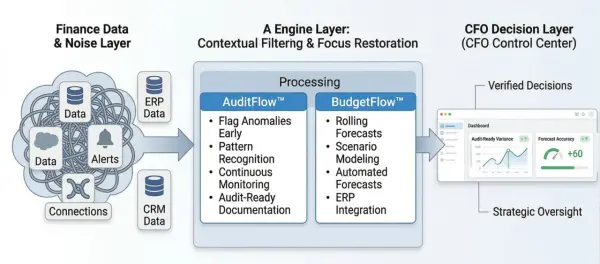
For more detail on remediation economics and workflow design, see the AuditFlow whitepaper: https://completeintel.com/auditflow-whitepaper/
How Corporate Finance Operates Today: The Architecture of Noise
In most organizations, the “CFO Layer” is a dashboard that is, unfortunately, sitting on top of an architecture of noise.
The Data Layer includes standard systems (ERP, CRM, General Ledger, Subledgers), which are increasingly integrated. However, the problem is not a lack of data; it’s a lack of context. The governance layer, meant to provide controls, is overwhelmed. It’s too slow. It requires manual check-offs, evidence retention, and control monitoring that are static and retroactive rather than dynamic and continuous.
This means that today’s “CFO Dashboard” is often an unstable structure. The visualizations and workflows seem clear, but the insights are based on manual pattern recognition by distracted professionals rather than continuous machine learning.
The Shift: Specialization Restores Focus Efficiency
The solution to AI sprawl and focus fragmentation is not to ban AI or simply adopt more tools. It is to move from periodic, manual processes to continuous, intelligent processes by adopting specialized AI engines.
General AI adds to the noise (more chat, more summaries, more content). Specialized AI engines filter it.
Continuous Monitoring Over Manual Sampling (AuditFlow™)
The manual close is the epitome of the low-focus, high-stress environment. It requires the consolidation of pattern recognition across transactions and GL accounts. A specialized engine for financial anomaly detection moves the human from searching for errors (low focus) to verifying anomalies (high focus).
AuditFlow provides AI tools that perform automated audit testing and continuously monitor financial activity. This does not replace human judgment; it restores it. By filtering out normal transactions, the system presents the professional with only the critical unusual account relationships, unusual deviations, or suspicious activity. This moves internal controls from a snapshot-in-time test to a dynamic control system.
Rolling Forecasts Over Static Budgets (BudgetFlow™)
Likewise, specialized tools for AI-driven forecasting eliminate the friction and disruption of the annual budget cycle. Traditional budgeting requires teams to switch contexts for weeks, creating massive organizational drag.
BudgetFlow provides AI tools that transform the static baseline into a living, dynamic model. By using historical transaction patterns, CRM activity, and market data, it generates rolling forecasts and automated forecasting that adapt continuously as conditions change. This reduces the manual effort for FP&A teams, allowing them to focus on high-value scenario modeling rather than data aggregation.
Strategic Implications for Finance Leadership
For the CFO, Controller, or Internal Audit Partner, this architectural shift demands a new strategic focus.
-
Stop Budgeting for Headcounts, Start Budgeting for Capabilities: The ActivTrak data on underutilization suggests you cannot solve your productivity crisis by simply hiring. Instead, invest in specializations that allow your existing team to move from manual rework to data quality engineering.
-
Audit the “AI-Augmented” Workforce: Internal control frameworks must adapt. Are your teams using generative AI to produce financial evidence or documentation? This requires new governance standards (Evidence retention, approval workflows, audit trails). Continuous monitoring through engines like AuditFlow ensures that these digital interactions don’t introduce new risks.
-
Mandate a “Human-in-the-Loop” Protocol: Your architecture should not give AI the final decision. AI should provide the Intelligence Filter, but the control should rest with the professional to document explanations and resolutions. This maintains the executive-grade visibility required for confident, real-time decision-making.
The shift is clear: Finance is moving from periodic reporting to Continuous Intelligence.
Conclusion
The data proves that the shorter workday does not equal a more focused workload. Finance teams are currently drowning in the noise of AI sprawl and context-switching. To reclaim the strategic narrative, finance leaders must move past generalized automation and embrace specialized AI engines.
By shifting internal control from periodic sampling to continuous monitoring with tools like AuditFlow, and transforming forecasting from static events into dynamic rolling processes with tools like BudgetFlow, organizations can filter out the low-value noise. This restores the deep focus needed to turn raw financial data into trusted, continuous, and intelligent foresight.
FAQ: CFO Layer & Continuous Intelligence
What is the “CFO Layer” or “CFO Dashboard”? This is the interface, ideally a streamlined decision center, where the CFO and finance leadership visualize anomalies, strategic variance, and forecast accuracy, allowing for executive-level oversight and verified decision-making.
How is a specialized AI engine different from generic AI like ChatGPT? Generic AI provides broad analysis and synthesis across disparate topics, often contributing to multitasking noise. A specialized engine, such as AuditFlow, is dedicated to a single domain (e.g., continuous financial monitoring) and provides context-aware filtering that restores rather than disrupts focus.
Why is “Continuous Intelligence” replacing “Periodic Reporting”? Continuous intelligence uses machine learning and real-time data to update forecasts and detect risks during the current period. Periodic reporting only provides a retroactive snapshot (e.g., a month later), which is insufficient for managing high-velocity financial operations or volatile market conditions.